What is Natural Language Processing (NLP)?
Learn how NLP understands and generates language, while OCR converts images and PDFs into usable text. Combined, they speed up information extraction, reduce errors, and improve process quality.

NLP (natural language processing) allows systems to understand and produce text consistently. This article presents the essentials: definition, use cases, key steps and coordination with OCR for faster and more accurate documentary processes.
What is NLP?
The Natural Language Processing NLP (or natural language processing in French) is a field of artificial intelligence and machine learning that makes it possible, via linguistic and statistical algorithms, to understand natural human language.
Its main objective is therefore to enable machines to understand, interpret, and produce human language in a way that is both relevant and useful.
The majority of users have already interacted with NLP without really being aware of it.
This technology is in fact at the heart of virtual assistants such as Oracle Digital Assistant (ODA), Siri or Alexa. It allows them to understand user requests and respond to them in a natural language. In the same way, some messaging applications rely on NLP to analyze the content of a message and automatically offer an appropriate response.
NLP vs NLU vs NLG: Key differences
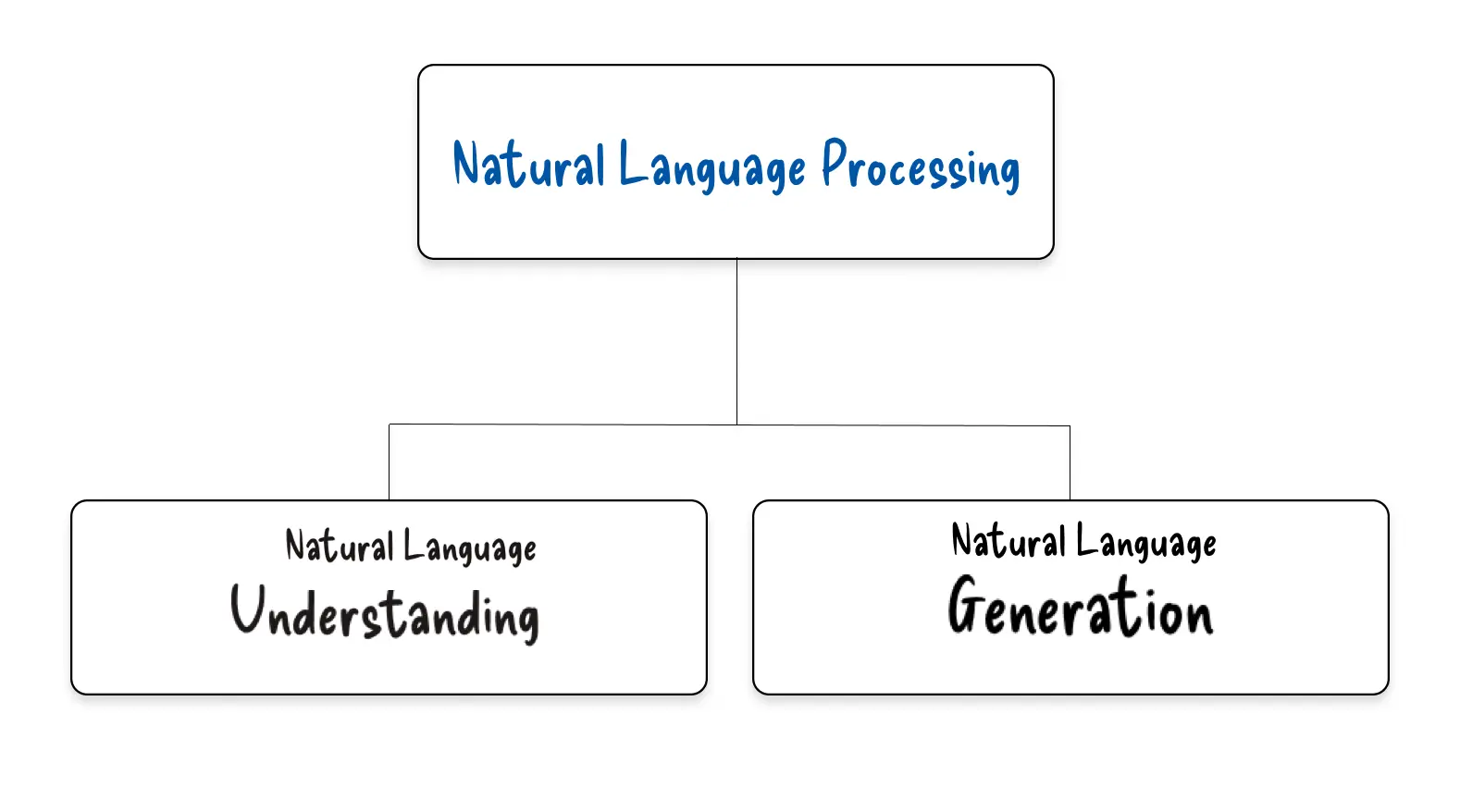
In the world of automatic language processing, several related terms coexist and sometimes lead to confusion. The NLP (Natural Language Processing), the NLU (Natural Language Understanding) and the NLG (Natural Language Generation) actually refer to complementary approaches around natural language.
- NLU (Natural Language Understanding) Corresponds to the capacity of the machines to Analyze and understand The structure and meaning of a sentence expressed by a human. This is the “comprehension” aspect, allowing you to interact with computers using natural sentences.
- NLG (Natural Language Generation) Focuses on the Text production based on data. We Also Talk About “Language out” : the computer generates a verbal description, summary, or explanation in plain language, often using linguistic models or rules (sometimes called Grammar of graphs).
- NLP (Natural Language Processing), more broadly, encompasses both the comprehension and generation of language. It is the field of engineering that aims to build systems that can process, analyze, produce, and manipulate human language.
At the same time, the Computational linguistics (Computational Linguistics — CL) constitutes the scientific field that studies the theoretical and computational aspects of human language, while the NLP focuses on concrete application and the engineering of usable solutions.
The main applications of NLP
Natural language processing covers a wide range of uses and is increasingly shaping our daily practices.
Here is an overview of its most significant uses:
The 6 key steps of natural language processing (NLP)
Natural language processing (NLP) follows a structured pipeline, combining linguistic, statistical, and machine learning techniques. Here are the main steps for turning plain text into actionable information.
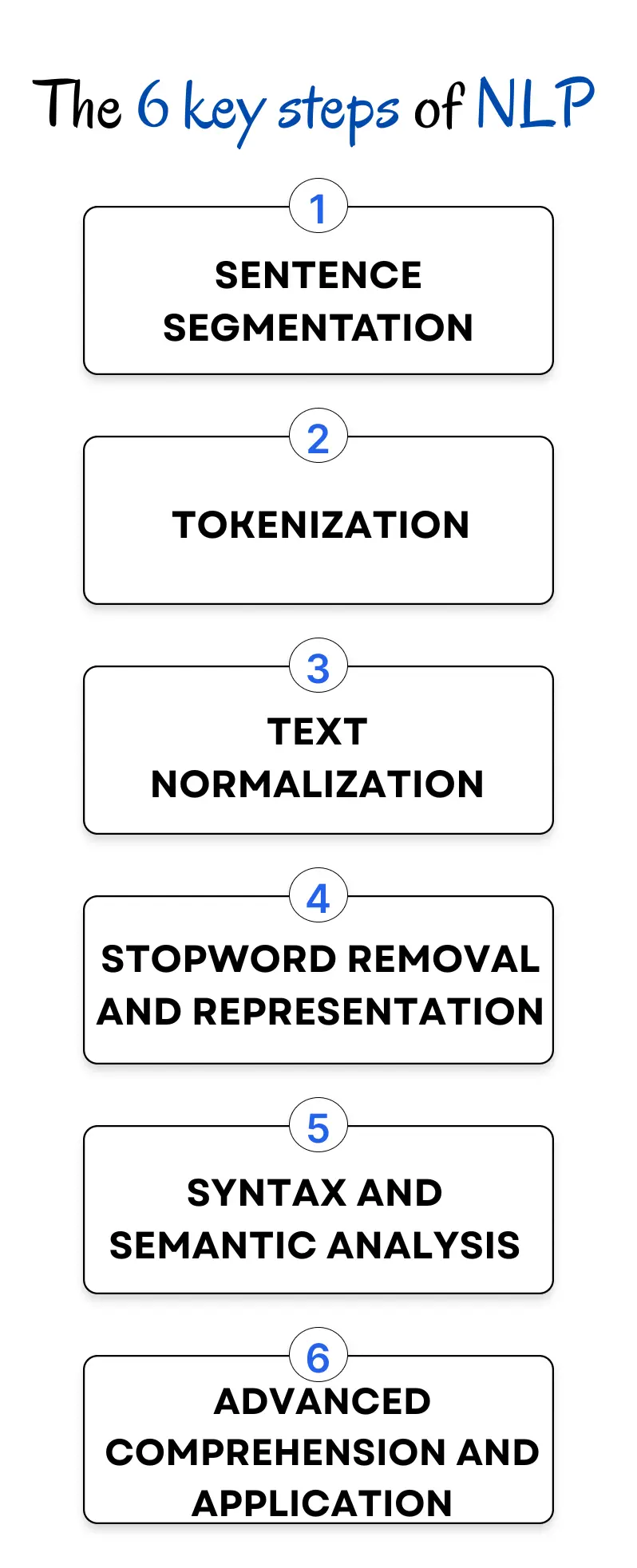
1. Sentence segmentation
The process starts with segmentation, which breaks up text into distinct sentences. An algorithm identifies punctuation marks (periods, exclamations, questions) in order to isolate complete units of meaning. It all starts with segmentation, which consists in breaking up text into distinct sentences.
2. Tokenization
Tokenization divides each sentence into elementary units called Tokens : words, subwords, numbers, or punctuation.
This stage prepares the ground for grammatical and semantic analysis.
3. Normalizing the text
The text is then simplified to reduce linguistic variability.
Two main techniques are used:
- Rooting (stemming) : cut the suffixes to keep only the root of the word (“eaten” → “mang”).
- Lemmatization : returns the word to its correct canonical form (“eaten” → “eat”).
This step ensures better consistency in the analysis of textual data.
4. Suppression of stop words and representation
Some Common Words, Said Stop Words (“and”, “of”, “the”), are removed because they provide little information.
Then, the text is converted into usable numerical data:
- Through a Bag-of-Words Model Or a TF-IDF,
- Or via Embeddings (Word2Vec, BERT) that captures the meaning and context of words.
5. Syntactic and semantic analysis
At this stage, the system seeks to understand sentence structure:
- PoS tagging : assign to each word its grammatical function (noun, verb, adjective...).
- Parsing Syntactic : identify subject—verb—complement relationships.
- NER (Named Entity Recognition) : extract entities such as people, places, or organizations.
6. Advanced Understanding and Applications
Finally, the text can be used in concrete applications:
- Sentiment analysis (positive, negative, neutral),
- Automatic summary gold Translation,
- Co-reference resolution (“Jean has arrived. He was tired” → “He” = “Jean”).
It is at this stage that NLP becomes directly useful in business cases: chatbots, search engines, document extraction (OCR + NLP), virtual assistants, etc.
The challenges of NLP
.webp)
Despite its spectacular advances, this discipline still faces several technical and linguistic obstacles that limit its large-scale deployment.
When OCR meets NLP
Optical character recognition (OCR) is the technology that makes it possible to transform an image containing printed or handwritten text (scanned invoice, signed contract, expense report, form, etc.) into usable digital text.
This step is essential for converting paper documents or image files into structured data, ready to be processed by a computer.
Where OCR is limited to Capture Text Faithfully, NLP adds a layer ofIntelligence and contextual understanding. It is able to classify, contextualize, and extract relevant information, thus transforming plain text into data that can be immediately used by business systems.
In summary: OCR digitizes, NLP includes.
What OCR + NLP integration allows
The combination of OCR and NLP offers several advantages for businesses:
Q&A
Content

The agents that automate your documents
Real life insights on document automation

Developers launch MacDoc, an illegal fake passport generator
In February 2026, US authorities shut down OnlyFake, a widely used fake document generator. Weeks later, an identical service reopened under the name MacDoc. Its forgeries are getting past the KYC checks of major institutions including PayPal, Airbnb and Coinbase.
.webp)
Document deepfakes: catch the fakes slipping past your checks (2026)
In 2026, document fraud has a new face: the document deepfake, a fake generated entirely by AI. According to Shufti's Identity Fraud Index 2026, it's the fastest-growing fraud category, with an annualized increase estimated at nearly 3,900%. What sets these fakes apart: they're clean on the surface. Here's how to detect the ones still slipping past your checks.
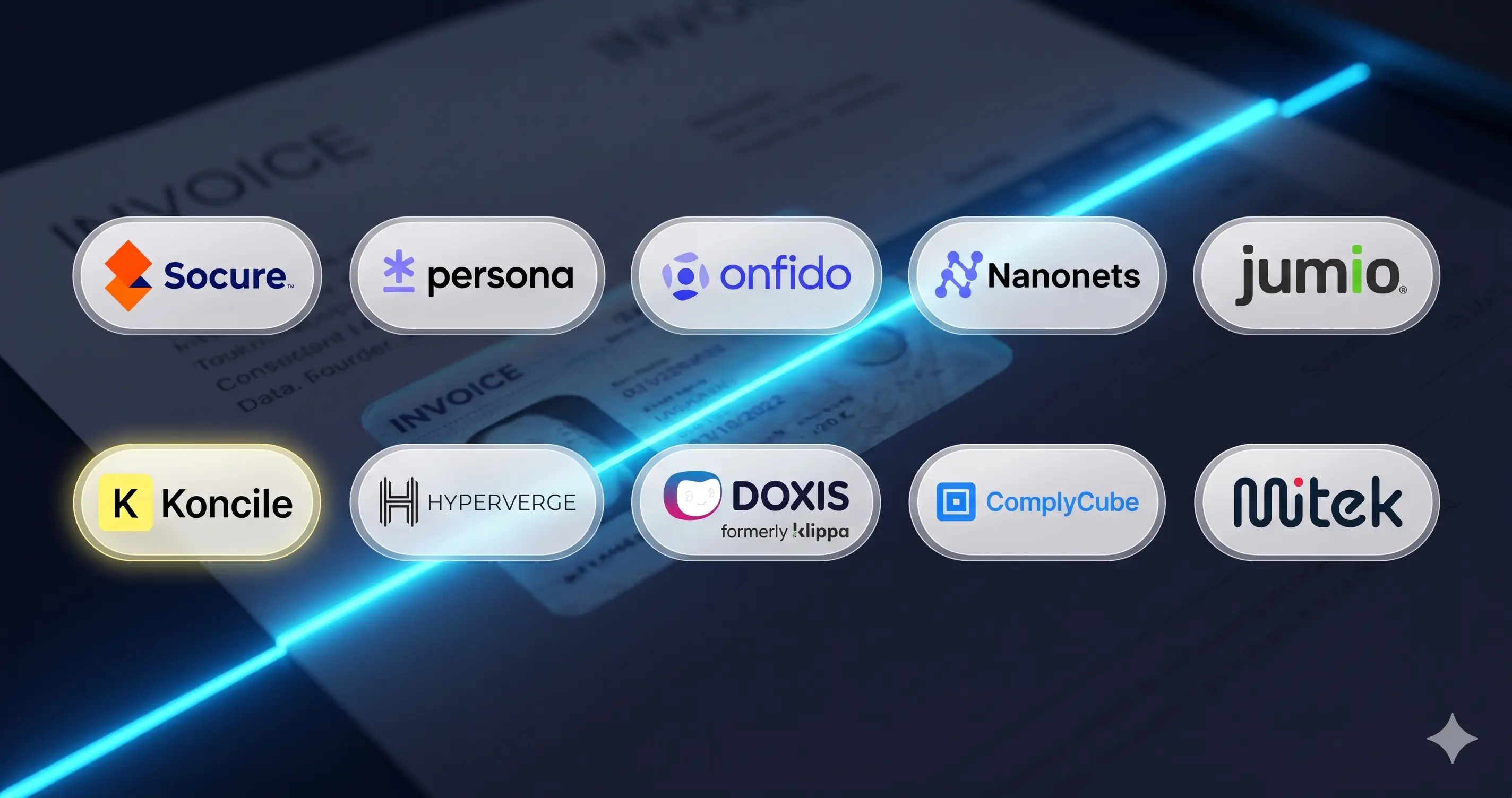
Top 10 Best Document Fraud Detection Software in 2026
Document fraud has outgrown Photoshop. In 2026, the fastest-growing threat is the AI-generated fake: invoices, bank statements and payslips produced from scratch, pixel-perfect, with clean and consistent metadata. Here is our comparison of the 10 best document fraud detection software platforms every finance and risk team should know, and how to choose the right one.
5 Best French OCR Solutions to Extract Data from Your Documents
Five French OCR solutions now make it possible to automatically extract data from your invoices, contracts, and accounting documents using optical character recognition, with hosting based in France. Here's our overview.
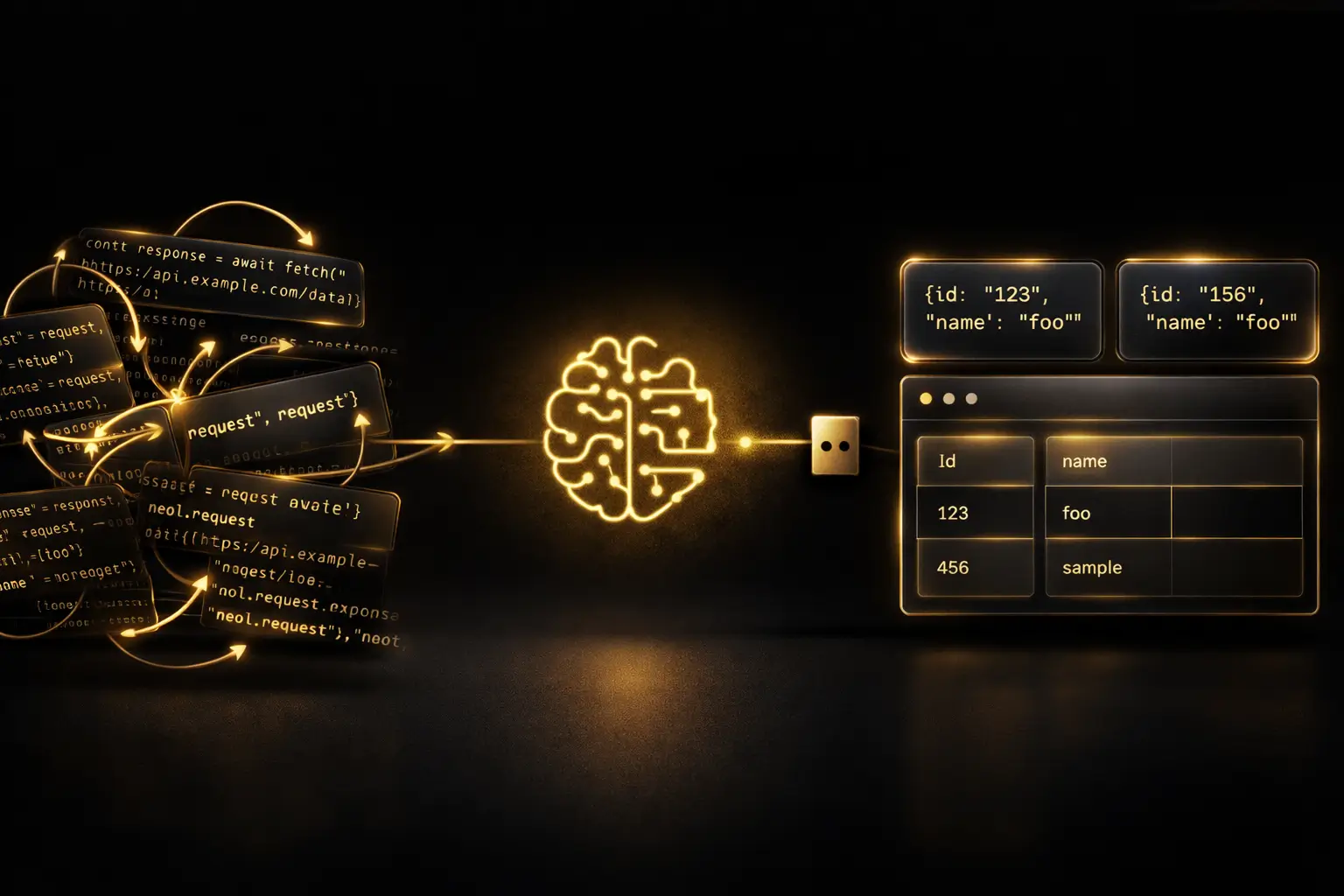
MCP OCR: How Koncile Lets AI Agents Extract Documents Natively
Until recently, connecting an OCR engine to an AI assistant meant writing custom code, managing API calls manually, and building the glue between your language model and your document processing pipeline. With the Model Context Protocol (MCP), that entire layer disappears. At Koncile, we built an MCP OCR server so that Claude, Cursor, or any compatible AI agent can extract, read, and manage documents without a single line of integration code