Top 10 Document Fraud Detection Software in 2026
Ten document fraud detection platforms compared on detection approach, fraud focus, integration and target profile, from semantic specialists to identity-verification incumbents.

Every accuracy figure in this market is self-reported and none has ever been independently verified. Meanwhile forgery services sell documents built specifically to defeat named detection vendors, openly, on the indexed web. Here is our comparison of the 10 best document fraud detection software platforms and the five weaknesses that separate them.
For $8.99, a website called PaystubHero will sell you a pay stub it advertises as “Snappt approved.” The page is titled “How to Get Around Snappt 2026” and it ranks on the first page of Google for that query.
Snappt is one of the largest document fraud detection vendors in North America. It has analyzed more than 14 million documents and claims 99.8% accuracy. There is now a small industry building products specifically to defeat it, and to defeat its competitors, and those products are sold openly on the indexed web rather than on a darknet forum.
That is the state of the market this year. Detection vendors publish accuracy figures. Forgery services publish workarounds for those same vendors. Neither set of claims has ever been independently tested.
So this comparison does something different. Earlier this year we investigated MacDoc, a fake passport generator that relaunched after US federal prosecutors shut down its predecessor. Taking that engine apart showed us exactly where detection tools fail, and we are using those five failure modes as the criteria here.
How the 10 platforms compare
Each platform is scored against the five things detection tools most often get wrong. Those five are explained in the section below, and every vendor is covered in detail after that.
A note on the accuracy figures you will see
Every number in this market is self-reported. Snappt states 99.8%. Resistant AI publishes 99.2% on its own site and 99.92% on its AWS Marketplace listing. Ocrolus states a 90%+ true positive rate.
No independent benchmark exists across these vendors. Nobody has run a shared corpus of known forgeries through all of them and published the results. Until someone does, treat every percentage on this page, including any associated with us, as a marketing claim rather than a measurement.
Ask any vendor you shortlist to run your own documents in a proof of concept. Fifty of your own files, including any known fakes you have kept, will tell you more than any data sheet.
Resistant AI, forensic document analysis at scale

Resistant AI raised a $25 million Series B in October 2025, backed by Experian and GV, the largest recent funding event in this category.
Founded in Czechia and selling globally, the platform examines each document in more than 500 ways across content and layout, creation quality, insertion and manipulation signals, and device fingerprinting, then returns a Trusted, Warning or High Risk verdict. It has extended into Gen AI detectors specifically for AI-generated fraud.
Against the five flaws it is strongest on raw file analysis, which is the classical forensic stack executed at unusual depth. It is thinner on cross-document reconciliation, since it evaluates the file rather than the case around it, and it does not verify 2D-DOC codes.
Best for: Lenders, banks and insurers facing high-volume document fraud detection where forensic breadth matters most.
Inscribe, agentic fraud detection for financial services

Inscribe claims to have created this category in 2017, and it has the longest continuous track record among the fraud-first vendors here.
Across 2024 and 2025 it moved to an agentic model: AI agents that read a document's formatting, structure, metadata and contextual cues, then cross-reference information across every document in the same application. That directly addresses flaw four, and it is the reason Inscribe scores well on cases rather than files. A forger can produce one convincing pay stub. Producing three that agree with each other and with a bank statement is considerably harder.
It added a dedicated AI-generated document detector in 2025.
Best for: North American risk and underwriting teams in banking, lending and fintech. API-first, quote-based pricing, SOC 2 and ISO 27001.
Snappt, document fraud detection for rental applications

Nobody in this market has a clearer proof of market position than Snappt, and it comes from an unusual source: it is the vendor forgery services name when they advertise.
Founded in 2019 and focused almost entirely on multifamily property management, Snappt examines over 10,000 data properties per document against a reference set drawn from more than 2,000 financial institutions. That reference set is the best answer to flaw three on this list. It reports analyzing 14 million documents and preventing $1.9 billion in bad debt, with a dedicated Fraud Forensics team updating detection models continuously.
Its narrowness is the trade-off. Snappt is built for pay stubs and bank statements in a leasing workflow. Point it at a supplier invoice or a customs declaration and it is the wrong tool. Identity verification runs through a CLEAR partnership rather than in-house.
Best for: Property managers and leasing teams in US multifamily.
Koncile, three-layer detection built on document-specific checks

Koncile runs document fraud detection in three layers, with more than 150 individual tests applied per document.
Forensic analysis comes first. Several layers of ML models run in parallel, each trained on a different class of manipulation, because there is no single detector that covers the range a document can be altered. One model targets clone stamp use in tools like Photoshop. Another targets AI imprints inside otherwise genuine documents, such as a small fabricated image dropped onto a real receipt. Others handle post-capture modification, resaving artefacts and layer reconstruction.
Metadata and raw file analysis comes second, and it goes well below the surface. Careless fraudsters leave obvious traces such as a Canva producer string. Careful ones strip those. But every PDF edit leaves something in the raw file structure, and in some cases the original pre-edit values are still recoverable, which shows exactly which field was changed. Alongside this runs a reference database of expected metadata characteristics per document type and per issuer, including individual banks, updated daily.
Context and business-rule checks come third, and they are deliberately document-specific rather than generic. The value is in encoding what a given document type should contain: recomputing totals and tax rates, validating identifiers against known formats, checking regulatory rules for that document class. Third-party database verification runs where a suitable source exists. Documents carrying a 2D-DOC, including European identity documents and some invoices, are verified against the issuing authority's public key.
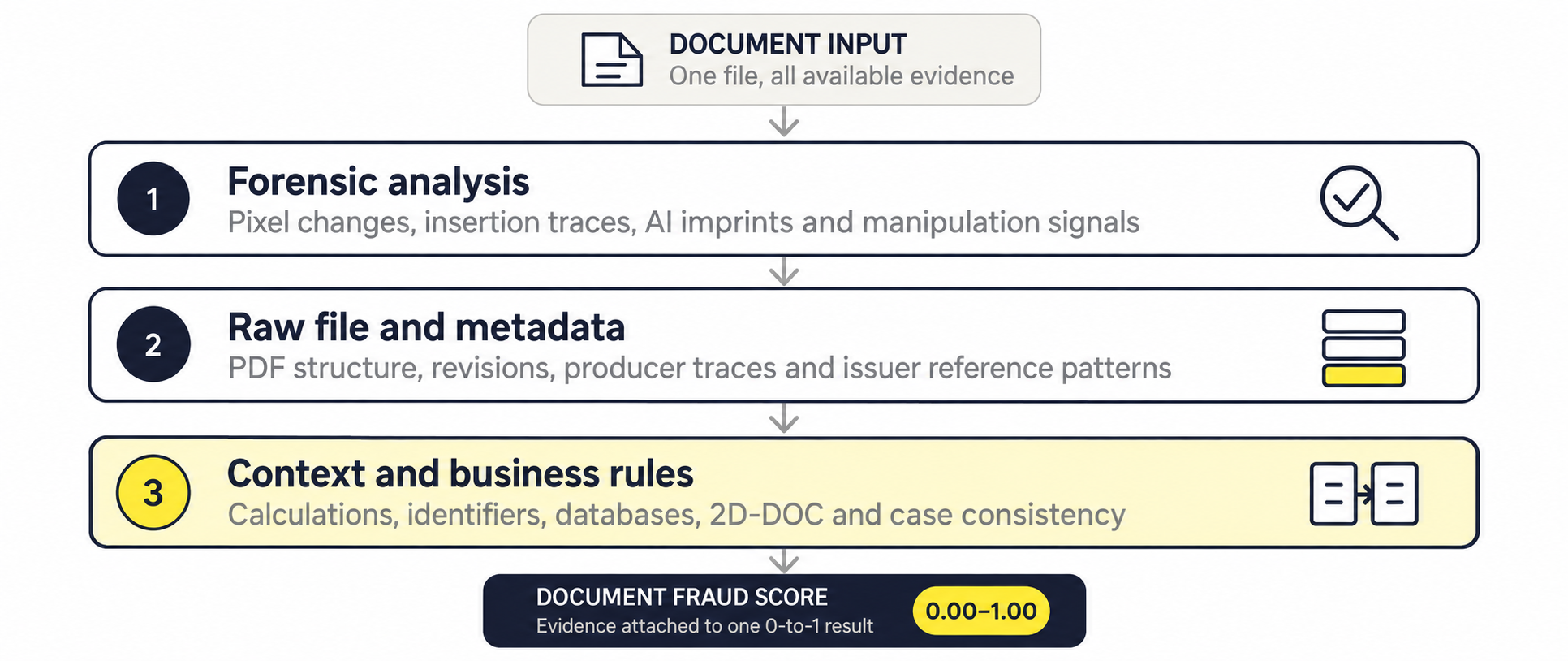
The document families it covers in depth are bank statements, insurance documents, pay slips, invoices, identity documents, loan application documents and company KYB documents. Every document returns a 0-to-1 risk score, and extraction and fraud checking happen in the same pass rather than as two separate integrations.
Processing runs on ISO 27001-certified infrastructure, with SOC 2, GDPR and HDS compliance and EU hosting available. Integration covers a no-code platform, a REST API into ERP, HRIS and credit workflows, plus Zapier, n8n and Power Automate. There is no identity biometrics layer, so consumer onboarding flows will need a separate tool for liveness and face matching. As with every other figure on this page, the 150+ tests and the accuracy of the risk score are our own numbers and have not been independently benchmarked.
Best for: Finance, risk and procurement teams where the fraud sits in the numbers rather than the pixels.
Ocrolus, OCR-first extraction with a fraud layer

Ocrolus arrives at fraud detection from the opposite direction to everyone else here, and that shapes both its strengths and its gaps.
The company built its reputation on document capture and OCR accuracy for financial services, particularly bank statement parsing at scale, and added Ocrolus Detect on top. The extraction quality is genuinely strong, and if your primary pain is turning messy scans into clean data with fraud screening as a secondary requirement, that ordering may suit you.
The fraud layer is thinner than in the fraud-first platforms. It states a 90%+ true positive rate, a notably more modest claim than the 99%-plus figures elsewhere on this page, and arguably a more honest one.
Best for: Lenders and fintechs with heavy bank statement OCR volume who need extraction and screening from one vendor.
Doxis AI.dp, document processing and fraud screening in one platform

The rebrand matters for anyone searching: Klippa DocHorizon is now part of the SER group and trades as Doxis AI.dp. Older comparisons still list it under the old name.
The product pairs intelligent document processing with a fraud module, combining multi-layer image forensics for copy-move, splicing and Photoshop traces, EXIF metadata forensics, and GenAI deepfake content detection. It returns a verdict in under five seconds per document.
Its appeal is consolidation. OCR, fraud analysis and verification on one ISO 27001-certified platform is a simpler procurement story than stitching three vendors together, and the pre-built ERP connectors reduce integration work meaningfully.
Best for: Enterprises that want document processing and fraud screening inside a single workflow and a single contract.
Fortiro, financial document fraud for lending and onboarding

Fortiro is one of the more focused entries here, built specifically around financial document fraud rather than as a fraud module attached to something else.
It concentrates on the document families where the money actually is: pay slips, bank statements, tax documents and proof of income. That narrowness produces deeper checks on those specific formats than a general-purpose platform typically manages, and it means less configuration work for teams whose document set matches.
It is a smaller vendor than Resistant AI or Inscribe, which cuts both ways. Less proven at extreme scale, more responsive on roadmap and support.
Best for: Lending and onboarding teams whose fraud exposure sits almost entirely in income and banking documents.
Finovox, French document conventions and 2D-DOC verification

Finovox is the French domestic option, and for organizations processing French administrative documents that carries practical weight beyond preference.
The 2D-DOC signature scheme used on French identity documents, tax notices and proof of address requires reading a Data Matrix against a public key published by the administration. A platform without that capability cannot perform the single most conclusive check available on those documents, which is flaw five on this list. French salary slip conventions, URSSAF references and tax notice formats are similarly specific.
Finovox positions around insurance, banking, real estate and HR, where fraud detection in banking and insurance claims overlap heavily.
Best for: Organizations processing French administrative documents, particularly insurance and real estate.
Regula, global identity document template matching

Regula's asset is its database, which is the part competitors find hardest to replicate.
The company maintains one of the most comprehensive identity document template libraries in existence, covering specimens from across the world with the security features, layouts and machine-readable zone specifications for each. Detection compares a submitted document against the authoritative template for that exact country and revision, which is a strong answer to flaw three within its category.
For identity document OCR and passport verification this is a genuine advantage. For financial document fraud, invoices and bank statements it is the wrong category of tool. Available as SDK and API, including offline deployment, which some regulated environments require.
Best for: Border control, travel, and any organization verifying international identity documents at depth.
Sumsub, unified KYC, AML and document checks

Sumsub covers the widest surface of anything here, combining KYC OCR, AML screening, liveness detection, business verification and document forgery checks behind a single integration.
That breadth is the pitch and also the caveat. One vendor covering identity, sanctions screening and document authenticity removes several procurement headaches. But breadth usually trades against depth, and Sumsub's document forgery checks are not as forensically deep as a specialist like Resistant AI, nor as document-specific on financial files as the platforms built for that.
Best for: Crypto, fintech and marketplace platforms that need KYC, AML and document checks in one contract.
The adjacent category: identity verification
Onfido (now part of Entrust), Jumio, Mitek and ComplyCube appear on most lists of this kind, and they are capable platforms, but they answer a different question.
Identity verification asks whether a person is who they claim to be. Document fraud detection asks whether a document is what it claims to be. Those overlap on ID cards and passports and diverge completely everywhere else. Onfido covers 195 countries and 2,500 document types. Jumio shipped deepfake-resistant liveness in 2025 and extended into continuous post-onboarding monitoring in April 2026. Mitek is rooted in cheque verification and added deepfake, face-morph and injection detection in February 2026.
None of them will tell you whether a supplier invoice has been altered, because that is not what they are built to do. If your exposure is consumer onboarding at international scale, start with them. If your exposure is a forged invoice or a doctored bank statement, they are the wrong shortlist.
5 flaws in fraud detection tools and how to overcome them
Generative AI changed the shape of this problem, though not in the way most coverage suggests. Digital document forgeries rose 244% in a year. The tools that struggle are the ones built to spot cloned pixels and edited EXIF data, because the fakes that matter now have neither.
Five weaknesses show up repeatedly across the platforms on this page. Each one is fixable, and knowing which applies to your document set is more useful than any published accuracy figure.
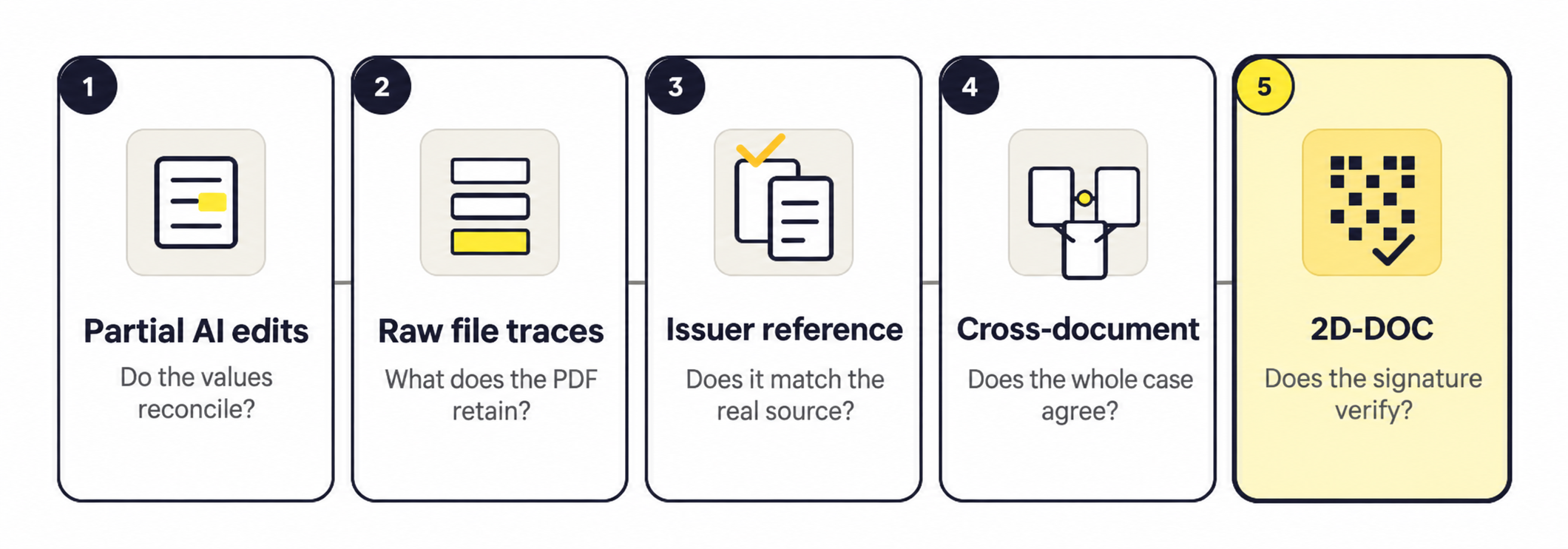
1. They cannot see partially AI-edited documents
This is the hard one, and most tools are helpless against it today.
Worth separating two things that get confused. A document whose image is entirely AI-generated is still relatively easy to catch. The human eye often spots it, the model artefacts are detectable, and fraudsters frequently forget to strip the metadata that gives it away.
The difficult case is a genuine document where AI has edited only part of it. A real bank statement with three numbers changed. A real pay slip with the gross figure adjusted. There is no splicing artefact because nothing was pasted. There is no clone-stamp signature because nothing was cloned. Traditional ML forgery models are trained to spot manipulation patterns that simply are not present, and they return a clean verdict on a document that has been altered in the only place that matters.
How to overcome it: Stop asking whether the pixels were altered and start asking whether the values make sense. Recompute the totals. Check the tax rate against the jurisdiction. Compare the figure against the other documents in the same file. An edited number survives forensic inspection but rarely survives arithmetic.
2. They read surface metadata instead of the raw file
Some fraudsters leave obvious residue. A PDF that has passed through Canva announces itself in the producer string, and any tool reading visible metadata will catch it. Careful fraudsters strip that field entirely, and at that point most tools have nothing left to look at.
Every PDF edit leaves traces somewhere in the raw file structure regardless of what the visible metadata says. Object revisions, incremental save history, cross-reference table anomalies, font subset inconsistencies. In some cases the pre-edit content is still recoverable from the file, which shows not only that a document was altered but exactly where.
How to overcome it: Treat this as raw file analysis rather than metadata reading. Ask any vendor whether they parse PDF object structure or only read the document properties panel. The answer separates platforms that catch careful fraudsters from platforms that catch careless ones.
3. They have no reference data for what a genuine document looks like
A detection tool that examines a bank statement in isolation can only ask whether it looks internally plausible. It cannot ask the more useful question: does this look like a statement that bank actually issues?
Real issuers are remarkably consistent. The same generator, the same fonts, the same margins, the same PDF production chain, month after month. A forgery built from a screenshot or a template will differ in ways nobody notices by eye but that show up immediately against a reference set.
How to overcome it: Use a platform that maintains expected values per document type and per issuer, and that updates that reference set continuously as issuers change their templates. A static library goes stale within months.
4. They check the document, not the case
Most detection runs one file at a time. A fraudster submitting a loan application is not submitting one file. They are submitting a pay slip, a bank statement, an ID and a proof of address, and those four documents have to agree with each other.
Producing one convincing forgery is achievable. Producing four that reconcile on employer name, salary figure, account number, address and dates is considerably harder, and it is where most fraud attempts actually fall apart. A tool that scores each file separately never gets to ask the question.
How to overcome it: Score the submission, not the document. Cross-reference names, amounts, dates and identifiers across every file in the case, and treat a mismatch between two clean documents as a stronger signal than a minor anomaly in one.
5. They ignore the barcode that would settle it
Any document carrying a 2D-DOC, QR code or Data Matrix hands you a cryptographic answer, and a surprising number of platforms simply do not read it.
A French ID card's Data Matrix is signed with a private key held only by France Titres. A forger has two options and both are detectable. They can generate a code carrying the right-looking data with an invalid signature. Or they can paste a valid code lifted from another card, in which case the signature verifies but the contents do not match the holder printed on the document.
How to overcome it: Confirm the platform reads the Data Matrix against the issuing authority's published public key, and that it compares the decoded contents against the printed fields. Reading the code without cross-checking its contents catches the first attack and misses the second.
How to choose document fraud detection software in 2026
Start with the document, not the vendor.
If your fraud arrives as forged invoices, altered bank statements or manipulated pay slips, you need context and business-rule checks, not just forensics. An AI-edited invoice with untouched metadata and no splicing artefacts passes a forensic scan and fails a VAT recalculation. Koncile, Inscribe and Fortiro are built around that. Pairing fraud scoring with duplicate invoice detection and a proper invoice verification software workflow closes a gap that pure forensics leaves open.
If your fraud arrives as rental applications, Snappt has more relevant reference data than anyone.
If it arrives as identity documents from many countries, Regula's template library or the identity specialists above will outperform any generalist.
If you handle documents carrying a 2D-DOC, including European IDs, French tax notices and some invoices, confirm the platform verifies the Data Matrix against the issuing authority's public key. Several on this list cannot.
If you need extraction and fraud screening in one pass, that narrows the field quickly: Koncile, Doxis AI.dp and Ocrolus, depending on whether you weight fraud depth or OCR volume.
Three questions to put to any vendor before signing. Ask them to process fifty of your own documents, including known fakes you have kept, and show you the output. Ask what happens to the confidence score when a document is borderline, and whether a human reviews it. Ask specifically how they detect a genuine document where only a few numbers have been changed, because that is the case most tools handle worst.
Visual forensics alone no longer settles it. What a forger cannot fake is consistency: totals that reconcile, tax identifiers that check out, dates and parties that agree across every document in a file. The strongest defense reads the data, not just the picture.
FAQs
Sources
• Entrust, Onfido Identity Fraud Report. Research on digital document forgery growth and deep fake attack frequency.
• Koncile, Developers launch MacDoc, an illegal fake passport generator. Original investigation, August 2026.
• US Department of Justice, press release on the charges and guilty plea of OnlyFake's creator.
• Resistant AI, Series B funding announcement, October 2025.
• Vendor documentation and public product pages for each platform listed, accessed September 2026.
• Field observations from Koncile customer conversations and platform data.

Real life insights on document automation

5 Best French OCR Solutions to Extract Data from Your Documents
French OCR solutions now make it possible to automatically extract data from your invoices, contracts, and accounting documents using optical character recognition, with hosting based in France. Here is a real comparison of all five OCR solutions, corrected against current 2026 figures where vendor claims had gone stale, covering what actually differentiates them beyond the fact that they are all hosted in France.
Document processing and fraud detection: build or buy?
Extracting and structuring document data, enriching it, detecting fraud: with AI, building your own end-to-end solution has never looked so simple. Buying off the shelf still often turns out to be the better option. Here are the thirty-nine difficulties to expect before you start.
In healthcare, an OCR is judged on what it flags, not on what it reads
Every OCR vendor advertises high accuracy rates, and most of them deliver. On a health document, that is not the right buying criterion. What counts is what the tool does when it is not sure, what it lets you verify, and what it guarantees about the data it handles.

Top Healthcare OCR Tools: HIPAA Compliance and What the Clinical Evidence Shows
Amazon Textract has been formally HIPAA-eligible since October 2019. Most healthcare OCR comparisons never mention that, or check which of the other four tools on their list actually offer a signed BAA. Here is a rebuild that checks compliance status directly, and looks at what the real clinical trials on ambient AI scribes actually found, not just what the marketing claims.
Best Accounting Software for Sole Proprietors and Freelancers in 2026
A freelancer sending a dozen invoices a month can blow through Xero's cheapest plan by week three, and a $19-a-month FreshBooks account caps out at five clients. The number on a pricing page is rarely the number you actually pay. Here is a real comparison of QuickBooks, Xero, Wave, and FreshBooks built for a business of one, not a growing team.