Document fraud detection software: 3 ways to catch fake documents
Three complementary approaches to document fraud detection software, from image forensics to AI-powered consistency checks on financial documents.

Document fraud is growing faster than manual teams can keep up. In this article, we compare three concrete approaches to document fraud detection software, from simple Python tools to AI-powered platforms like Koncile.
What is document fraud detection?
Document fraud consists of altering official documents to obtain an advantage that should not be granted: a loan, a rental, a social benefit, a contract, a job, and so on. Detecting document fraud means verifying that the files provided are both authentic and internally consistent before triggering any business decision.
In practice, this mainly concerns financial and identity documents such as bank statements, pay stubs, tax returns, tax notices, identity documents, proof of address, invoices, or other administrative records. The bank statement is by far the most common, and our nine methods to detect a fake bank statement detail the checks available. If any of these documents is manipulated, the entire decision chain becomes unreliable: credit scoring, tenant screening, KYC, onboarding, anti-fraud procedures.
Historically, document fraud detection relied on manual review. An analyst would compare documents one by one, check amounts, dates, logos, signatures or stamps, and use experience to spot inconsistencies. This remains useful, but quickly becomes unmanageable when volumes increase.
Today, three main approaches are emerging: visual analysis based on the document image, metadata inspection based on the file’s technical footprint, and AI-powered consistency checks that verify whether the information in the documents makes sense together. The goal is not to choose a single “best” method, but to understand what each one covers, its limitations, and how to combine them into an industrial-grade workflow.
Document Forgery: The core of document fraud detection
Document forgery is the most common form of document fraud. It involves altering, recomposing, or fabricating documents so they appear authentic while telling a false story. This can range from crude edits to highly sophisticated manipulations that are invisible to the naked eye.
To address this effectively, there is no single silver-bullet technique. Instead, multiple complementary approaches are required, each targeting a different type of forgery.
Method 1: Python packs for visual document fraud detection
The first method focuses purely on the visual layer: the image of the document. The idea is simple: before you even look at the content (names, amounts, addresses), you ask a question:
“Has this image been tampered with?”
This is where Python image-forensics libraries come into play. They analyse pixels, compression, patterns and textures to detect signs of editing such as cloned regions, pasted stamps, altered fields or inconsistent noise.
This approach is helpful to catch obvious forgeries or quick Photoshop jobs, but it is fragile with low-quality scans, mobile photos, or carefully prepared fakes based on genuine templates.
How the method works
In this method, a document (ID card, invoice, tax notice, pay stub) is treated as a plain digital image. Algorithms typically:
- split the image into blocks and search for repeated patterns (clone detection)
- analyse compression artefacts and noise to highlight retouched regions
- look for visual inconsistencies: strange contours, different grain, edges that don’t match
- generate heatmaps or scores that indicate suspicious areas
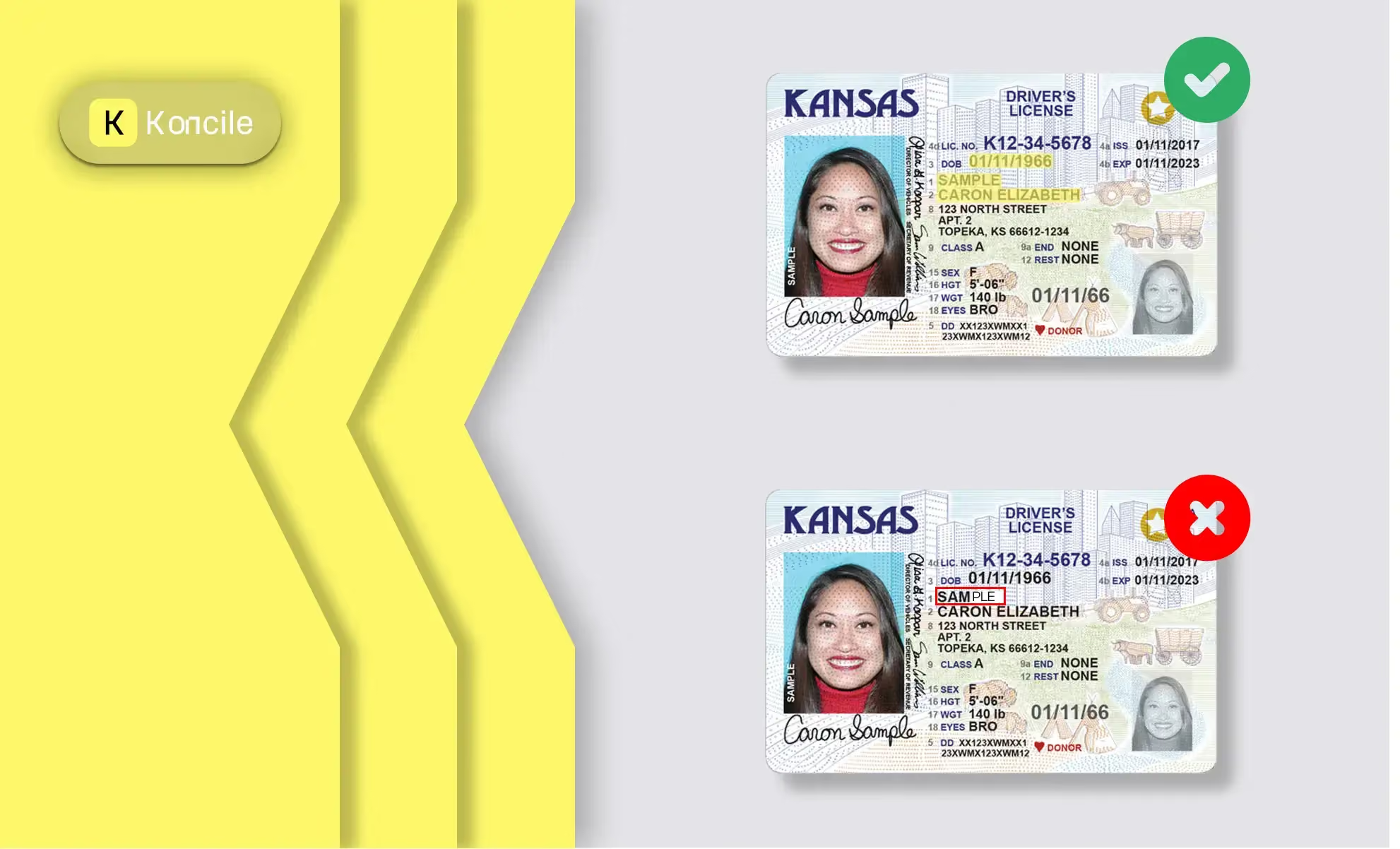
Common red flags include:
- a profile picture on an ID that doesn’t blend naturally with the background
- a stamp or signature pasted on top of an existing scan
- a logo copied from another document, with a different resolution or sharpening
Again, this doesn’t tell you if the income or identity information is realistic. It simply flags documents that visually look “edited” and should be escalated.
Example

Python packs for visual document fraud detection
Python packs for visual forensics are mostly used for R&D, proof of concepts and internal tools. They’re powerful bricks but not turnkey “document fraud detection software” for business teams.
They are great when you want to:
- explore visual forgery detection on a specific document type
- train fraud teams to recognise common visual signals
- build a first filter before more advanced checks
DocAuth (Python)
DocAuth is a Python project for basic document authentication and image forgery detection.
Typical features:
- run image analysis on ID cards, certificates and official documents
- detect modified regions in sensitive zones (photo, signature, stamp)
- produce suspicion scores or heatmaps per region
- integrate into simple Python pipelines for experiments or demos
DocAuth is quite limited and not heavily maintained, but it’s a good starting point to explore the topic.
PhotosHolmes (Python)

PhotosHolmes is a Python library focused on digital image forgery detection. It is not dedicated to identity documents, but its techniques can be reused for document images.
Typical features:
- clone detection: highlight regions copied and pasted within the same image
- localisation of retouching operations on specific areas (headers, stamps, amounts)
- visual maps to guide a human analyst towards suspicious regions
- combination of multiple forensic algorithms in one workflow
For document fraud, you can adapt PhotosHolmes to scan IDs, invoices or tax notices for copy–paste patterns and local edits.
pyIFD (Python Image Forgery Detection toolkit)
pyIFD is a Python toolkit that bundles several image forgery detection techniques in one place.
Typical features:
- multiple algorithms for detecting manipulations in JPG/PNG/TIFF images
- example scripts to test different techniques on the same dataset
- flexible architecture for extending or combining methods
- quick experimentation on scanned documents and attachments
It’s useful in exploratory phases, but you need to check maintenance and compatibility before using it in production.
Forensically (web-based)

Forensically is a well-known web tool for image forensics. It’s not a Python pack, but it’s often used as a reference or manually by fraud teams.
Typical features:
- clone detection to spot duplicated regions
- error level analysis (ELA) to highlight retouched zones
- additional forensic tools (noise analysis, metadata view, etc.)
- visual UI that’s very convenient for investigating sensitive cases
Forensically is great to assist analysts or validate suspicions on a handful of documents. For high-volume automation, it needs custom integration work.
Comparing visual detection packs
Visual Python packs help catch obvious manipulations on scanned or photographed documents. They are a good layer for experimentation and training, but they don’t replace a full document fraud detection software stack.
| Tool | Type | Use Case | Strengths | Limitations |
|---|---|---|---|---|
| DocAuth | Python package document authentication | Testing ID cards, certificates or official documents for POCs and demonstrations. | Easy to use, good starting point to explore visual fraud detection. | Project not actively maintained, limited scope, not production-ready as is. |
| PhotosHolmes | Python library image forensics | Analysis of internal copy–move edits and local retouching on document images. | Strong clone detection algorithms, useful complement in a visual pipeline. | Not specialized for “documents”, requires tuning for specific business cases. |
| pyIFD | Python toolkit Image Forgery Detection | Quick experiments for detecting alterations on scanned images. | Multiple techniques grouped into one toolkit, convenient for comparisons. | Older tool, maintenance and compatibility depend on file formats. |
| Forensically | Web tool image forensics | Manual or semi-automated checks on IDs, invoices, and tax notices. | Very educational interface, ideal for analyzing sensitive cases. | Not designed for large-scale automated integration without heavy adaptation work. |
Pros of visual detection
- good at catching cheap, quickly edited fakes
- provides visual evidence (heatmaps, highlighted areas) to support decisions
- useful for R&D, internal POCs and analyst training
Cons of visual detection
- heavily dependent on image quality (compression, angle, resolution, blur)
- blind to the business meaning of fields (income, dates, names, addresses)
- hard to scale and maintain as the only line of defence
Method 2: metadata analysis with open source tools and Python packs
The second method focuses on the technical history of a document. Every digital file carries metadata, including creation and modification timestamps, the software used to generate or edit it, and sometimes device-related information.
Metadata analysis helps answer simple but important questions: was the document generated by an official system? Was it edited manually before submission? Do multiple documents share the same unusual technical signature?
It does not assess whether the content itself is fraudulent, but it highlights abnormal behavior around the file.
How the method works
The idea is to extract metadata from files using open-source tools and Python libraries, then compare this information with what would normally be expected in a given process.
In practice, analysts examine creation and last modification timestamps, the software and version used to create or edit the document, the type of device involved (such as a smartphone camera, scanner, or desktop application), and, where relevant, EXIF or XMP fields embedded in image-based documents.
Certain abnormal situations tend to stand out quickly. A tax notice allegedly downloaded from a government portal may turn out to have been modified in a generic PDF editor shortly before submission. A pay stub that claims to come from payroll software may actually have been saved using a photo-editing application. In other cases, multiple documents within the same file or application may share the exact same unusual metadata pattern, suggesting mass-produced or reused documents.
Again, metadata analysis does not prove document fraud on its own, but it provides valuable signals that can be fed into document fraud detection systems and risk scoring mechanisms.
Advantages of metadata analysis
Metadata-based analysis is relatively fast to deploy and scales well across large document volumes. It remains effective even when documents appear visually clean and consistent, and it helps surface technical inconsistencies that are difficult to detect through manual review alone.
Limitations of metadata analysis
Metadata can be missing, incomplete, or intentionally altered. Legitimate operations such as OCR processing, electronic signatures, or PDF merging frequently modify metadata without indicating any fraudulent intent. For this reason, no single metadata field should be treated as a standalone proof of fraud.
Why this method remains complementary
When used in isolation, metadata analysis mainly produces weak signals. Its real value emerges when these signals are combined with other approaches, such as content analysis, cross-document consistency checks, and business rules within a broader risk scoring framework.
Tools (open source & Python) for metadata analysis
This method relies heavily on open source tools and libraries that you can embed into scripts or processing pipelines.
ExifTool (open source)

ExifTool is the go-to open source tool for extracting technical metadata from images and some PDFs (EXIF, XMP, IPTC and others).
Typical features:
- read detailed metadata for images and certain document formats
- extract creation and modification dates
- reveal software, device and other technical information
- run in batch via command line or scripts
For document fraud detection, ExifTool is especially useful to check if the technical story of the file matches the claimed origin.
Exiv2 (open source)

Exiv2 is a C++ library with a command line interface used to read and write image metadata.
Typical features:
- handle EXIF, IPTC, XMP for most image formats (JPEG, PNG, TIFF, etc.)
- integrate directly into C++ applications and image-processing tools
- support for both reading and updating metadata fields
In a fraud context, Exiv2 is a strong alternative or complement to ExifTool when your stack is C++ or heavily image-focused.
hachoir-metadata (Python pack)
hachoir-metadata is part of the Hachoir ecosystem, a Python library for parsing binary files and extracting metadata.
Typical features:
- extract metadata from many file types (images, videos, archives, etc.) via binary parsing
- integrate naturally into Python scripts and services
- combine metadata analysis with other checks (OCR results, visual forensics, rules)
For document fraud detection, it’s particularly interesting when you want a pure Python pipeline analysing large volumes of uploaded files.
Comparing metadata tools
Metadata tools add an extra layer to your document fraud detection strategy. They don’t evaluate business content but help you understand how the file was produced and modified.
| Tool | Integration | What it inspects | Strengths | Limitations |
|---|---|---|---|---|
| ExifTool | CLI + scripts | EXIF, XMP, IPTC and other technical metadata on images and some PDFs. | Industry reference, very feature-rich, great for batch processing. | Mostly CLI-based, less accessible for non-technical users. |
| Exiv2 | C++ library + CLI | EXIF, IPTC, XMP metadata on most common image formats. | Well integrated in the open source ecosystem, strong fit for C++ apps. | Image-focused, less versatile than ExifTool, requires C++ skills. |
| hachoir-metadata | Python library | Low-level technical metadata from many file formats via binary parsing. | Easy to plug into Python pipelines, suited for high-volume inspection. | Requires custom fraud rules to turn raw metadata into risk signals. |
Pros of metadata analysis
- reveals technical inconsistencies that are invisible to the human eye
- easy to automate in batch or near real time
- helps identify recurring fraud patterns (same editor, same device, same pipeline)
Cons of metadata analysis
- doesn’t analyse the actual content: amounts, names, addresses can still be fake
- some fields may be missing, cleaned or manually edited by advanced fraudsters
- must be combined with visual and business-level checks to be truly effective
Method 3: consistency checks with AI-powered document fraud detection software
The third method is the one that comes closest to how seasoned fraud analysts actually work. Instead of focusing solely on the appearance of the file or on its technical metadata, it examines the story the documents are telling. The central question becomes: do all these documents make sense together for this person, this profile, and this application?
AI-powered solutions such as Koncile, Inscribe or Resistant AI follow this logic. They combine OCR specialised in financial and identity documents, data structuring and normalisation, business-rule engines, and anomaly-detection models to assess whether a dossier is coherent.
This approach is especially relevant for financial and administrative documents like bank statements, payslips, tax returns, tax notices, invoices, utility bills, and identity documents used in financial decisions. Instead of asking whether a document has been visually altered, it asks whether the information across the entire file forms a credible, consistent narrative.
How the method works
Typical steps:
- OCR API and extraction
Extract key fields from documents: amounts, dates, IBAN/account numbers, employer, address, balances, periods, IDs, etc. - Structuring and normalisation
Convert these fields into consistent schemas: standard date formats, currencies, unified employer names, transaction categories, income vs expenses, etc. - Business rules and consistency checks
Apply domain-specific logic, for example:- does gross, net and contributions match on a pay stub?
- are the declared incomes consistent with cash flows on bank statements over several months?
- do tax numbers, addresses and income levels line up across tax returns and pay stubs?
- are employment periods continuous and plausible?
- AI and anomaly detection
Use AI models and statistical patterns to highlight:- income profiles that don’t fit the job or industry
- combinations of documents rarely seen in genuine applications
- unusual transaction patterns or suspicious document layouts
The goal is no longer just “is this file edited?”, but “is this entire dossier believable?”.
AI-powered solutions for consistency-based document fraud detection
Several players use this approach; here are three representative examples.
Koncile (AI-powered)

Koncile focuses on automating the reading and checking of financial and administrative documents in credit, tenant screening and onboarding workflows. Two examples in production: Toyota Assurances checks the consistency of nine documents per underwriting file, and Meelo plugs this file analysis underneath its own scoring for customer onboarding.
Key capabilities:
- Invoice OCR, as well as OCR for bank statements, pay stubs, tax notices, tax returns, and other financial documents
- structuring of extracted data into schemas tailored to your use cases (credit application, rental file, KYC)
- business rules to check consistency between fields and between documents (income, expenses, balances, dates, identities)
- AI-based anomaly detection to surface dossiers that look unusual or high-risk
- API-first approach to plug document fraud detection directly into your existing systems
Inscribe (AI-powered)

Inscribe targets banks and fintechs who need to detect forged or manipulated documents during onboarding and underwriting.
Typical capabilities:
- analyse bank statements, pay stubs, tax documents and IDs
- combine forensics, metadata and data checks to highlight hidden inconsistencies
- generate risk scores and fraud alerts for teams reviewing applications
It’s a good example of a solution that treats document fraud as a consistency problem across documents, not just an image manipulation problem.
Resistant AI (AI-powered)

Resistant AI offers a multi-layer “document forensics” approach for financial institutions processing high volumes of documents.
Typical capabilities:
- support for bank statements, pay slips, utility bills, tax forms and more
- analysis of file structure, content patterns and manipulation clues
- risk profiling at both document and case level
- integration into KYC, lending and monitoring workflows
Comparing AI-powered solutions
AI-powered consistency checks sit at the top of your document fraud detection stack. They bring together visual, metadata and content signals into a single decision layer.
| Solution | Positioning | Document types | Analysis type | Best suited for |
|---|---|---|---|---|
| Koncile | OCR + AI for financial and administrative documents. | Bank statements, payslips, tax notices, invoices, tax returns. | Structured extraction, business rules and consistency checks across fields and documents. | Lenders, landlords, KYC/Onboarding teams that want automation plus fraud detection. |
| Inscribe | Document fraud detection for banks and fintechs. | Bank statements, pay stubs, tax documents, IDs. | Forensics, metadata and data checks to surface hidden inconsistencies. | Lenders and fintechs aiming to cut fraud without adding friction for good customers. |
| Resistant AI | Multi-layer document forensics platform. | Bank statements, payslips, utility bills, tax forms, and more. | Risk profiling based on file structure, content and manipulation patterns. | Banks, insurers, BNPL and lending platforms processing very high document volumes. |
Pros of consistency-based AI checks
- closest to how humans really validate dossiers, but at scale
- able to catch fraud that looks visually clean and technically “normal”
- integrates naturally into decision workflows and case management tools
Cons of consistency-based AI checks
- requires upfront work to define schemas, business rules and use cases
- needs a minimum data and process maturity to deploy effectively
- doesn’t completely remove the need for human review on high-risk cases, but sharply reduces volume
In summary
No single method will eradicate document fraud. But combined intelligently, these three layers make fraud much harder, more expensive and more risky for attackers:
- visual detection for cheap, obvious forgeries
- metadata analysis for suspicious file histories
- AI-powered consistency checks for deep, dossier-level fraud detection
Modern document fraud detection software like Koncile brings these layers together so your teams can focus on the cases that truly matter instead of manually reviewing every single document.
Q&A
What is document fraud exactly?
Which documents are most frequently falsified?
Are Python visual detection packs enough to fight document fraud?
Why is metadata analysis useful for fraud detection?
How is Koncile different from a basic OCR tool?

Real life insights on document automation

5 Best French OCR Solutions to Extract Data from Your Documents
French OCR solutions now make it possible to automatically extract data from your invoices, contracts, and accounting documents using optical character recognition, with hosting based in France. Here is a real comparison of all five OCR solutions, corrected against current 2026 figures where vendor claims had gone stale, covering what actually differentiates them beyond the fact that they are all hosted in France.

Document processing and fraud detection: build or buy?
Extracting and structuring document data, enriching it, detecting fraud: with AI, building your own end-to-end solution has never looked so simple. Buying off the shelf still often turns out to be the better option. Here are the thirty-nine difficulties to expect before you start.
In healthcare, an OCR is judged on what it flags, not on what it reads
Every OCR vendor advertises high accuracy rates, and most of them deliver. On a health document, that is not the right buying criterion. What counts is what the tool does when it is not sure, what it lets you verify, and what it guarantees about the data it handles.

Top Healthcare OCR Tools: HIPAA Compliance and What the Clinical Evidence Shows
Amazon Textract has been formally HIPAA-eligible since October 2019. Most healthcare OCR comparisons never mention that, or check which of the other four tools on their list actually offer a signed BAA. Here is a rebuild that checks compliance status directly, and looks at what the real clinical trials on ambient AI scribes actually found, not just what the marketing claims.
Best Accounting Software for Sole Proprietors and Freelancers in 2026
A freelancer sending a dozen invoices a month can blow through Xero's cheapest plan by week three, and a $19-a-month FreshBooks account caps out at five clients. The number on a pricing page is rarely the number you actually pay. Here is a real comparison of QuickBooks, Xero, Wave, and FreshBooks built for a business of one, not a growing team.