Fraud detection on documents: weak signals that matter
How weak technical signals reveal document fraud risks.

Modern document fraud is rarely obvious. It does not rely on crude forgeries anymore, but on documents that look legitimate, read correctly, and pass basic checks. Detecting fraud today is less about spotting errors, and more about identifying subtle technical signals that reveal inconsistencies, manipulation, or implausible trajectories. This article focuses on those weak but scalable signals, and on why combining them into a probabilistic score matters more than searching for a single proof.
Document fraud detection is a scoring problem, not a verdict
Document fraud detection is often approached as a binary question: is this document fake or real. In practice, this mindset fails quickly. Most fraudulent documents are not fully fake. They are partially altered, reused in the wrong context, or manipulated just enough to remain plausible.
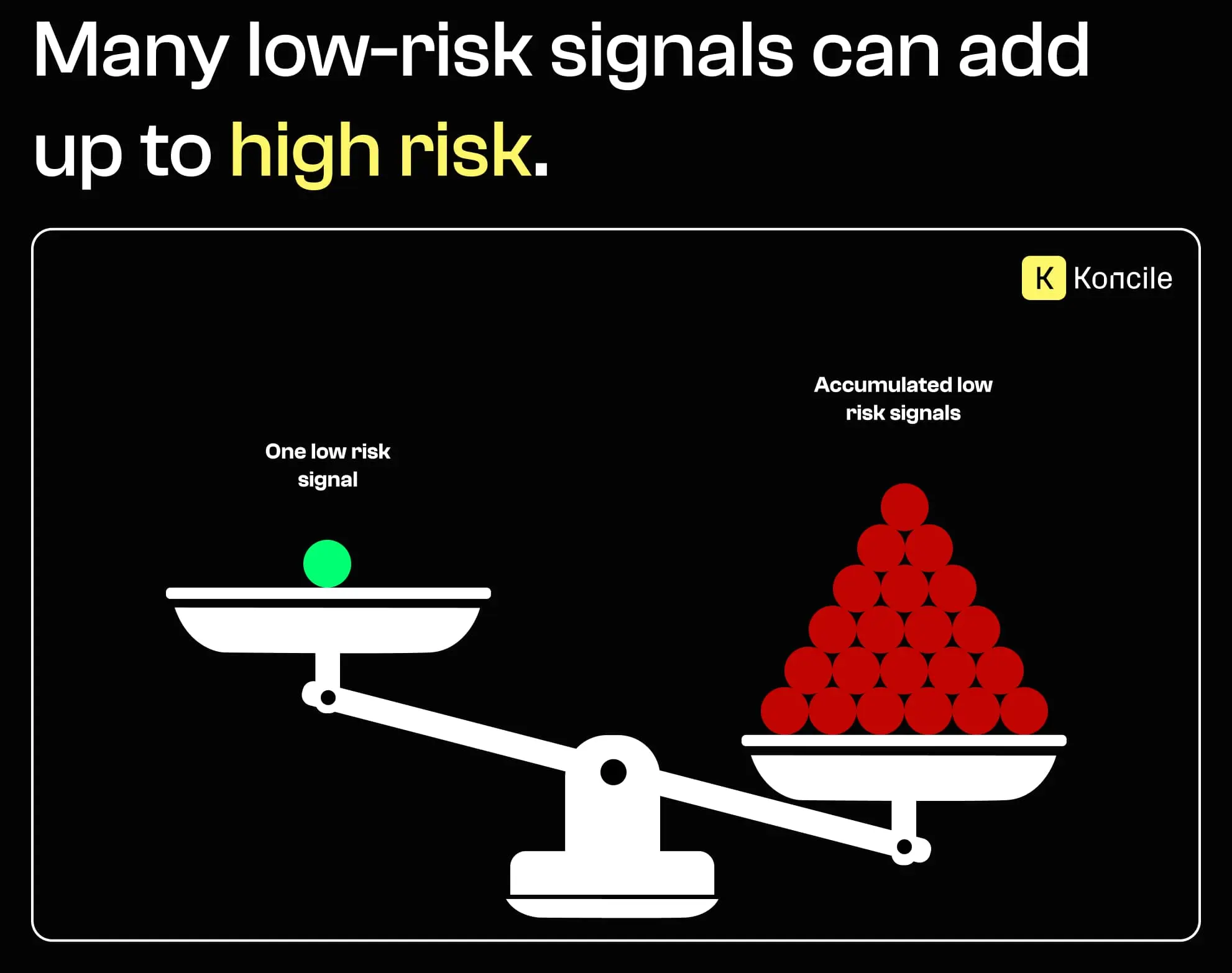
A more effective approach is to treat fraud detection as a scoring problem. Each signal slightly increases or decreases the overall risk. No single test is decisive on its own, but their accumulation creates a meaningful confidence level.
This is especially important at scale, where thousands of documents must be processed automatically and consistently.
PDF metadata: weak signals with massive leverage
PDF metadata is often ignored or treated as unreliable. Yet, when used carefully, it provides some of the most scalable and low-cost signals available.
PDF version consistency as a temporal signal
Another often overlooked metadata field is the PDF version itself.While this information rarely raises suspicion on its own, it becomes meaningful when compared with the document’s supposed age and origin. A document presented as recent but generated using an outdated PDF version can indicate the use of obsolete tools, unofficial pipelines, or manual re-exporting. As with other metadata, the signal is weak in isolation, but it helps assess whether the document’s technical context actually makes sense, especially when evaluated against its document structure and the expectations tied to its origin.
CreationDate vs ModDate: detecting invisible edits
PDF files store technical timestamps, including the moment they were created and the last time they were modified. It is entirely possible to alter visible content in a PDF without leaving any visual trace. A date, an amount, or a name can be changed manually, while the document still looks authentic.
Metadata tells a different story. When a document shows a significant gap between its creation date and its modification date, it raises questions.
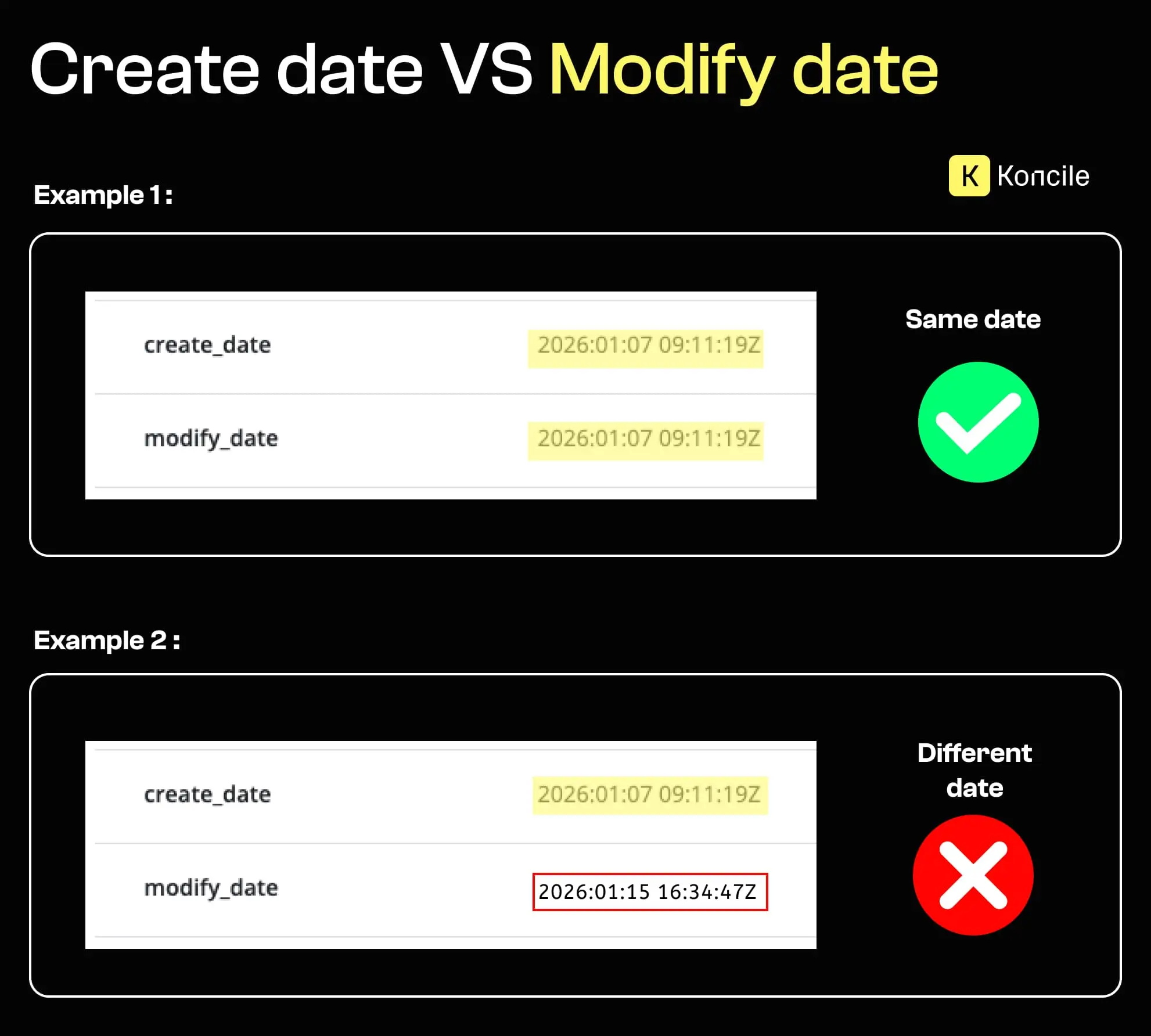
The signal itself is weak. Many legitimate documents are modified after creation. What matters is the context: how long after creation the modification occurred, what type of document it is, and whether such edits are expected in a normal workflow.
Why ModDate alone is not enough
A late modification does not mean fraud by default. Without interpretation, it creates noise and false positives. What makes the signal valuable is its combination with other factors: document type, semantic impact of the edit, and consistency with expected timelines.
Embedded JavaScript as a high-risk metadata anomaly
Some metadata fields are almost never present in legitimate business or administrative documents. Embedded JavaScript is one of them. While PDF supports scripting for advanced use cases, its presence is rare in standard document workflows. When detected, it often signals non-standard behavior such as automation, dynamic manipulation, or attempts to alter how the document behaves when opened. Because of its rarity, this field typically carries a higher risk weight than more common metadata indicators.
Creator and Producer metadata: when the tool becomes a signal
Every PDF contains information about the software that generated it. This includes the Creator and Producer fields. These values often reveal whether a document was generated automatically by a system, or manually edited using consumer tools.
Server-generated PDFs versus editing tools
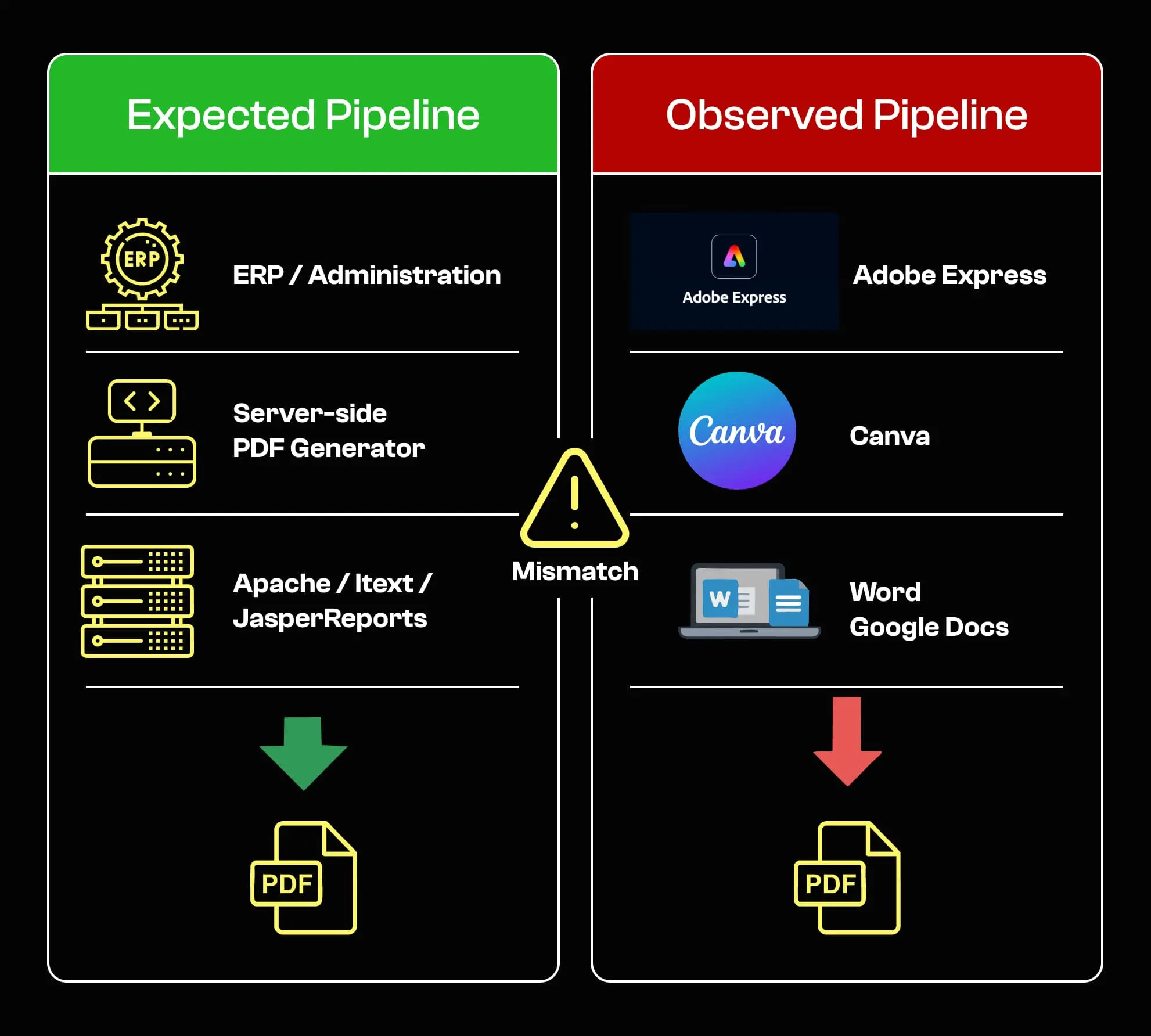
On practice, Creator and Producer metadata often reveals whether a document was generated automatically or manually edited. PDFs produced by server-side or industrial tools such as reporting engines, ERP systems, or form generators typically include creators like Apache-based generators, iText server libraries, JasperReports, or Adobe LiveCycle.
These tools are commonly used by administrations and enterprises to generate documents at scale, with limited human intervention. By contrast, documents showing creators such as Adobe Express, Canva, Microsoft Word, Google Docs, or PowerPoint often indicate manual editing.
This does not imply fraud by itself, but it becomes a strong risk signal when such tools are used for documents that are normally generated automatically, such as official certificates, contracts, or administrative records. This is precisely the kind of contextual, multi-signal reasoning that distinguishes a heuristic approach from true intelligent document processing focused on risk."
For example:
1 – This document was generated using Adobe Express, as indicated by its Creator metadata.
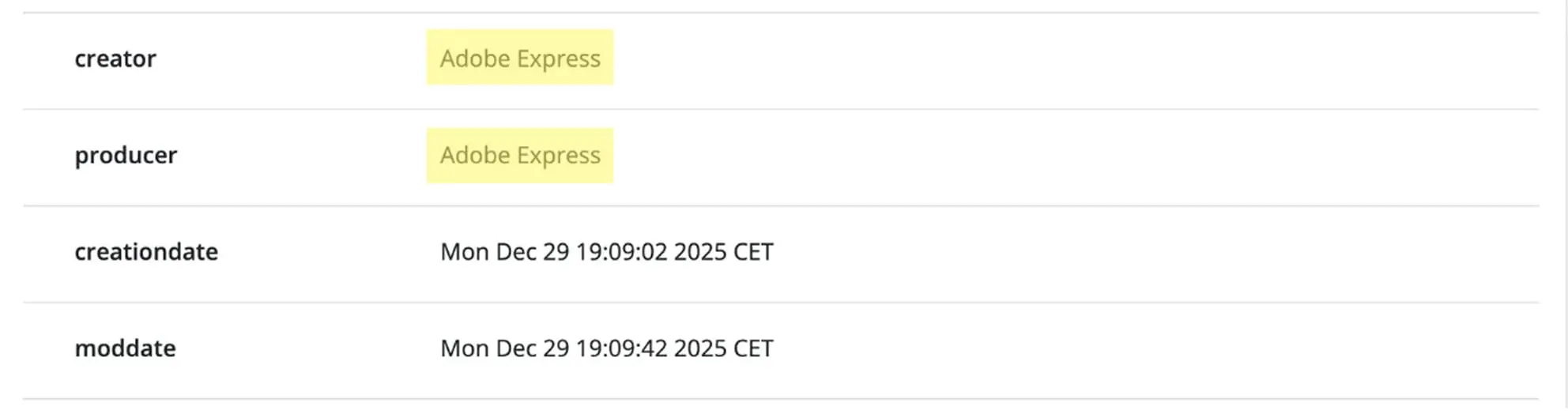
2 – The original version of this document was generated by an Apache-based PDF engine, before being reopened and modified using an editing tool. You can also see that the CreationDate was altered accordingly.

Green flags and red flags are contextual
A marketing brochure generated in Canva is perfectly normal. A government certificate generated in Canva is not. The same tool can be harmless in one context and highly suspicious in another.
Document structure and semantic tagging
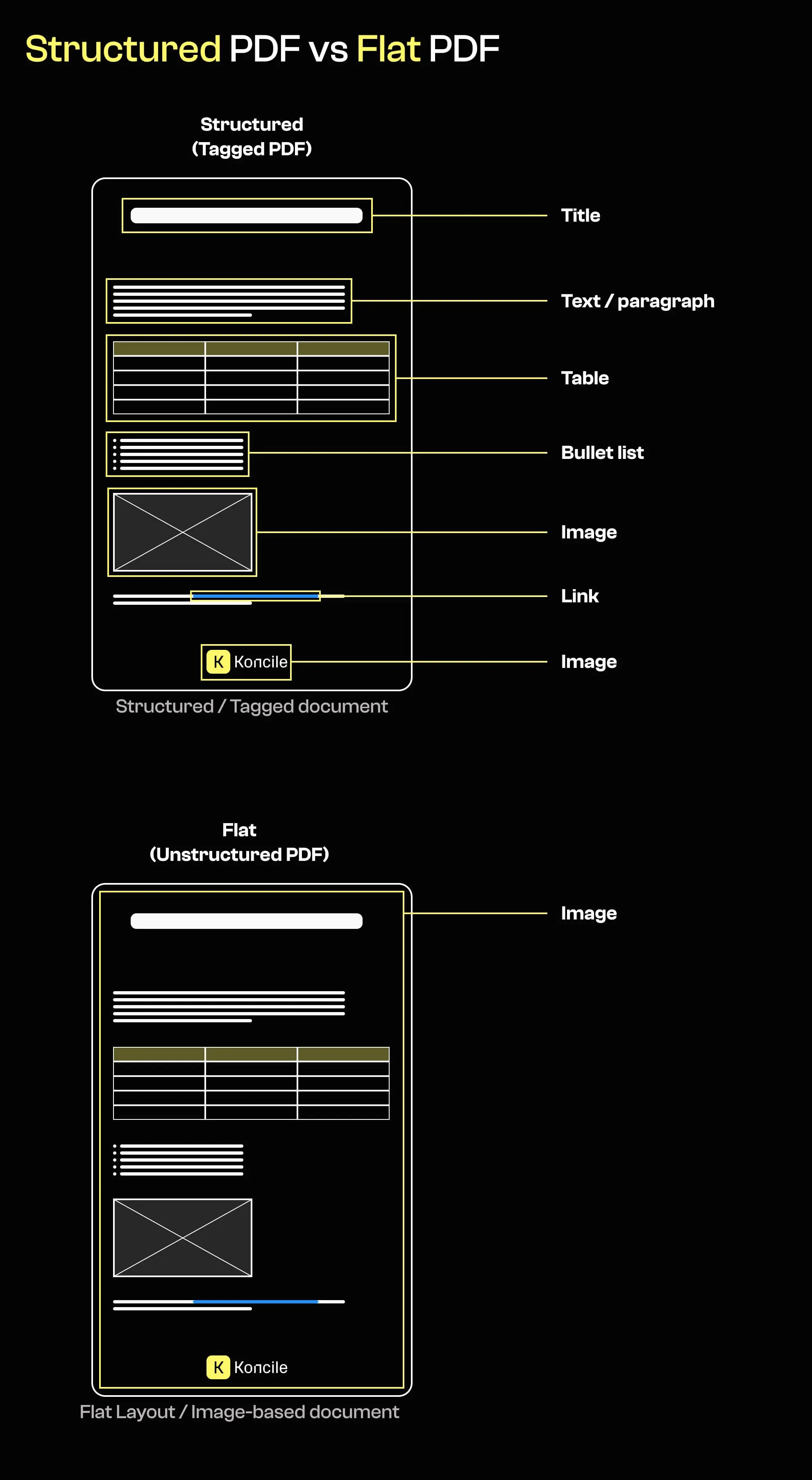
Beyond the software used to generate a PDF, its internal structure provides important clues about its origin. Many official or regulated documents are produced using structured templates that contain identifiable text objects, logical hierarchies, and sometimes semantic tagging.
By contrast, documents exported as flat layouts or images often lack this internal structure. They may consist of a single full-page image per page, occasionally augmented with an OCR text layer added after the fact.
The absence of structure does not prove manipulation on its own. However, it can indicate that the document was generated or transformed using tools or pipelines that differ from those normally associated with its supposed origin.
A document should not only be evaluated based on how it looks, but on whether the way it was produced makes sense for what it claims to be.
Color profiles and clues about document origin
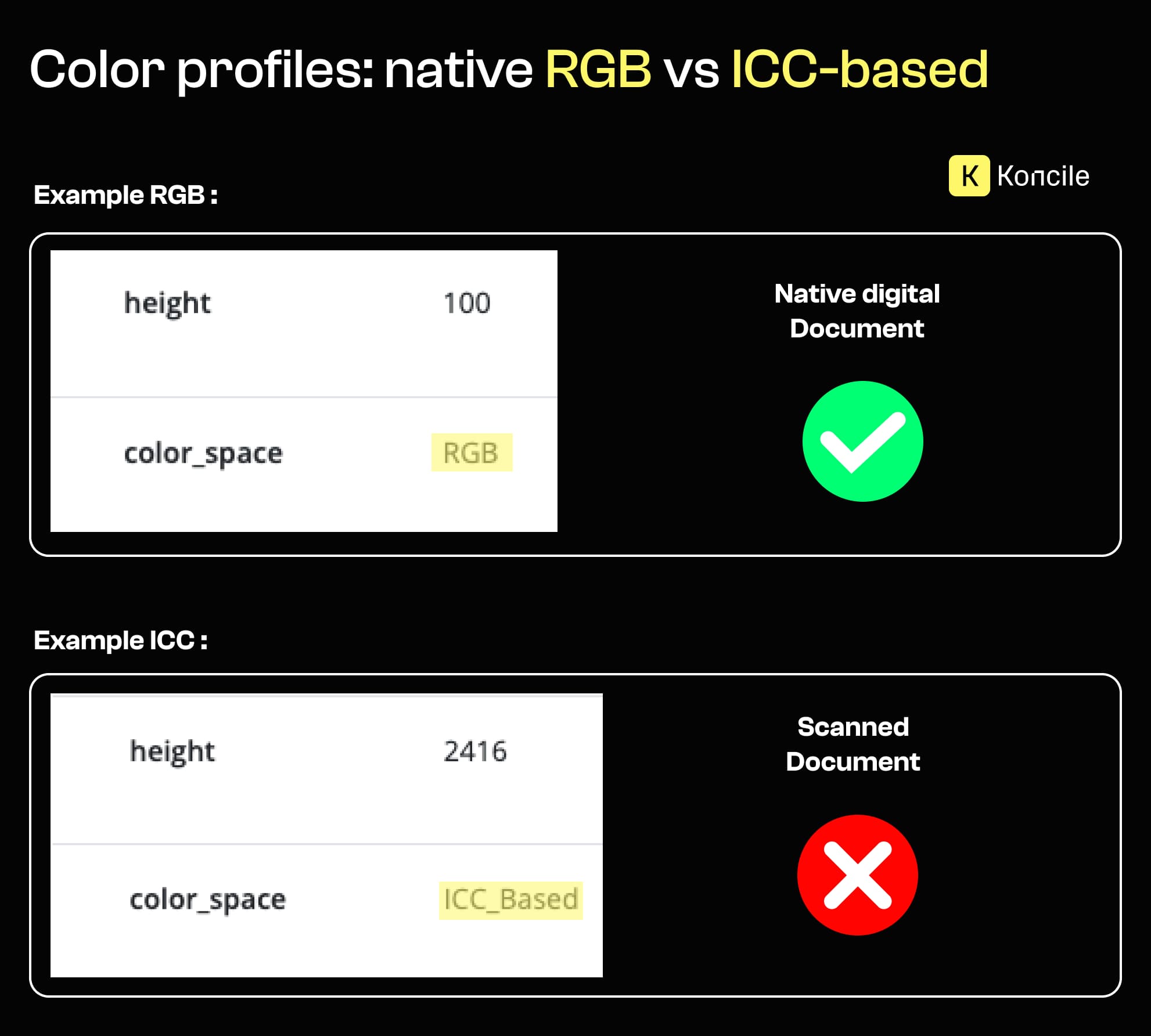
Signals related to document structure often align with other technical traces that reveal how a file was produced. Metadata can, for instance, expose clues about the document’s origin through elements such as color profiles.
ICC color profiles are commonly introduced by scanners, printers, or image-processing pipelines. When a document presented as natively digital contains metadata typically associated with scanned images, it raises questions about how it was actually produced.
This type of signal is subtle and rarely meaningful on its own. But when combined with a flat document structure or the absence of semantic tagging, it helps distinguish genuinely digital documents from scans presented as originals.
Custom metadata: a quiet but powerful indicator
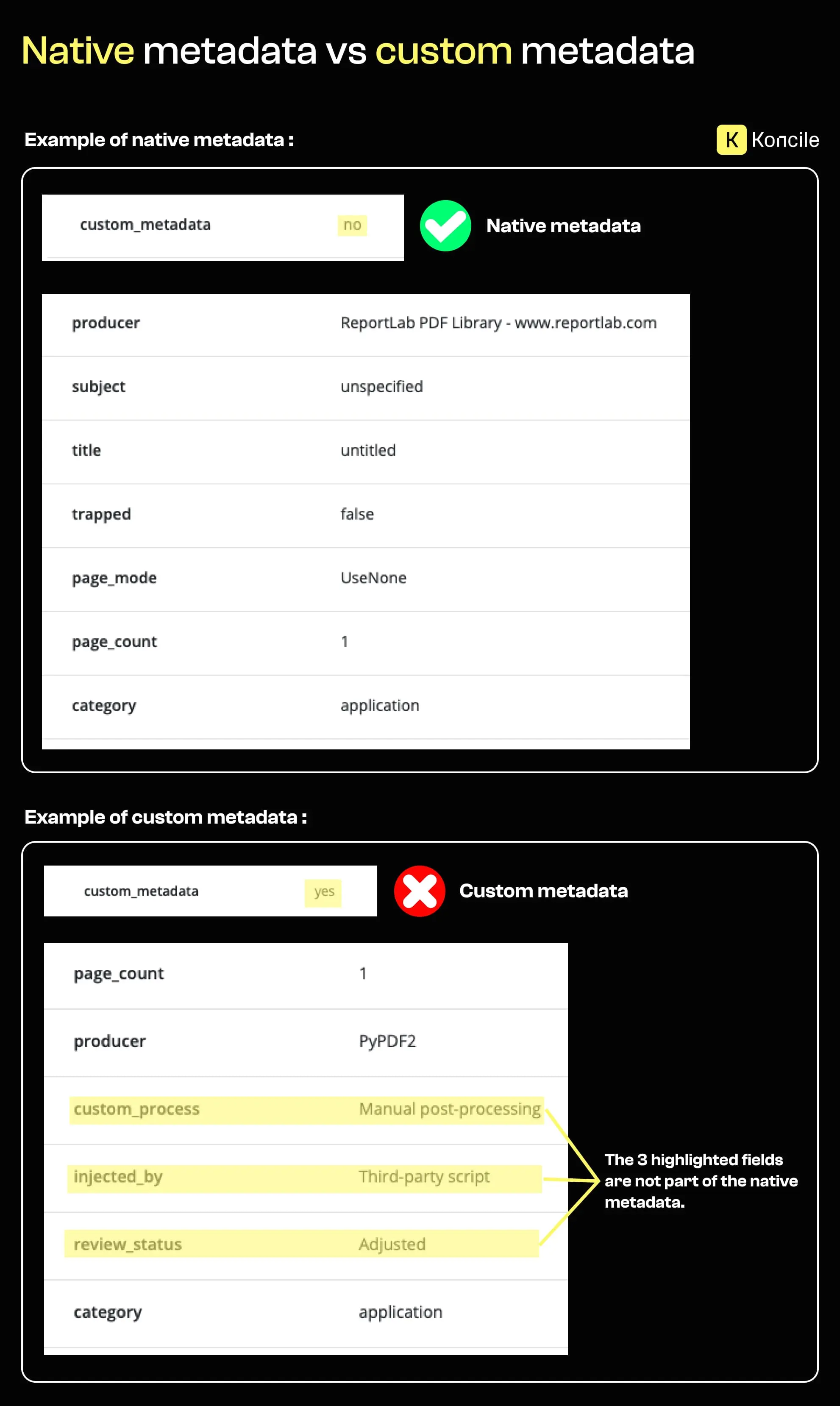
Some PDFs contain custom metadata fields that were added after the initial document generation. These fields often appear when scripts, third-party tools, or manual processes inject additional information into the file.
In official or regulated documents, custom metadata is relatively rare. Its presence does not prove manipulation, but it indicates that the document went through a non-standard production or transformation process.
At scale, recurring custom metadata patterns across similar documents can reveal industrialized manipulation rather than isolated or legitimate edits.
What sounds smart but fails in practice
Not every technical idea that sounds rigorous actually helps detect fraud. Some approaches are intuitive, popular, and ultimately misleading.
File hashes (MD5, SHA): identity is not credibility
File hashes are often suggested as a way to detect tampering. A hash uniquely represents a file. If the file changes, the hash changes.
This is true, but also trivial. Any modification, legitimate or not, produces a new hash. Hashes only tell whether two files are strictly identical. They say nothing about whether a document is credible, consistent, or fraudulent.
Hashes are useful for deduplication and file integrity checks. They are not fraud detection signals.
Forensic tools: powerful but not scalable
Forensic analysis tools allow deep inspection of file structures, binary differences, and historical traces. They are invaluable for investigations and legal expertise.
However, they are slow, complex, and require human intervention. They are designed to explain what happened after suspicion arises, not to detect risk across thousands of documents automatically.
The real challenge: detecting meaningful changes
The critical distinction in document fraud detection is not whether a file changed, but whether the change matters. Adding an annotation or correcting a typo is not equivalent to modifying a monetary amount, a date, or an identity.
Semantic changes alter the meaning or legal impact of a document. Cosmetic changes do not. Effective systems must differentiate between the two and assign risk accordingly.
This requires combining technical signals with document understanding, rather than relying on file-level checks alone.
Beyond the file: why context will matter even more in 2026
Fraud rarely exists in isolation. A single document may appear legitimate, but patterns emerge when documents are compared over time or across users.
Repeated similarities, micro-variations, improbable timelines, or reused structures can all indicate organized manipulation. Contextual analysis transforms isolated weak signals into strong evidence.
For a broader overview of document fraud strategies and prevention methods, see our existing guide on document fraud detection on the Koncile website.
Conclusion
Document fraud detection is shifting away from binary rules and visible errors. The most effective fraud detection system focuses on weak technical signals, contextual coherence, and explainable scoring. Metadata, production tools, and subtle inconsistencies are often overlooked, yet they provide valuable insight when combined intelligently. As document generation becomes easier and more automated, detecting fraud will depend less on strict rules and more on understanding what is plausible. To compare the tools available, explore our roundup of the leading document fraud detection software.
FAQ

Real life insights on document automation

5 Best French OCR Solutions to Extract Data from Your Documents
French OCR solutions now make it possible to automatically extract data from your invoices, contracts, and accounting documents using optical character recognition, with hosting based in France. Here is a real comparison of all five OCR solutions, corrected against current 2026 figures where vendor claims had gone stale, covering what actually differentiates them beyond the fact that they are all hosted in France.

Document processing and fraud detection: build or buy?
Extracting and structuring document data, enriching it, detecting fraud: with AI, building your own end-to-end solution has never looked so simple. Buying off the shelf still often turns out to be the better option. Here are the thirty-nine difficulties to expect before you start.

In healthcare, an OCR is judged on what it flags, not on what it reads
Every OCR vendor advertises high accuracy rates, and most of them deliver. On a health document, that is not the right buying criterion. What counts is what the tool does when it is not sure, what it lets you verify, and what it guarantees about the data it handles.

Top Healthcare OCR Tools: HIPAA Compliance and What the Clinical Evidence Shows
Amazon Textract has been formally HIPAA-eligible since October 2019. Most healthcare OCR comparisons never mention that, or check which of the other four tools on their list actually offer a signed BAA. Here is a rebuild that checks compliance status directly, and looks at what the real clinical trials on ambient AI scribes actually found, not just what the marketing claims.
Best Accounting Software for Sole Proprietors and Freelancers in 2026
A freelancer sending a dozen invoices a month can blow through Xero's cheapest plan by week three, and a $19-a-month FreshBooks account caps out at five clients. The number on a pricing page is rarely the number you actually pay. Here is a real comparison of QuickBooks, Xero, Wave, and FreshBooks built for a business of one, not a growing team.