.avif)
Place des Énergies: Energy Bills Sorted by Client
Discover how Place des Énergies uses Koncile to automate the processing of 5,000 monthly energy bills. Line-by-line extraction and automated auditing eliminate billing errors while speeding up data analysis.
Founded in 2013 and based in Saultain, in the Hauts-de-France region, Place des Énergies is a broker that negotiates and audits gas and electricity contracts for several hundred corporate clients. Every invoice received from a supplier must be verified and then filed under the correct client, even though nothing in the document itself indicates this classification. Place des Énergies currently manages several hundred corporate clients, each typically having around ten consumption sites, representing a continuous flow of documents that Koncile's data extraction platform collects, reads, and verifies.
The True Role of a Broker: Auditing Supplier Invoices
An energy broker does not simply negotiate a rate at the time of signing. Their added value comes into play afterwards, invoice by invoice: checking that the contracted capacity (subscribed power) corresponds to the billed power, identifying abnormally high consumption, recalculating consumption site by site based on meter readings, or ensuring that no pricing errors have slipped into line items. It is this auditing process, repeated across an entire client portfolio, that justifies the broker's role: without it, a supplier billing error remains at the client company's expense, often without them even realizing it.
The Problem: Invoices Designed by Supplier, to Be Filed by Client
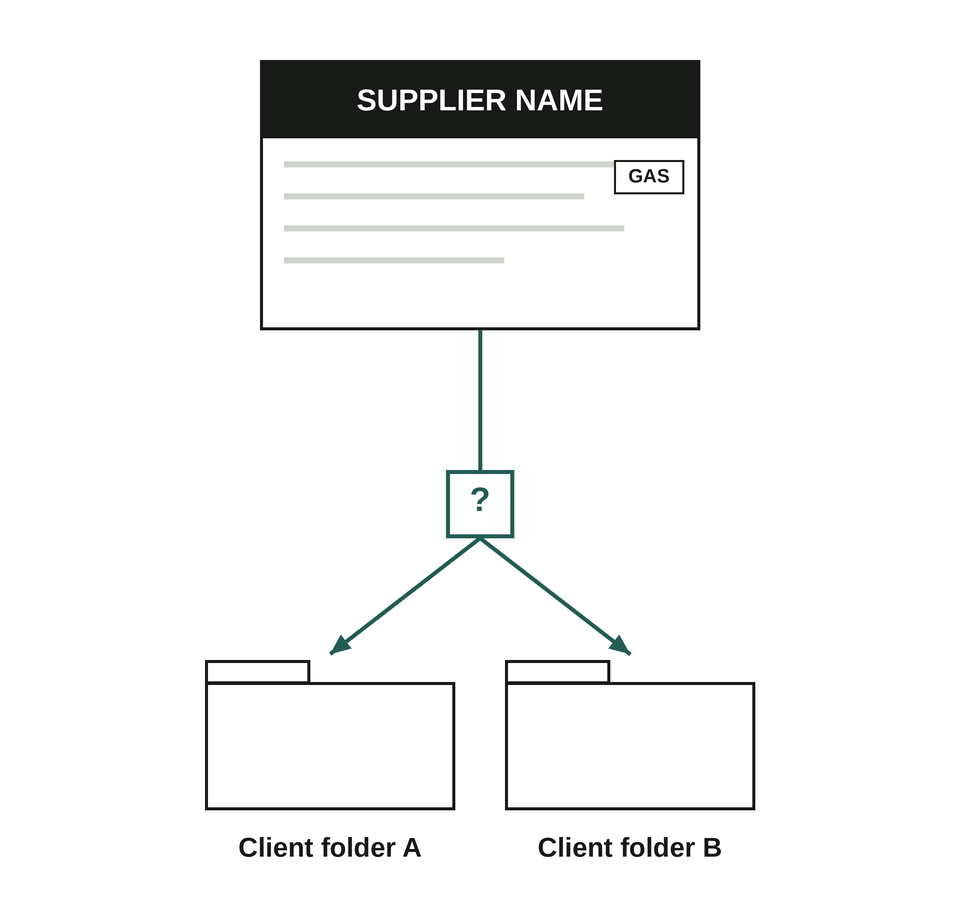
A gas or electricity bill is a document constructed from the supplier’s perspective: it describes a site, a contract, and a consumption period, without ever specifying under which final client of the broker it should be filed. However, the same supplier often bills multiple clients in Place des Énergies' portfolio, and a single client may have multiple sites, multiple suppliers, and separate gas and electricity bills. The document's structure (by supplier, by site, by contract) is therefore the exact opposite of what the team needs for its tracking (by client).
I need to visualize distinct folders per client because the list of invoices can quickly become overwhelming for clients for whom we check dozens of invoices per month.
Laetitia Leclercq, Project Manager, Place des Énergies
Without this organization, it is impossible to see at a glance which client has submitted their monthly invoices and which one needs a follow-up.
Two Sources of Ambiguity to Resolve for Reliable Classification
Implementing automated classification by client ran into two practical challenges rather than a simple document reading issue.
One Supplier, Multiple Clients to Avoid Confusion
In initial tests, a gas invoice ended up filed in the folder of a different client than the one it actually belonged to, as the extraction model primarily recognized the issuing supplier rather than the target final client. Explicit classification rules had to be added to each client folder (specifying which information on the invoice must be searched to identify the correct client, and when a document should be excluded from one folder over another) to make automated filing reliable, even for infrequent suppliers in the portfolio.
Two Import Streams That Must Not Overlap
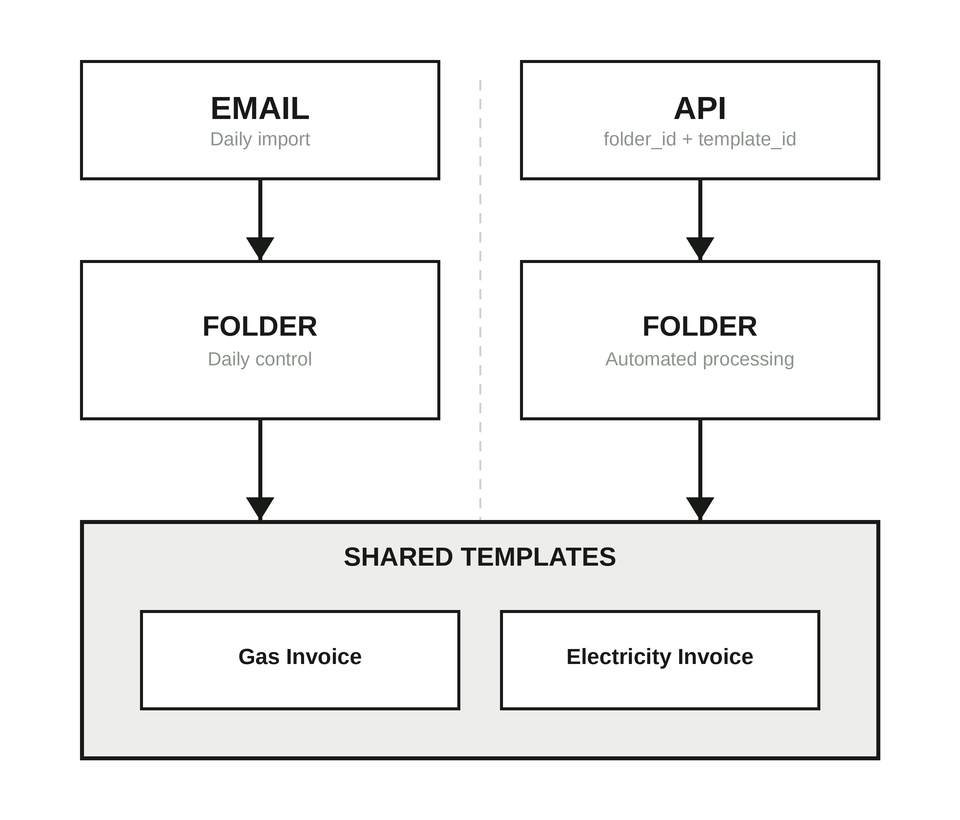
Daily billing audits rely on email imports: invoices arrive continuously to be sorted and checked as they come in. A second, more industrialized use case relies on API imports to route each document directly to the correct folder and extraction model. Both streams rely on very similar models (a gas bill remains a gas bill regardless of the channel), creating a risk that documents arriving by email might be classified automatically as if they came from the API stream, or vice-versa. The configuration therefore had to include explicit rules at the folder level so that each channel remains isolated, even when identical models are used.
The Technical Solution Implemented with Koncile
Rather than multiplying models by supplier, Place des Énergies and Koncile built two generic models—Gas Invoice and Electricity Invoice—which were then duplicated for each client in the portfolio. In practice, an OCR engine capable of reading widely varying layouts from one supplier to another feeds a line-by-line configurable data extraction system: prices, quantities, VAT rates, subscribed power, and peak demand are reconstructed invoice after invoice, regardless of the originating supplier. Each client folder then carries its own classification rules, added as edge cases arose, so the tool knows where to file an ambiguous document rather than categorizing it at random.
The value of having a folder per client is being able to quickly spot which client hasn't sent us their invoices, so we can follow up with them right away.
Laetitia Leclercq, Project Manager, Place des Énergies
It is this tracking logic, rather than document parsing alone, that guided the setup. Today, two import channels coexist to adapt to each user's workflow:
Who Does What Between Koncile and Place des Énergies
The division of responsibilities followed a simple logic: Koncile handles technical setup (duplicating models across the entire portfolio, configuring classification rules, and API support), while Place des Énergies defines the required business rules (how a client folder should be structured, which line items to verify) and performs the daily billing audit. This split between technical configuration and business validation is found in other high-volume document management sectors, such as at Toyota Assurances, where subscription files arrive already entered and checked.
Key outcome: Scalable control across the entire portfolio
The main result isn't just a number, but a fundamental shift in how the work is done: billing checks, which previously relied heavily on manual sorting, have now been structured around customer-based categorization across the entire portfolio. The emergence of a second, more automated use case, alongside routine email checks, is itself a clear sign that adoption has gone well beyond a simple trial.
Frankly, I can't live without it anymore.
Laetitia Leclercq, Project Manager, Place des Énergies
Next Step: Pushing Automated Analysis Further
Beyond filing, Place des Énergies now possesses structured, line-by-line data for every single one of its energy invoices. This opens the door to advancing automated analysis, an objective envisioned since the initial discussions: detecting excessive consumption, identifying meter index anomalies, and performing systematic site-by-site recalculations across the entire portfolio rather than folder by folder.
Frequently Asked Questions

Real life insights on document automation

Supplier invoice OCR: how Next&Go processes 30,000 rental invoices a year
Half a day freed up daily and two hires avoided, at a fifteen-person broker. The full case study.

PDF Bank Statements: How Meelo Automates Extraction With AI
How Meelo automates the analysis of PDF bank statements with Koncile's AI: reliable extraction, fraud detection, and solvency scoring in seconds.
.png)
Document fraud detection in insurance: how ADN.Solutions and CMAM secure motor underwriting
Motor insurance's most-forged document now goes through a single check: extraction and authenticity, in one API call. ADN.Solutions has deployed it white-label across its insurers, including CMAM, and now detects 87% of falsified statements, with under 2% false positives.
.png)
At HealthNet Homecare, the prescription is reviewed by AI before entering the system
The UK homecare provider processes more than a million pages a year with Koncile. On a hospital prescription, several treatments are printed but only one is actually prescribed, marked with a checked box. Koncile picks out only that one, matches it against the medication database, and checks the result against the team's own data entry.

At Toyota Assurances, the underwriting file arrives captured and checked
Nine document types in a single PDF. Koncile identifies them, reads them, checks their validity and their consistency with one another, then sends the data and the alerts back via API into the systems of the insurer AND-E.
EPSON × Koncile: AI data extraction built into the scanner
How EPSON turned its scanners into true data-entry points with Koncile's AI. Operational in a few minutes, with zero manual re-entry.
.avif)
RewardPulse Automates Proof-of-Purchase Checks
RewardPulse designs loyalty and incentive programs for other companies. Reliably validating each proof of purchase at scale turned out to be far more complex than expected.
Place des Énergies: Energy Bills Sorted by Client
Discover how Place des Énergies uses Koncile to automate the processing of 5,000 monthly energy bills. Line-by-line extraction and automated auditing eliminate billing errors while speeding up data analysis.

Nona Automates Supplier Invoice Processing with Koncile's OCR
Nona equips more than 650 collective kitchens to build menus that meet France's EGalim sustainability targets. With Koncile, manual invoice entry has become an automated flow, linked directly to its food database.
.avif)
Mark Young Construction Automates Subcontractor Insurance Certificate Checks
Mark Young Construction has to check every subcontractor's certificate of insurance before the job site opens. With Koncile, reading each certificate and flagging anomalies became immediate."

Grainz is transforming the processing of its invoices and delivery notes thanks to OCR
Extractions that speed up processes, reduce errors, and improve compliance.

360 Smarter Administration centralizes and structures the processing of its payroll documents
From PDFs to actionable data: Koncile OCR automates payroll processing at 360 Smarter Administration, reducing manual effort and improving data reliability.