
At Toyota Assurances, the underwriting file arrives captured and checked
Nine document types in a single PDF. Koncile identifies them, reads them, checks their validity and their consistency with one another, then sends the data and the alerts back via API into the systems of the insurer AND-E.
At Toyota Assurances, underwriting files (registration certificate, driving licence, claims history statement, bank details…) were until now checked manually, document by document. Faced with growing volumes, insurer Toyota Assurances compared several automation solutions before choosing Koncile, for the quality of its extraction and the speed of its implementation.
The problem: an underwriting file that has to be checked document by document
Toyota Assurances insures Toyota, Lexus and Kinto customers in France. Behind the brand is AND-E, Aioi Nissay Dowa Insurance Company of Europe, a member of the MS&AD group: 60,000 motor policies in the portfolio, 20,000 new contracts every year. It's a high-volume document extraction business, where every file underpins a real contract.
The underwriting file: 9 documents to verify for every motor contract
Every underwriting process starts the same way. The customer or the dealership sends its documents to a dedicated processing inbox, unsorted, most often merged into a single ten-to-fifteen-page PDF, with no order or table of contents.
Nine types of documents need to be extracted from it: registration certificate, temporary registration certificate, driving licence, proof of identity, bank details (IBAN), SEPA mandate, claims history statement, certificate of transfer of ownership, and loan agreement.
Each type carries its own pitfalls, and it's this variety that makes the case difficult.
- A registration certificate where the owner and co-owner are poorly matched, and where one of the two is a financing company rather than a person.
- A driving licence that may be in the old pink format or the new one, with up to three drivers, whose issue date and expiry date appear on two different lines on the back.
- A proof of identity that may be a national ID card, a passport or a residence permit, and which must be mapped to the same set of fields.
- A claims history statement issued by any insurer, each with its own layout, around twenty data points to extract, and sometimes two statements in the same file.
- A name that may include a maiden name and a married name, which must be cleanly separated to be usable.
- A contract number that appears on none of the documents and is found only in the accompanying message.
A complexity confirmed by Olivier Jannin, Sales Director at Toyota Assurances:
We worked iteratively with the Koncile teams to capture complex information in the document bundles of our underwriting files. They supported us until we reached the best possible extraction quality, with no errors after human verification on samples. We then automatically feed the data to our systems via API.
Olivier Jannin, commercial director, Toyota Insurance
The numbers behind automation at Toyota Assurances
The model built with the Toyota Assurances teams now extracts 200 fields and control points per file, with 99.2% of fields extracted error-free, as measured by human verification on samples. The full rollout, from delivery of the nomenclature to going into production, took five weeks.
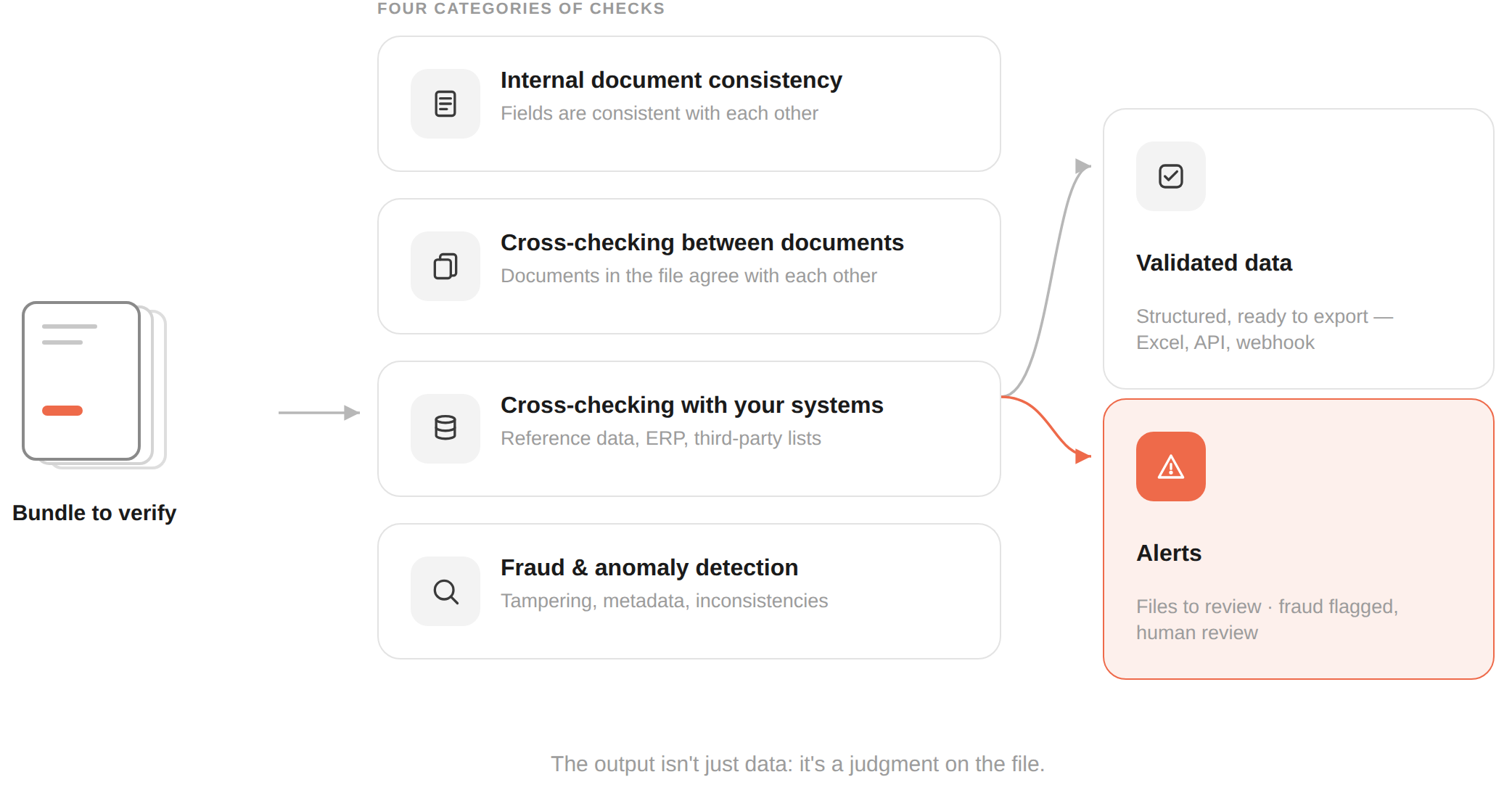
What Koncile checks in every underwriting file
Extraction is only half the job. A claims handler never just copied fields: they process a file, check that it's complete, that each document is valid, and that they all refer to the same person and the same vehicle. The model built with the Toyota Assurances teams applies these checks to every bundle, and the results flow back through the same pipeline as the data.
Completeness and classification
Every page is assigned a type, even when it wasn't anticipated in the model: it is then classified separately rather than ignored. Duplicates are detected and discarded. An alert is triggered when a bundle contains multiple proofs of identity, or more than two claims history statements.
Document validity
Expiry dates for the driving licence and the ID document, start and end dates of coverage on the claims history statement, roadworthiness test status shown on the registration certificate, actual presence of a signature on the SEPA mandate and on the transfer certificate.
Authenticity
A registration certificate crossed out with the word "sold" is flagged. A driving test pass certificate, submitted while awaiting the final licence, is identified as such and is not treated as a driving licence.
Consistency across documents
The name on the registration certificate is checked against the name on the bank details, the driving licence and the claims history statement; the registration number on the registration certificate against the one on the claims history statement. This is where a file's compliance is determined, and no document-by-document reading can catch it.
Koncile makes it possible to systematically compare and check the consistency of our various documents with each other.
Ghislain Averty, COO, Toyota Insurance
The email is part of the file
The subject line, body and sender of the message are submitted along with the document bundle and analysed on the same basis as the documents. This is how the contract number, almost never present on a registration certificate or bank details, is found in the message and linked to each document, applying the specific formatting rules of each distributed brand — Toyota, Lexus or Kinto.
This is also what makes it possible to qualify the submission itself. The same customer sends two messages a minute apart: the first is compliant, the second is not. Without the context of the email, neither can be processed correctly.
Alerts are returned along with the data, in the same call. 87% of bundles are processed end-to-end without human intervention. The claims handler no longer opens every file — only the 13% that require a judgment call.
What the claims handler used to do, and no longer does
Before (manual processing)
- Open the email, open each attachment
- Identify the nature of each document
- Find the contract number, missing from the documents
- Manually re-enter the data field by field into the management tool
- Manually check the validity of the documents and their consistency with one another
- Spot incomplete files and follow up with the customer
14 min of manual entry and checking per file
Today (with Koncile)
- The document bundle and the email context are automatically sent to Koncile
- Every page is typed, even when the type wasn't anticipated
- The contract number is retrieved from the message, in the format of the relevant brand
- The 200 fields are automatically fed into the database via API
- Validity, authenticity and consistency checks are run on every bundle
- The claims handler only arbitrates the flagged files
40 sec of automated processing, then 2 minutes of review on flagged files only
Across the 20,000 new contracts processed each year, the savings exceed 4,000 hours of entry and checking — the equivalent of more than two full-time positions freed up for the core business. Processing runs in parallel: a thousand bundles sent at once are processed within minutes, with no queue.
Implementation: five weeks for a fully custom-built model
None of the above comes off the shelf. Every field, every reading rule and every control point was defined by the operations teams themselves, in plain language, with no development and no model to train. The business nomenclature became the shared reference, and the tool adapted to it rather than the other way around.
The nomenclature was defined by the underwriting and operations department, which becomes the reference standard for it. Configuration was done in plain language: claims handlers write their own extraction rules and control points, and adjust them without going through anyone else. API integration was completed in four days, testing was carried out on real documents, using the bundles actually received, and the scope keeps expanding to new document types and new checks, with no new project needed.
The scope has grown from seven to nine document types since going live, with rules written directly by the operations teams, in a matter of hours and without any technical intervention.
Next step: documentary fraud detection
Building on what already works today, a multi-layer fraud detection initiative is being developed with the Toyota Assurances teams. It focuses first on the claims history statement, the most sensitive document in the underwriting file and the easiest to tamper with: an altered no-claims bonus/malus coefficient, a shifted cancellation date, an erased claim.
Three areas are under review, the same three already applied to bank statements in Meelo's onboarding files: the file's metadata (editing traces, creation software, modification history, internal date inconsistencies); the page's visual integrity (font and alignment breaks, recomposed areas, overlaps, local alterations); and the business-logic consistency of the information (plausibility of the coefficient given policy age and claims history, continuity of coverage periods, agreement with the other documents).

Real life insights on document automation

Supplier invoice OCR: how Next&Go processes 30,000 rental invoices a year
Half a day freed up daily and two hires avoided, at a fifteen-person broker. The full case study.

PDF Bank Statements: How Meelo Automates Extraction With AI
How Meelo automates the analysis of PDF bank statements with Koncile's AI: reliable extraction, fraud detection, and solvency scoring in seconds.
.png)
Document fraud detection in insurance: how ADN.Solutions and CMAM secure motor underwriting
Motor insurance's most-forged document now goes through a single check: extraction and authenticity, in one API call. ADN.Solutions has deployed it white-label across its insurers, including CMAM, and now detects 87% of falsified statements, with under 2% false positives.
At Toyota Assurances, the underwriting file arrives captured and checked
Nine document types in a single PDF. Koncile identifies them, reads them, checks their validity and their consistency with one another, then sends the data and the alerts back via API into the systems of the insurer AND-E.
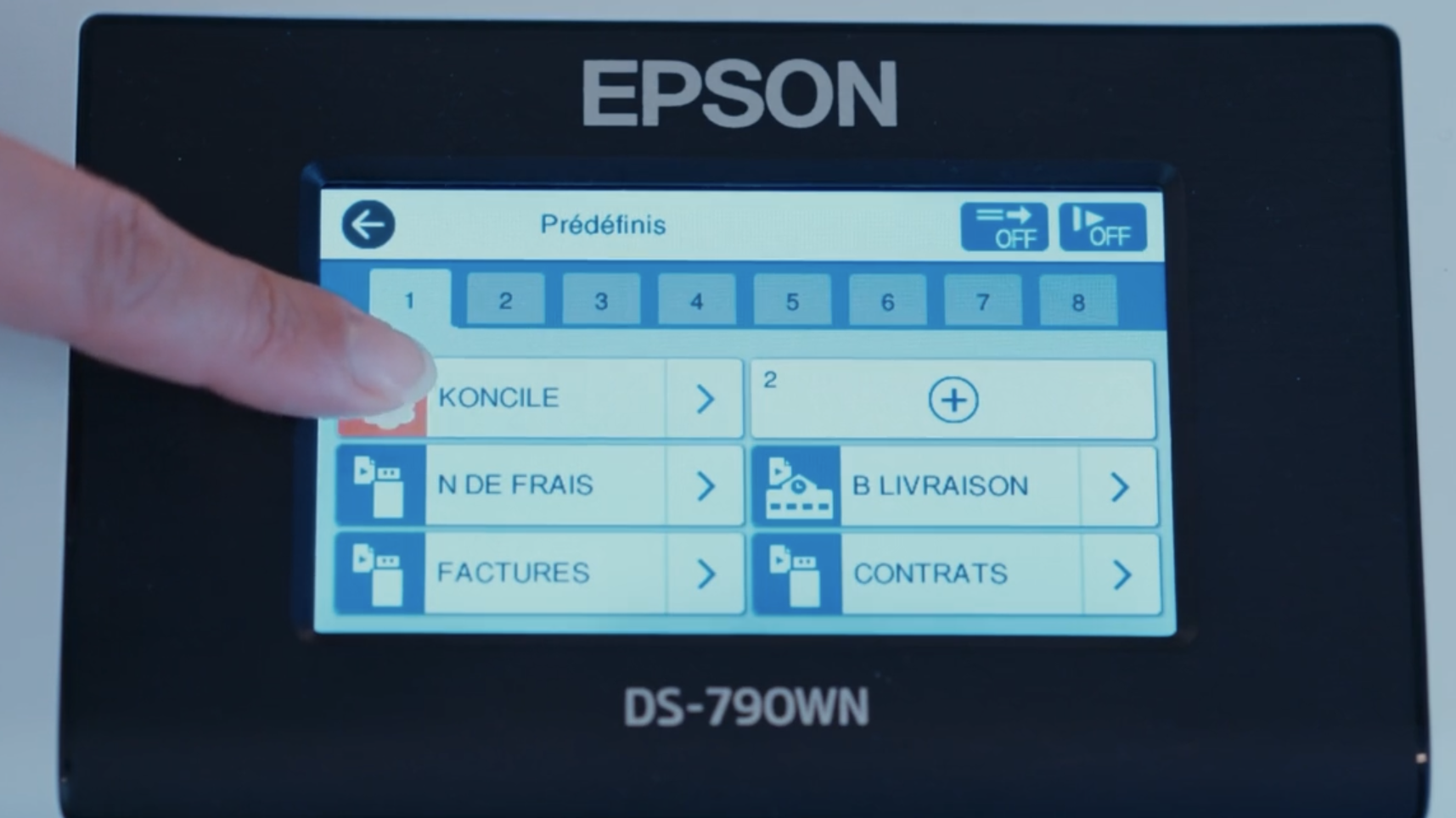
EPSON × Koncile: AI data extraction built into the scanner
How EPSON turned its scanners into true data-entry points with Koncile's AI. Operational in a few minutes, with zero manual re-entry.
.avif)
RewardPulse Automates Proof-of-Purchase Checks
RewardPulse designs loyalty and incentive programs for other companies. Reliably validating each proof of purchase at scale turned out to be far more complex than expected.
.avif)
Place des Énergies: Energy Bills Sorted by Client
Discover how Place des Énergies uses Koncile to automate the processing of 5,000 monthly energy bills. Line-by-line extraction and automated auditing eliminate billing errors while speeding up data analysis.

Nona Automates Supplier Invoice Processing with Koncile's OCR
Nona equips more than 650 collective kitchens to build menus that meet France's EGalim sustainability targets. With Koncile, manual invoice entry has become an automated flow, linked directly to its food database.
.avif)
Mark Young Construction Automates Subcontractor Insurance Certificate Checks
Mark Young Construction has to check every subcontractor's certificate of insurance before the job site opens. With Koncile, reading each certificate and flagging anomalies became immediate."

Grainz is transforming the processing of its invoices and delivery notes thanks to OCR
Extractions that speed up processes, reduce errors, and improve compliance.
Material certificate OCR: how Bilfinger LTM Industrie automated traceability without kitting out the shop floor
Instead of handing out tablets, they digitised what comes out of the workshop. Ten certificates handled in two minutes.

360 Smarter Administration centralizes and structures the processing of its payroll documents
From PDFs to actionable data: Koncile OCR automates payroll processing at 360 Smarter Administration, reducing manual effort and improving data reliability.