Nona Automates Supplier Invoice Processing with Koncile's OCR
Nona equips more than 650 collective kitchens to build menus that meet France's EGalim sustainability targets. With Koncile, manual invoice entry has become an automated flow, linked directly to its food database.
Nona builds management software designed for collective catering: school canteens, medico-social facilities such as nursing homes, central kitchens and local authorities. More than 650 establishments now use it to design menus that meet EGalim sustainability targets, track stock, manage budgets and digitize their food-safety plan (HACCP). Much of that work rests on one invisible building block: a reliable product database able to link every ingredient purchased to its nutritional and regulatory equivalents. That database is built from unglamorous but essential material: the invoices and purchase documents each kitchen receives from its suppliers, which Nona now has read automatically by Koncile's data extraction platform.
Onboarding a kitchen starts with a year's worth of invoices
Before a kitchen can start reconciling its accounts in Nona, it first has to feed everything it already buys into the system. In practice, that means retrieving roughly a year of supplier invoice history to identify the products actually in use (meat, vegetables, dry goods, dairy) and make the software usable from its very first menu. Historically, this was done by hand: every invoice line was re-read and retyped, whether the document was a clean PDF or a handwritten invoice from a small local supplier. A slow, repetitive process, inherently prone to human error, imposed on kitchens whose job is cooking, not data entry.
It's this step, invisible to the cook using the finished software but structurally important for everything else in it, that Nona set out to automate first.
Why a collective-kitchen invoice is unlike any other
What makes this hard isn't the volume of documents, it's how different they are from one another. A collective kitchen doesn't receive one standard invoice type: it receives invoices from food wholesalers, multi-column product catalogs, unit price schedules from public tenders (BPU), and sometimes restaurant menus that need to be re-exported while keeping their column-by-dish layout. Each of these documents has its own layout, its own conventions, and its own way of naming the same product.
A generic food database to feed line by line
To support nutritional calculations and EGalim ratio tracking, every invoice line has to be linked to a generic food item (beef, tomato, tuna, bread...) drawn from a database of roughly 3,300 values at Nona. The catch is that the same food item is named differently depending on the supplier, the packaging or the unit of sale: an invoice line never explicitly says "this is beef." The system therefore has to match a supplier's own label, sometimes cryptic, to the right entry in the generic database, without manual work on every new invoice.
The meat invoice case: when the right code depends on a breed mentioned at the bottom of the page
The clearest example concerns invoices from certain specialized meat suppliers. The product code to extract can't always be read from the line alone: with a given supplier, two different products can share the exact same reference number, distinguished only by the breed of the animal, noted in small print at the bottom of the page. Extracting the right line therefore means cross-referencing several pieces of information scattered across the document, in a reading order that isn't obvious to a standard OCR engine.
What's great about Koncile is that there's AI built in, which lets it adapt to different types of invoices.
Timothée Berthault, Supplier Relations & Integration Manager, Nona
The technical solution built with Koncile
To handle this diversity, Nona doesn't rely on a single extraction model but on several dedicated ones, one per document type: standard invoice, unit price schedule, wholesaler catalog, restaurant menu. Each model applies instructions written together with the Koncile team, down to very specific rules, such as the one that looks up the meat's breed at the bottom of the page to disambiguate a product code. The extracted data comes out structured, ready to use without reformatting, through Koncile's OCR and its data extraction building blocks.
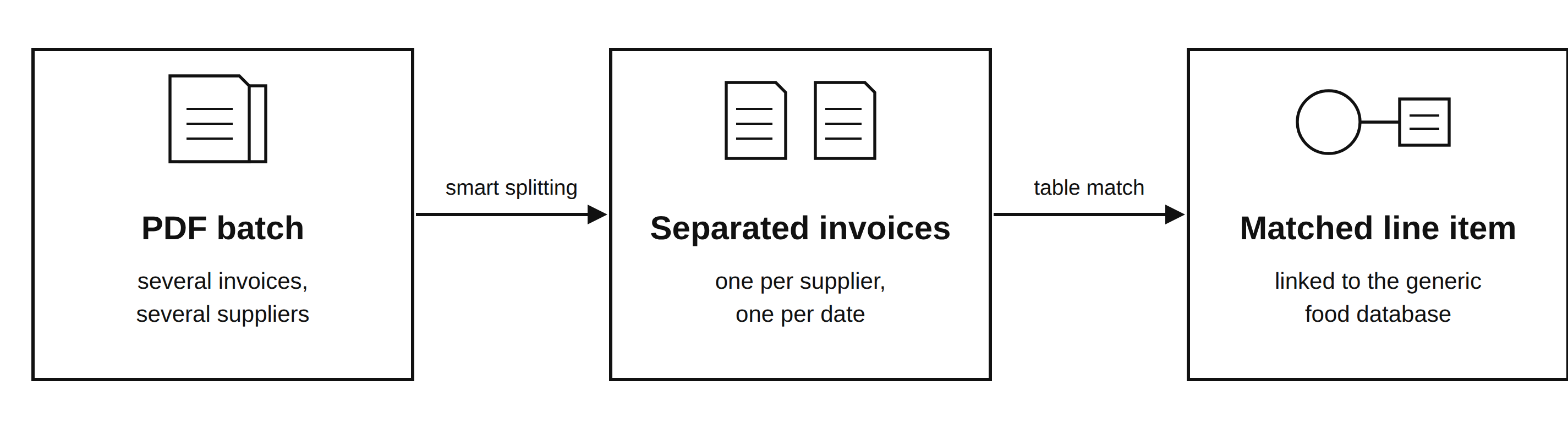
Two other features address Nona's constraints directly. Smart splitting automatically breaks up a PDF batch containing several invoices, based on rules defined with the client (a new invoice date or a new supplier marks the start of a new document). Table match automatically links each invoiced product to a value in Nona's generic food database, based on an exact or close match between the extracted label and the database entries. A move toward a dynamic match, connected continuously to an external database rather than a static import, is currently in progress.
The software processes the invoices on its own and hands us back an Excel file with data that's easy to work with.
Timothée Berthault, Supplier Relations & Integration Manager, Nona
Who does what between Nona and Koncile
Nona remains the sole owner of its business rules: Timothée Berthault's team defines the structure of its generic food database, the splitting rules specific to its invoice batches, and the expected export format for each document type. Koncile, on its side, configures and evolves the extraction models and their prompts, tunes the reading engine (particularly for low-resolution scanned documents), and handles one-off requests, such as adjusting a model when a supplier introduces a new invoice layout.
This split of responsibilities was built iteratively: as more kitchens were onboarded, new edge cases were reported to Koncile, which turned them into reusable rules for the next kitchens rather than one-off fixes.
Kitchens up and running faster
The clearest benefit is speed of rollout. Setting up a new account, which used to depend on weeks of manual re-typing, now happens at the scale of an entire kitchen, by dropping its invoice history directly onto the Koncile platform rather than retyping it document by document. Cooks get access faster to software already populated with their everyday products, which in turn speeds up day-to-day adoption of the tool.
We were able to send all of a kitchen's invoices in one go, and quickly see good results. Koncile's adaptability was a real plus.
Timothée Berthault, Supplier Relations & Integration Manager, Nona
What's next: a product match that keeps up with the supplier database
The next step in the collaboration is moving from a static match (the food database is imported at a given point in time) to a dynamic one, connected continuously to Nona's database: every new reference added on Nona's side would immediately become available for automatic matching, with no manual re-import. Other players in collective catering are working on a related challenge: that's the case for Grainz, which automated the processing of its invoices and delivery notes for the collective kitchens it serves.
"What Koncile offers is genuinely great, and we're very happy with it," is how Timothée Berthault sums up this long-running collaboration.
Frequently asked questions

Real life insights on document automation

Supplier invoice OCR: how Next&Go processes 30,000 rental invoices a year
Half a day freed up daily and two hires avoided, at a fifteen-person broker. The full case study.

PDF Bank Statements: How Meelo Automates Extraction With AI
How Meelo automates the analysis of PDF bank statements with Koncile's AI: reliable extraction, fraud detection, and solvency scoring in seconds.
.png)
Document fraud detection in insurance: how ADN.Solutions and CMAM secure motor underwriting
Motor insurance's most-forged document now goes through a single check: extraction and authenticity, in one API call. ADN.Solutions has deployed it white-label across its insurers, including CMAM, and now detects 87% of falsified statements, with under 2% false positives.

At Toyota Assurances, the underwriting file arrives captured and checked
Nine document types in a single PDF. Koncile identifies them, reads them, checks their validity and their consistency with one another, then sends the data and the alerts back via API into the systems of the insurer AND-E.
EPSON × Koncile: AI data extraction built into the scanner
How EPSON turned its scanners into true data-entry points with Koncile's AI. Operational in a few minutes, with zero manual re-entry.
.avif)
RewardPulse Automates Proof-of-Purchase Checks
RewardPulse designs loyalty and incentive programs for other companies. Reliably validating each proof of purchase at scale turned out to be far more complex than expected.
.avif)
Place des Énergies: Energy Bills Sorted by Client
Discover how Place des Énergies uses Koncile to automate the processing of 5,000 monthly energy bills. Line-by-line extraction and automated auditing eliminate billing errors while speeding up data analysis.
Nona Automates Supplier Invoice Processing with Koncile's OCR
Nona equips more than 650 collective kitchens to build menus that meet France's EGalim sustainability targets. With Koncile, manual invoice entry has become an automated flow, linked directly to its food database.
.avif)
Mark Young Construction Automates Subcontractor Insurance Certificate Checks
Mark Young Construction has to check every subcontractor's certificate of insurance before the job site opens. With Koncile, reading each certificate and flagging anomalies became immediate."

Grainz is transforming the processing of its invoices and delivery notes thanks to OCR
Extractions that speed up processes, reduce errors, and improve compliance.
Material certificate OCR: how Bilfinger LTM Industrie automated traceability without kitting out the shop floor
Instead of handing out tablets, they digitised what comes out of the workshop. Ten certificates handled in two minutes.
360 Smarter Administration centralizes and structures the processing of its payroll documents
From PDFs to actionable data: Koncile OCR automates payroll processing at 360 Smarter Administration, reducing manual effort and improving data reliability.