
DeepSeek OCR made simple: architecture and context handling
A clear, structured explanation of DeepSeek OCR and its approach to document context.

DeepSeek OCR is drawing attention for long-document performance, but its design often feels opaque. This article breaks down its architecture, context compression, and what it means in practice.
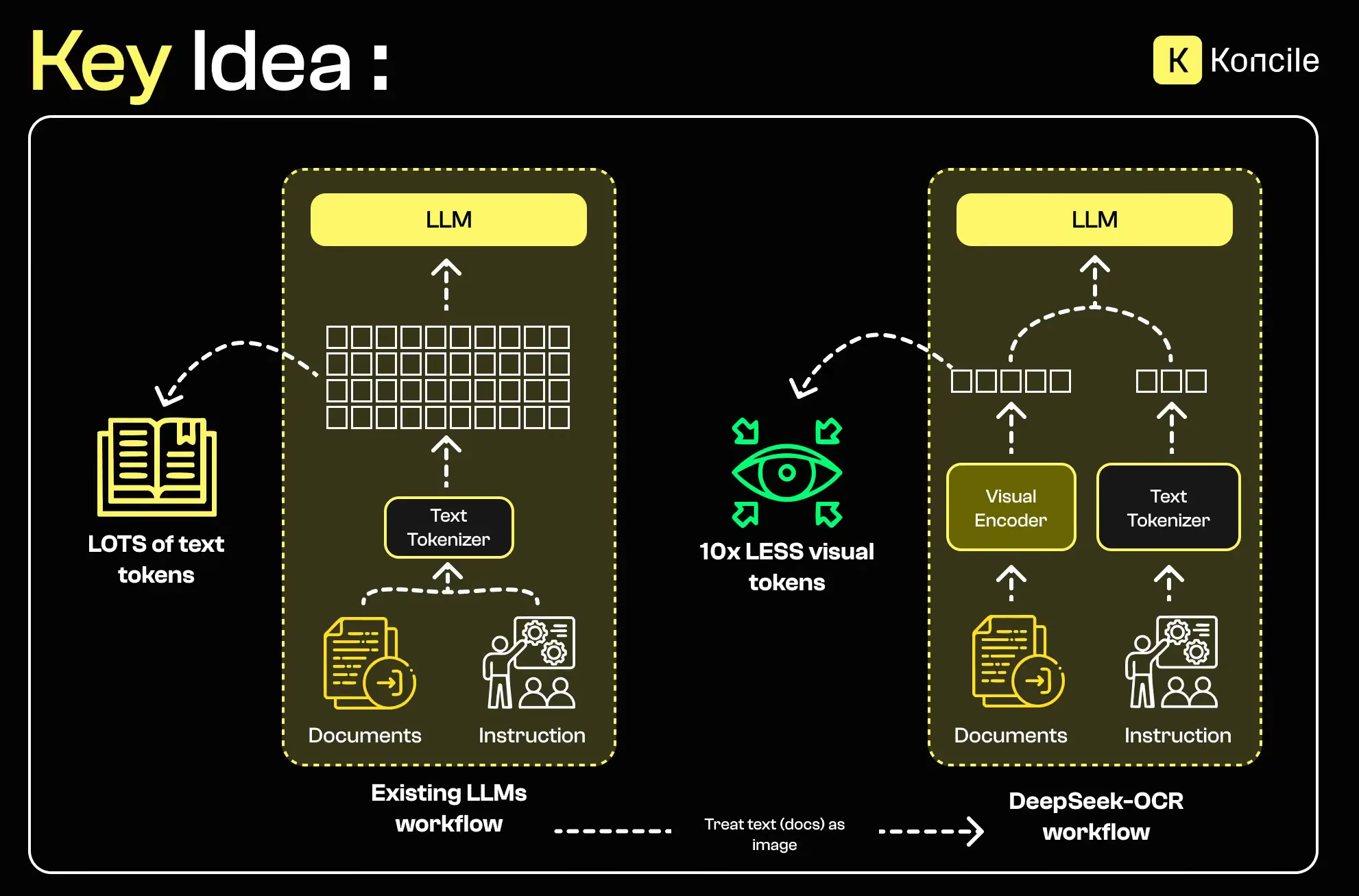
Modern OCR systems are no longer judged only by how well they recognize text, but by how well they handle long, complex, heterogeneous documents without blowing up compute costs. DeepSeek OCR fits into this shift with an approach centered on visual-context compression and inference efficiency.
What DeepSeek OCR is trying to solve
The limits of processing long documents
In many real-world use cases, documents are not a single isolated page. Administrative files, contracts, archives, and multi-page forms all share a recurring problem: the longer the document, the higher the memory cost and the greater the risk of losing context.
Classic OCR pipelines, and even some multimodal approaches, often handle long documents by splitting them into chunks or using limited context windows. It can work, but it introduces breaks in understanding between distant pages or sections.
These techniques are standardized and widely used, but they remain weak on one point: long-context handling.
Why context handling becomes critical
The challenge is not only reading text, but maintaining global consistency across the entire document. Dependent fields, cross-references, and information spread across pages require a compact yet faithful representation of both the visual and textual content.
This is exactly where DeepSeek OCR positions its technical proposal.
Reported performance and how to read it
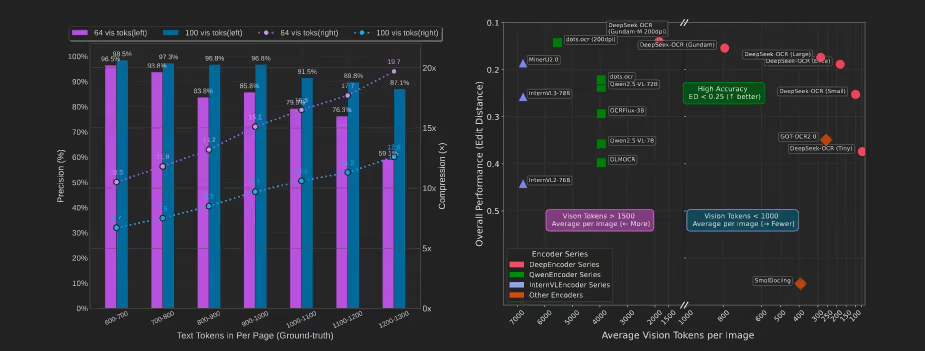
DeepSeek OCR highlights strong results on specialized benchmarks, including the FOX dataset, often used to evaluate information extraction on structured administrative documents. This kind of evaluation sits within a broader intelligent document processing approach, where the goal is no longer just reading text, but extracting reliable, usable information.
What the FOX dataset actually measures
The FOX dataset focuses on high-density documents with repeated structures, named entities, and implicit relationships. Strong results on this benchmark typically indicate the ability to capture document structure beyond plain character recognition.
The table below helps compare the reported performance across several dimensions: accuracy, document type, average input length, and test assumptions.
Context compression: what does it really mean?
When DeepSeek OCR mentions “10x compression,” it does not mean compressing source files. It refers to shrinking the internal representations used by the model (tokens). The goal is to preserve the essential information while reducing the memory required to process long contexts.
DeepSeek OCR overall architecture
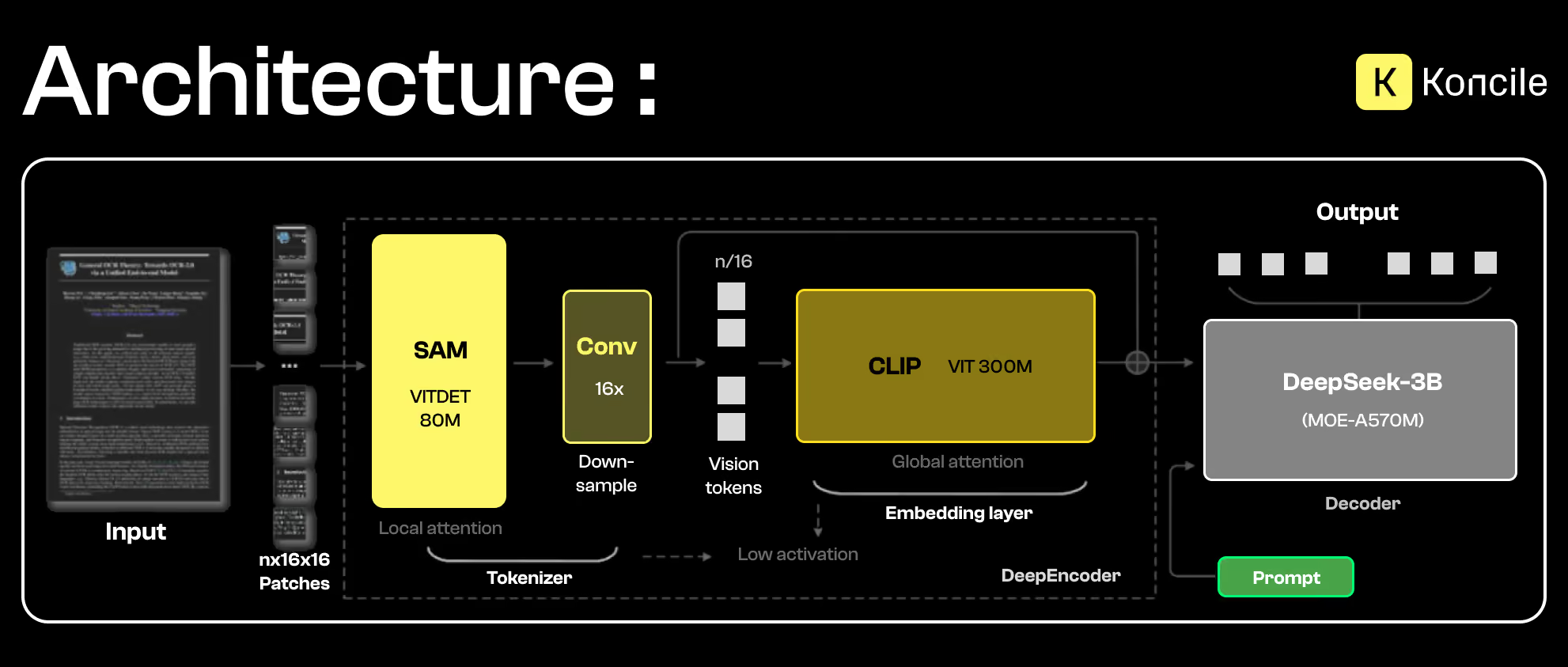
DeepSeek OCR separates visual encoding from text decoding, connected through a mechanism that compresses intermediate representations.
1 - Vision encoder: combining local and global understanding
DeepSeek OCR’s vision encoder relies on two complementary components designed to process visual information at different levels.
On one side, SAM (Segment Anything Model) supports segmentation and local image analysis. Thanks to its local attention behavior, it can identify relevant regions of a document such as text blocks, tables, margins, and visual separators. This step is key to capturing fine details, contours, and spatial structure.
On the other side, CLIP (Contrastive Language–Image Pretraining) contributes a more global and semantic understanding. Unlike SAM, CLIP is not focused on local details; it maps the image into a semantic space aligned with language, which helps associate detected regions with concepts, intents, or broader document structures.

By combining both approaches, DeepSeek OCR produces a visual representation that is both precise and contextual. SAM provides a structured, fine-grained reading of the document, while CLIP supports global interpretation. This enriched representation becomes the basis for context compression and text generation, before the decoder steps in.
2 - MoE decoder: efficiency and specialization
MoE, or Mixture of Experts, is an increasingly common model architecture. As the name suggests, it can be viewed as a mixture of specialized experts, each focused on a specific kind of pattern. Each “expert” is a sub-network, and the whole system is controlled by an intelligent router that decides which experts should process a given request.
The idea is to activate only the resources needed for the user’s request and avoid unnecessary computation. This approach also enables very large models with extremely high total parameter counts without necessarily increasing inference cost proportionally. Experts can specialize strongly in their domains, improving output quality. Finally, at comparable density and scale, MoE architectures often deliver faster inference than fully dense models.
In simple terms, it is like going to a hospital and being routed directly to the most relevant department, rather than seeing a general practitioner who is decent at many topics but not truly specialized in any.
MoE can improve inference efficiency, but quality depends heavily on routing and the data used.
Key metrics at a glance
These indicators provide a first read of the claimed gains, but they make much more sense once you understand the underlying mechanisms. The table below summarizes the core metrics before diving deeper into the pipeline and memory optimizations.
Document processing pipeline
From image to compressed representation
The pipeline starts by splitting the image into patches. These are analyzed locally to extract relevant visual structures. A compression step then reduces the dimensionality of representations before global contextualization.
This chain aims to reduce redundancy while preserving important relationships between different areas of the document.
Memory and attention optimizations (MLA)
DeepSeek OCR includes attention optimizations designed to reduce the memory footprint of long-context processing. These optimizations help keep performance stable as document size grows.
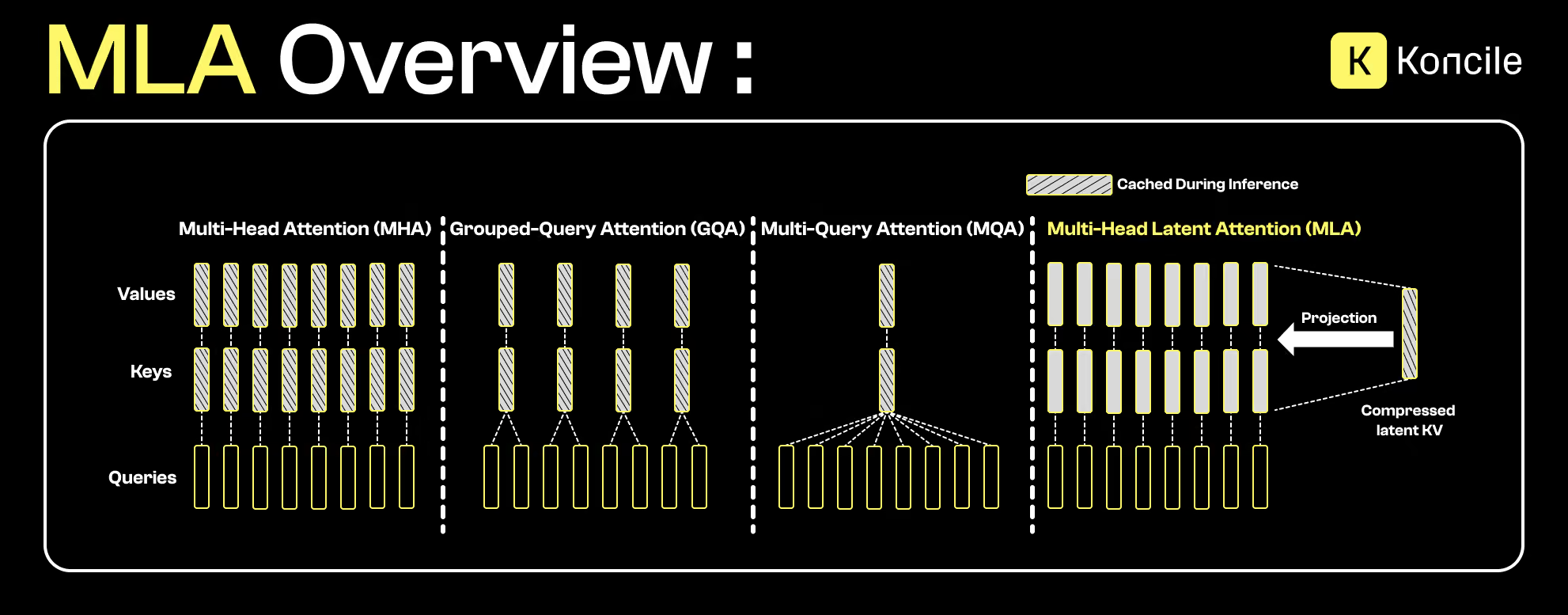
Before introducing Flash MLA, it helps to understand the idea behind Multi-Head Latent Attention (MLA).
Unlike standard attention mechanisms, where keys and values (KV) are stored explicitly for each attention head, MLA projects this information into a compressed latent space. This keeps essential token relationships while drastically reducing the KV-cache memory required at inference.
In practice, MLA can be seen as an evolution of approaches such as Multi-Query Attention (MQA) or Grouped-Query Attention (GQA). Where those methods partially share keys and values, MLA goes further by compressing the representation itself. This is especially relevant for long contexts, where KV-cache memory becomes the limiting factor.
Flash MLA: hardware-level acceleration

DeepSeek OCR uses Flash MLA, an optimized implementation of latent multi-head attention. It leverages NVIDIA GPU kernels to speed up computation while reducing memory needed for the KV cache. Performance can remain stable even when memory is reduced significantly.
Flash MLA’s benefits are practical: less memory without a proportional quality drop, reduced “lost in the middle” behavior, longer contexts without memory saturation, and improved energy efficiency.
What this changes in practice for OCR
When the gains can be significant
Large, heterogeneous, weakly standardized documents with internal dependencies can benefit from better global context handling. Archives, legal files, and multi-section reports often fall into this category.
When the impact can be limited
For short, highly structured documents that are already well segmented, the benefits of advanced context compression may be marginal. In those cases, integration and maintenance costs should be weighed against the real-world gain.
Limits and practical cautions
Like any advanced approach, DeepSeek OCR comes with constraints. Compression can cause loss of fine-grained information in specific cases. The architecture also relies on multiple pre-trained components, which can make adaptation to very specific contexts more challenging.
Finally, deployment and optimization complexity remains a key factor in production environments.
From lab to production: industrializing document extraction
In production settings, these advances raise another question: how do you turn technical capabilities into systems that are reliable, controllable, and scalable?
Solutions like Koncile follow that logic. Rather than maximizing context compression at all costs, the production priority is robust extraction, field traceability, and the ability to adapt to a wide range of real documents. In practice, the value often comes from integration into a clear document workflow, with validation and operational controls.
In that kind of system, context handling is not only about model size or latent compression. It also relies on structuring, validation, and business-level controls to keep extraction quality stable on long or heterogeneous documents, without introducing unpredictable behavior in production.
Conclusion
DeepSeek OCR illustrates a clear direction in modern OCR: moving beyond visual decoding toward smarter context handling. By combining a vision encoder, representation compression, and an MoE-based decoder, the approach aims to process longer documents more efficiently.
Before adopting it, it remains essential to evaluate performance on real documents, integration constraints, and business objectives.
FAQ - DeepSeek OCR

Real life insights on document automation

5 Best French OCR Solutions to Extract Data from Your Documents
French OCR solutions now make it possible to automatically extract data from your invoices, contracts, and accounting documents using optical character recognition, with hosting based in France. Here is a real comparison of all five OCR solutions, corrected against current 2026 figures where vendor claims had gone stale, covering what actually differentiates them beyond the fact that they are all hosted in France.

Document processing and fraud detection: build or buy?
Extracting and structuring document data, enriching it, detecting fraud: with AI, building your own end-to-end solution has never looked so simple. Buying off the shelf still often turns out to be the better option. Here are the thirty-nine difficulties to expect before you start.

In healthcare, an OCR is judged on what it flags, not on what it reads
Every OCR vendor advertises high accuracy rates, and most of them deliver. On a health document, that is not the right buying criterion. What counts is what the tool does when it is not sure, what it lets you verify, and what it guarantees about the data it handles.

Top Healthcare OCR Tools: HIPAA Compliance and What the Clinical Evidence Shows
Amazon Textract has been formally HIPAA-eligible since October 2019. Most healthcare OCR comparisons never mention that, or check which of the other four tools on their list actually offer a signed BAA. Here is a rebuild that checks compliance status directly, and looks at what the real clinical trials on ambient AI scribes actually found, not just what the marketing claims.
Best Accounting Software for Sole Proprietors and Freelancers in 2026
A freelancer sending a dozen invoices a month can blow through Xero's cheapest plan by week three, and a $19-a-month FreshBooks account caps out at five clients. The number on a pricing page is rarely the number you actually pay. Here is a real comparison of QuickBooks, Xero, Wave, and FreshBooks built for a business of one, not a growing team.