Contents
- Mistral vs ChatGPT at a glance
- How we compared Mistral and ChatGPT
- What are Mistral AI and ChatGPT in 2026?
- Is Mistral better than ChatGPT?
- Pricing: Vibe plans, ChatGPT plans and API costs
- Privacy, data location and GDPR
- Which is better for documents and OCR?
- Mistral or ChatGPT: which should you choose?
- When the document itself is the risk
- Frequently asked questions
Mistral AI and ChatGPT now answer different needs. ChatGPT is the broader assistant, with the larger model range and the most features in one app. Mistral is the European option: cheaper paid plans, open-weight models you can host yourself, data kept in the EU by default and a dedicated OCR model for documents. If your work is reading invoices and PDFs, the comparison that matters is invoice OCR: Mistral sells a specialized document model, while OpenAI reads files through its general models. Every price, model name and data rule below was checked on the official Mistral and OpenAI pages on November 8, 2026.
This page first ran in March 2025 as a single invoice test of Mistral OCR against ChatGPT 4.5. That test is still here, clearly dated, but both vendors have replaced those versions since, so the comparison now covers the two products as they stand today.
Mistral vs ChatGPT at a glance
The table sums up the differences a team asks about first: the assistant you would use every day, the flagship model behind it, what a paid seat costs, where your data sits by default and whether a dedicated OCR model exists.
| Criterion | Mistral AI | ChatGPT (OpenAI) |
|---|---|---|
| Assistant app | Vibe (formerly Le Chat) | ChatGPT |
| Flagship API model | Mistral Large 4, open weights | GPT-6 Astra, closed |
| Individual paid plan | Pro, $14.99 a month | Plus and Pro, amount not shown |
| Team plan | $24.99 per user a month | Business, from 2 users |
| Default data location | European Union | Region on approval (API) |
| Dedicated OCR model | Yes, OCR 4.1 | No, file inputs |
| Self-hosting | Yes, open-weight models | No |
How we compared Mistral and ChatGPT
We read the vendors' own pages on November 8, 2026: mistral.ai/pricing, the Mistral models overview and API pricing in docs.mistral.ai, the Mistral OCR documentation and the OCR 4 announcement, the Mistral help center article on data storage, chatgpt.com/pricing, and the OpenAI developer pages on models, file inputs and data controls. When a page did not show a figure, we say so instead of filling the gap. We also read the ten pages that rank for this question in the United States, including the TechRadar test, Carly's guide and the main r/MistralAI thread, to cover what readers expect and to correct what has aged. Koncile publishes this page; it builds document extraction and document fraud detection, and competes with neither assistant.
What are Mistral AI and ChatGPT in 2026?
Both companies sell the same two things: a chat assistant for people and an API for developers. They differ in how open their models are and in how far each product reaches beyond chat.
Mistral AI: Vibe and open-weight models
Mistral was founded in April 2023 by Arthur Mensch, Guillaume Lample and Timothée Lacroix. Its assistant, long known as Le Chat, is now called Vibe (the rename dates from May 28, 2026, according to Carly's guide): Mistral states that conversations, settings and plans carried over. Vibe combines a work assistant (chat, search, documents, connectors to more than 100 tools) and a coding agent that runs in the terminal, the IDE or the browser.
On the API side, the current lineup lists Mistral Large 4 (open weights, general purpose and multimodal), Mistral Small 4 (instruct, reasoning and coding in one model, Apache 2.0), the small Ministral 3 models, Codestral for code, Voxtral for speech and OCR 4.1 for documents. Older names you will still see in comparisons, such as Mistral Medium 3.5, Mistral Large 3 or Magistral, are marked deprecated or retired in the Mistral documentation.
ChatGPT: one app, a wide model range
ChatGPT comes in Free, Go, Plus and Pro plans for individuals, and Business and Enterprise for companies. On the API, OpenAI recommends GPT-6 Astra for complex reasoning and coding, GPT-6.1 Sol to balance cost and quality, GPT-6.1 Terra for fast visual reasoning and GPT-6 Luna for high-volume work. All four accept text and images, offer a context window of 1.05 million tokens and support functions, web search, file search and computer use.
ChatGPT's strength is breadth: deep research, image creation, voice, memory, projects, scheduled tasks and custom GPTs live in the same app, and the paid plans unlock the reasoning models.
Is Mistral better than ChatGPT?
Neither vendor publishes a head-to-head test against the other, so any "better" depends on the task and on who ran the test. Two recent third-party tests point the same way. École Cube, updated October 20, 2026, gave ChatGPT three rounds out of four (image generation, PDF analysis, image recognition) and Mistral the creative writing round, where its story was livelier but ignored the length limit. PureThemes, in a documentation chatbot test run on July 27, 2026, scored GPT-5.6 Terra 9.8 out of 10 and Mistral Medium 3.5 8.8: correct core answers, but missing caveats. Both tests used models that have since been replaced, which is the main weakness of most pages on this question.
Older head-to-heads reach the same split. TechRadar's Eric Hal Schwartz compared the then new Le Chat app with ChatGPT on February 12, 2025, on everyday prompts (advice on making friends, a riddle, explaining a mortgage, a fantasy image): both handled everything, Le Chat was faster but "a little brusque and somewhat broad", ChatGPT sounded more human and drew the dragon with wings, and the author leaned toward ChatGPT while noting he might pick Le Chat if he lived in Europe.
Users describe the same trade-offs. In a long r/MistralAI thread started in October 2025 by a European user moving away from ChatGPT, people praised Mistral's speed, the sources cited under each answer even on the free plan, the document library, deep research reports and MCP connectors, and the price; the complaints were weaker image editing, more hallucinations on personal questions and file handling that needs explicit instructions. Several put Mistral close to GPT-4o at the time, and one reply months later reminded readers that both products had changed a lot since, which is why dated tests matter.
What holds across tests: ChatGPT is the safer choice for reasoning, multimodal work and following precise instructions. Mistral wins on cost, European data hosting and control, since you can run its open-weight models on your own servers. As Carly's comparison guide (July 14, 2026) puts it, by 2026 both are strong enough that the choice comes down to constraints rather than raw intelligence.
Pricing: Vibe plans, ChatGPT plans and API costs
Mistral Vibe. Free (limited messages, web searches and coding sessions), Pro at $14.99 a month before tax, Team at $24.99 per user a month, and Enterprise on quote with private deployments, audit logs and SAML SSO. Verified students pay $5.99 a month for Pro.
ChatGPT. The official pricing page lists Free, Go (which may include ads), Plus, Pro in three usage tiers, Business (monthly or annual, from 2 users) and Enterprise (annual). On November 8, 2026, the page did not display the amounts to our reader. Carly's guide of July 14, 2026 listed Go at $8, Plus at $20 and Pro at $200 a month, and notes that Go does not unlock the top model or the full agent toolset; we could not confirm these amounts on OpenAI's page, so check chatgpt.com/pricing for the price in your region before budgeting.
APIs. Both vendors bill per million tokens, input and output counted separately. The table compares the published standard prices of the main models; Mistral also offers a 50% discount on batch processing.
| Model | Vendor | Input | Output |
|---|---|---|---|
| GPT-6 Astra | OpenAI | $10 | $50 |
| GPT-6.1 Sol | OpenAI | $2 | $10 |
| GPT-6.1 Terra | OpenAI | $1 | $5 |
| GPT-6 Luna | OpenAI | $0.10 | $0.50 |
| Mistral Large 4 | Mistral | $0.70 | $2.10 |
| Mistral Small 4 | Mistral | $0.15 | $0.60 |
Prices in US dollars per million tokens, read on the vendors' pages on November 8, 2026. The flagship gap is large: Mistral Large 4 costs about a fourteenth of GPT-6 Astra on input. At the small end, GPT-6 Luna is cheaper than Mistral Small 4.
Privacy, data location and GDPR
This is where the two differ most for a European company, and where many comparisons overstate the case.
Mistral. Its help center states that data is hosted in the European Union by default, unless you call its US endpoint. It also says that, depending on the feature, data can be temporarily transferred outside the EU to the subprocessors listed in its Trust Center, under standard contractual clauses, and that Enterprise customers can switch some of those features off. The pricing table shows model training as opt-out on the Free, Pro and Team plans. Open-weight models can run on your own infrastructure, and OCR 4 can be self-hosted in a single container by enterprise customers.
OpenAI. Data sent to the API has not been used for training since March 1, 2023, unless you opt in. Abuse monitoring logs are kept up to 30 days by default; Zero Data Retention requires OpenAI's approval. Data residency is set per project, for eligible customers, with regions such as the EU served through eu.api.openai.com; a 10% uplift applies to models released on or after March 5, 2026, and any region other than the United States requires approved retention controls. On the ChatGPT plans listed in the privacy table of its pricing page, training on your content is opt-out.
So "your data never leaves Europe" is too strong for Mistral, and "OpenAI keeps everything in the US" is out of date. The real difference: EU hosting is Mistral's default, while at OpenAI it is an option you apply for.
Which is better for documents and OCR?
Here the products are built differently. Mistral sells a model made only for documents; OpenAI lets its general models read files.
Mistral OCR 4.1
Mistral released OCR 4 on June 23, 2026, and OCR 4.1 is now its latest OCR model. It returns the text with paragraph-level bounding boxes, block labels (titles, tables, signatures and more) and confidence scores by page, block or word, and handles PDF, DOCX, PPTX and images in more than 40 languages according to the documentation (170 according to the launch post). The API price is $4 per 1,000 pages for OCR 4.1 and $2 for OCR 3, with half price through the batch API. Mistral reports a score of 85.20 on OlmOCRBench and a 72% average win rate in blind human comparisons on more than 600 documents, and calls these benchmarks "directional", recommending tests on your own documents. Per-field reliability scores matter in practice, because they decide which values go straight into your system; our guide to the OCR confidence score explains how teams set review thresholds.
ChatGPT and the OpenAI API
OpenAI has no dedicated OCR model. Through the Responses API, a PDF sent to a vision model is read twice: its text layer is extracted and its pages are passed as images. A detail setting (low, high or auto) trades tokens for visual precision on small print and dense tables; since GPT-5.6, auto means high. Word and PowerPoint files are read as text only. The result is flexible, since you can ask for any output format, but you get no bounding boxes or per-word confidence, and the cost depends on tokens rather than pages. Our test of LLM invoice extraction shows where general models still drop fields.
Our March 2025 invoice test (older versions)
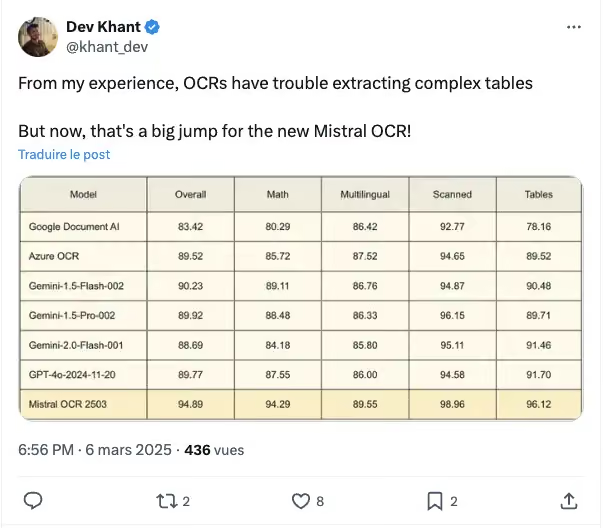
In March 2025, Mistral launched its first OCR model with a claimed 94.9% accuracy, and developers on X greeted it as a leap for table extraction. We put that model and ChatGPT 4.5 through the same invoice, and sorted each error into missing data, misplaced data and incorrectly transcribed data. Both versions are gone: Mistral retired that OCR model in December 2025.
Mistral's first OCR read the invoice below. The table lists, for each type of error, how many fields were affected and the share of the invoice they represent.
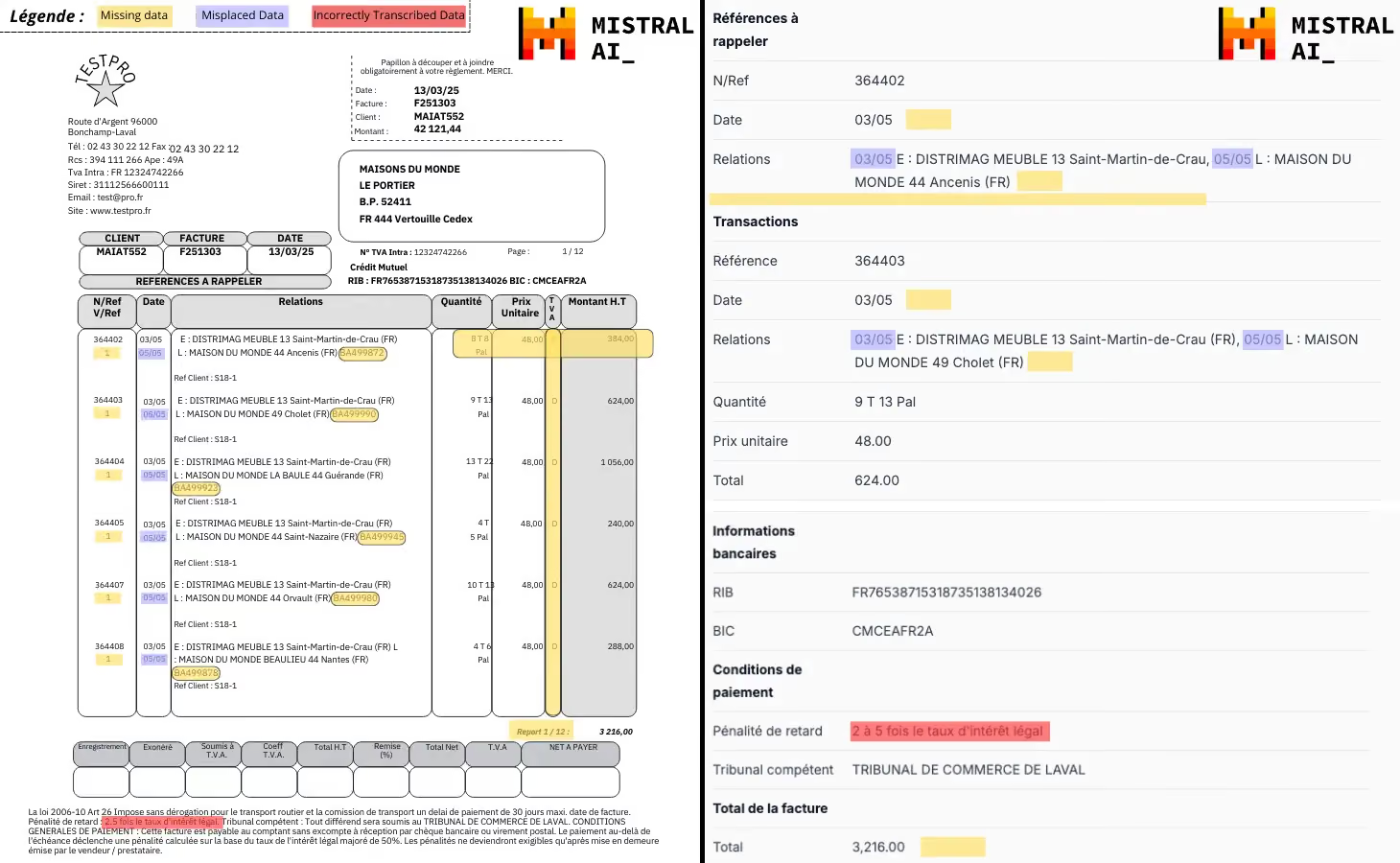
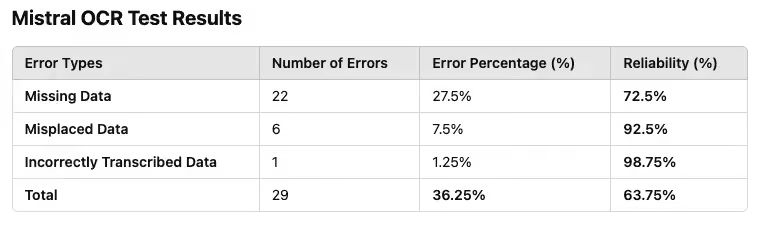
Mistral reached 63.75% overall reliability: it transcribed what it read almost perfectly (98.75%) but left out 27.5% of the data. ChatGPT 4.5 read the same invoice below.
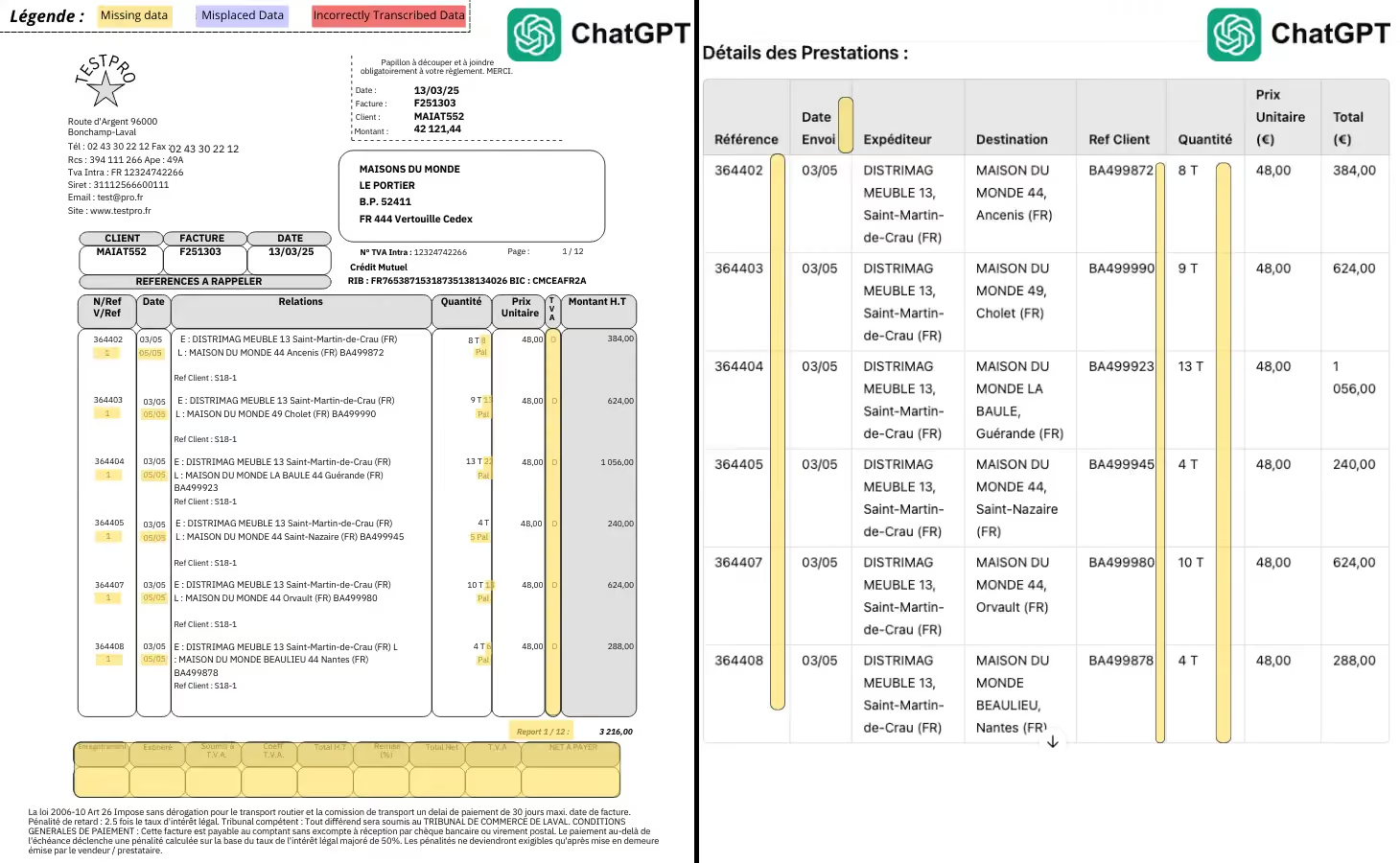
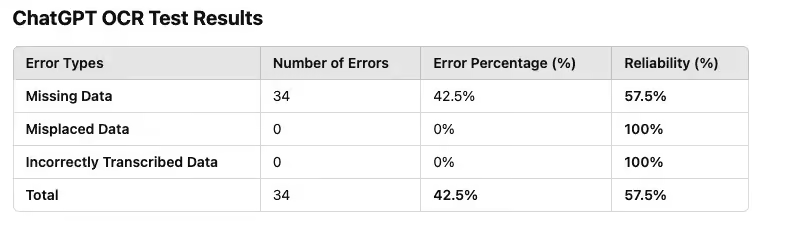
ChatGPT scored 57.5%: it placed the data it found in the right fields, but lost 42.5% of the information. Neither model delivered a complete invoice. The lesson still holds with today's versions: a high benchmark score says little about missing fields on your own documents, so test on a sample of your real files before choosing.
Mistral or ChatGPT: which should you choose?
Choose Mistral if your data must stay in Europe by default. EU hosting without an application, open-weight models you can run in house, and an Enterprise plan that can switch off transfers outside the EU fit regulated teams in finance, health and the public sector.
Choose Mistral for high-volume document reading. A dedicated OCR model billed per page, with bounding boxes and confidence scores, is easier to budget and to audit than token-billed file reading.
Choose ChatGPT for the widest range of tasks. Reasoning, research, image creation, voice and a large app ecosystem in one subscription suit teams that want one assistant for everyone.
Choose ChatGPT when output quality matters more than cost. In the recent third-party tests we read, OpenAI models followed instructions more closely and kept more caveats.
Use both when you can. Many teams keep ChatGPT for daily work and call Mistral's API for sovereign or high-volume pipelines; the two do not exclude each other.
When the document itself is the risk
Mistral and ChatGPT read what a document says. Neither checks whether the document is genuine, and both will extract a forged invoice as faithfully as a real one. That is the gap Koncile fills, and the only reason it appears on this page.
Koncile extracts invoices, bank statements, pay stubs and IDs into structured fields, each with a confidence score from 0 to 1, and checks the file in three layers: the image, for editing artefacts; the raw PDF, with its metadata, saved versions, fonts and the library that wrote it; and the business logic, such as totals that do not add up. The result is a score from 0 to 100 that tells your team where to look in cases of invoice fraud, a screening signal rather than a verdict.
Its limits, said plainly: Koncile is not a general assistant and will not write, code or research for you; it works on files you have already received, not in the app where a customer photographs a document; and a fine edit made in a specialist tool and then flattened into a new image can still slip through. Pricing starts with a plan sized to test on reasonable volumes, then grows with your volume.
Frequently asked questions
Is Mistral better than ChatGPT?
Not overall. ChatGPT won most rounds in the recent third-party tests we read, on reasoning, PDF analysis and images. Mistral is better on price, on European data hosting by default and on control, since its open-weight models can run on your own servers.
How is Mistral AI different from ChatGPT?
Mistral publishes open-weight models you can self-host, keeps data in the EU by default and sells a dedicated OCR model. ChatGPT runs only on OpenAI's closed models and packs more features into one app, from deep research to image creation and voice.
Are Mistral AI models free?
Partly. Vibe has a free plan with limited messages and searches, and its open-weight models, such as Mistral Small 4 under Apache 2.0, can be downloaded. Mistral's pricing FAQ adds that commercial deployments require a Mistral license with separate terms, and the API is billed per token.
Is Le Chat still available?
Yes, under a new name. Mistral renamed Le Chat to Vibe, and states that conversations, settings and plans carried over. The Pro plan costs $14.99 a month before tax, as checked on November 8, 2026.
Which is better for OCR, Mistral or ChatGPT?
For pure text extraction at scale, Mistral OCR 4.1: it is built for documents, priced at $4 per 1,000 pages and returns bounding boxes and confidence scores. ChatGPT is more flexible when you need to ask questions about a document, but bills by tokens and gives no per-word confidence.
What shouldn't you tell ChatGPT?
Anything your company or the law does not allow you to share with a third party: customer personal data, health records, credentials or confidential contracts. On ChatGPT plans, training on your content is opt-out, and API data is not used for training unless you opt in.