Driver onboarding process: managing license and vehicle documents at scale
Why driver and vehicle documents slow down driver onboarding at scale.
.avif)
As companies scale their operations, driver onboarding quickly shifts from a simple administrative step to a critical operational challenge. Licenses, vehicle documents, and compliance checks can silently slow down growth if they are not managed properly from day one.
Why driver onboarding processes break down at scale
Driver onboarding often works smoothly when teams manage a small number of drivers. Problems usually emerge when volumes increase, operations expand across regions, or multiple stakeholders become involved in the process.
Companies hiring drivers at scale, whether for fleet management, logistics, delivery, or transportation services, must handle recurring onboarding cycles. Each new driver brings a set of documents to review, validate, and archive. Over time, manual workflows struggle to keep up with this volume.
Operational friction typically appears when onboarding relies on email exchanges, spreadsheets, or shared folders. Documents are submitted in different formats, follow inconsistent naming conventions, or arrive incomplete. As a result, onboarding timelines extend, and teams spend more time chasing missing information than onboarding drivers.
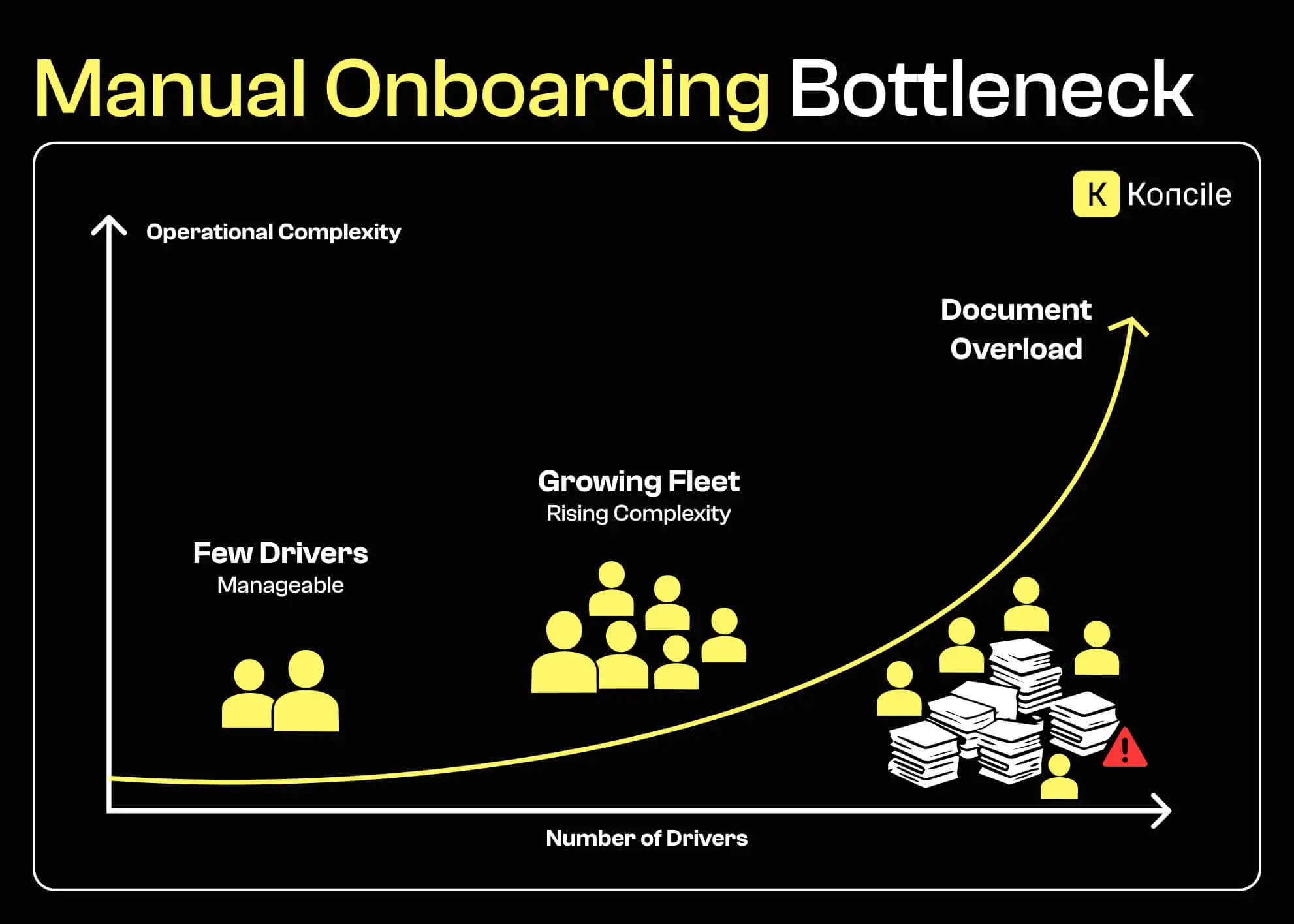
As driver onboarding volumes grow, document handling often becomes the first operational bottleneck companies encounter.
Which driver and vehicle documents are involved in onboarding
Driver onboarding processes almost always involve a combination of driver documents and vehicle documents. While requirements vary by country or state, the core document set remains relatively consistent across industries.
Driver documents generally include a valid driver’s license, sometimes accompanied by additional identification or certification depending on the role, especially when handling driver’s license documents at scale. Vehicle documents often include a vehicle registration certificate, proof of ownership, or documents issued by local authorities such as the DMV in the United States.
For fleet-based operations, onboarding may also require verifying that a driver is associated with a specific vehicle, which adds another layer of document dependency. In these cases, driver onboarding is no longer limited to individual compliance but extends to vehicle eligibility as well.
Are driver onboarding document requirements the same across industries?
No. While most driver onboarding processes rely on a common core of documents, such as a driver’s license and vehicle registration, additional requirements often depend on the industry. Logistics, ride-hailing, delivery, and fleet operations may require extra certifications, insurance coverage, or vehicle-specific documents.
Industry-specific regulations and operational risk profiles explain why document requirements can vary significantly between companies, even within the same country.
Do companies need to verify vehicle documents for every driver?
Not always, but it is common in fleet-based and vehicle-dependent operations. When drivers are assigned to specific vehicles, companies are typically required to verify that the vehicle meets regulatory and operational standards before onboarding is completed.
This creates a dependency between driver documents and vehicle documents that must be managed consistently to avoid delays.
Common document-related issues companies face during driver onboarding
Document-related issues are one of the most frequent causes of onboarding delays. These problems are rarely isolated incidents and tend to repeat as onboarding volumes grow.
Incomplete submissions are common, especially when drivers upload documents manually without guidance. Inconsistent data between driver licenses and vehicle documents can trigger additional verification steps. That cross-check between licence, registration certificate and claims history is what Toyota Assurances automated on its underwriting files. Variations in document formats, image quality, or language further complicate document reviews.
Administrative delays also play a role. Documents issued or validated by public authorities may take time to process, and companies often have little visibility into these timelines. When onboarding depends on these documents, operations slow down.
Why are document issues more frequent during large-scale driver onboarding?
As onboarding volumes increase, document variability increases as well. Drivers submit files from different devices, in different formats, and interpret requirements differently. Without standardized processes, these variations lead to higher error rates.
At scale, even minor inconsistencies can multiply into significant operational delays.
Why do document errors delay driver onboarding?
Document errors require additional checks, clarification requests, and sometimes resubmissions. Each correction introduces friction into the onboarding workflow and increases operational costs.
Why manual license and document checks don’t scale for businesses
Manual document checks can be effective for small teams, but they rarely scale. As driver onboarding volumes increase, manual reviews become time-consuming and error-prone.
Teams must visually inspect each driver license, compare it against internal requirements, and ensure vehicle documents are consistent. This process is difficult to standardize, especially when documents vary by region or authority.
Manual workflows also lack traceability. Tracking who reviewed a document, when it was validated, and why it was approved becomes increasingly complex. Over time, this creates blind spots in compliance and makes audits harder to manage.
How much time do manual document checks typically consume?
Manual document checks may take only a few minutes per driver at low volume, but at scale, they quickly accumulate. Reviewing licenses, cross-checking vehicle documents, requesting corrections, and tracking approvals can consume hours of operational time each day. As document volumes increase, many companies begin exploring automation technologies such as OCR to reduce manual workload and improve consistency.
Why is traceability difficult in manual onboarding workflows?
Manual workflows often rely on email threads, spreadsheets, or shared folders. These tools are not designed to track who validated which document, under what conditions, and at what time.
Without structured traceability, audits become harder and compliance risks increase.
Manual document verification may work for small teams, but it quickly turns into a cost and risk factor at scale.
Compliance and regulatory risks tied to driver and vehicle documents
Driver onboarding is not only an operational concern; it is also a compliance challenge. In many jurisdictions, companies are responsible for ensuring that drivers and vehicles meet regulatory requirements before operations begin.
Failure to properly verify driver licenses or vehicle registration documents can expose companies to fines, legal liability, or operational shutdowns. Regulatory requirements may differ across states or countries, adding complexity for businesses operating in multiple regions. Poor document verification processes not only slow down onboarding but also increase exposure to document fraud, especially when controls remain manual or inconsistent.
Audits further increase pressure on onboarding processes. Without clear documentation trails, companies may struggle to demonstrate that proper checks were completed during onboarding.
Who is legally responsible for document compliance during onboarding?
In most jurisdictions, companies are responsible for ensuring that drivers and vehicles meet regulatory requirements before allowing operations to begin. Even when drivers submit their own documents, the obligation to verify compliance often remains with the company.
This makes document verification a legal responsibility, not just an administrative task.
How do regulatory differences impact multi-region onboarding?
Companies operating across multiple states or countries must adapt to varying regulatory frameworks. Document formats, validation rules, and renewal cycles may differ significantly, increasing the complexity of onboarding workflows.
Without a structured approach, these differences can lead to compliance gaps.
What happens if driver documents are non-compliant?
Non-compliant documents can invalidate contracts, delay operations, or trigger penalties during audits.
How companies modernize driver document management within onboarding workflows
To address these challenges, many companies are rethinking how driver documents are handled within onboarding workflows. Rather than treating document checks as a standalone task, they are integrating document management directly into structured onboarding processes.
Modern approaches focus on standardizing document requirements, improving data consistency, and reducing manual handling. This allows onboarding teams to process driver documents more efficiently while maintaining compliance visibility.
What does structured document management mean in driver onboarding?
Structured document management means treating driver and vehicle documents as standardized data inputs rather than unstructured files. Requirements are clearly defined, validation rules are consistent, and document status is visible throughout the onboarding process.
This approach improves efficiency, compliance, and audit readiness.
Some companies rely on document automation platforms such as Koncile to support these workflows, especially when onboarding large fleets or managing driver onboarding across multiple regions. The goal is not only faster onboarding, but also better operational control and audit readiness.
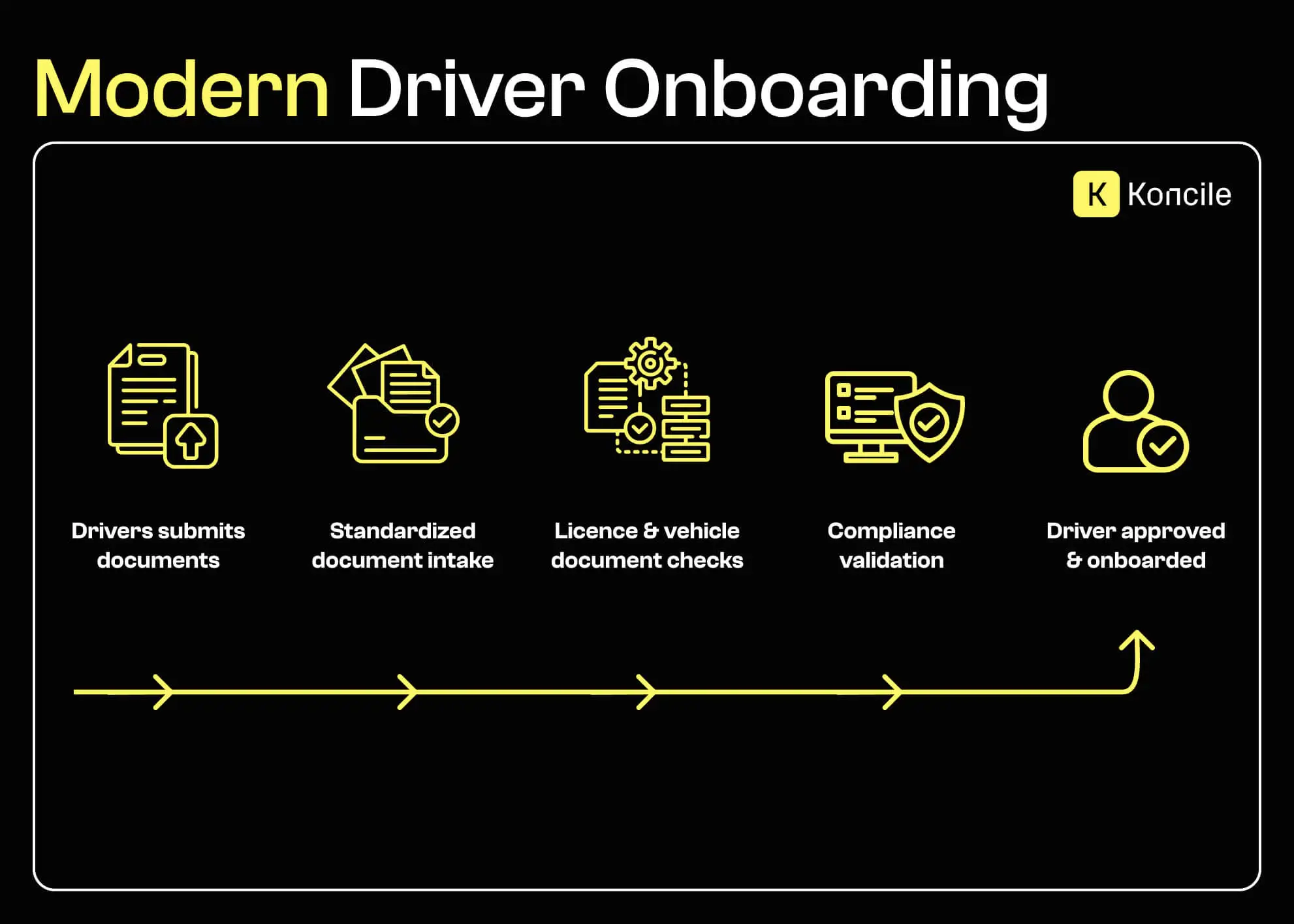
Modern onboarding workflows treat driver and vehicle documents as structured data, not just files to review.
Conclusion
Driver onboarding processes increasingly depend on the ability to manage driver licenses and vehicle documents at scale. As operations grow, manual document checks become a bottleneck that impacts speed, compliance, and operational efficiency. Companies that modernize how they handle driver and vehicle documents are better positioned to scale onboarding without sacrificing control or compliance.

Real life insights on document automation

5 Best French OCR Solutions to Extract Data from Your Documents
French OCR solutions now make it possible to automatically extract data from your invoices, contracts, and accounting documents using optical character recognition, with hosting based in France. Here is a real comparison of all five OCR solutions, corrected against current 2026 figures where vendor claims had gone stale, covering what actually differentiates them beyond the fact that they are all hosted in France.

Document processing and fraud detection: build or buy?
Extracting and structuring document data, enriching it, detecting fraud: with AI, building your own end-to-end solution has never looked so simple. Buying off the shelf still often turns out to be the better option. Here are the thirty-nine difficulties to expect before you start.

In healthcare, an OCR is judged on what it flags, not on what it reads
Every OCR vendor advertises high accuracy rates, and most of them deliver. On a health document, that is not the right buying criterion. What counts is what the tool does when it is not sure, what it lets you verify, and what it guarantees about the data it handles.

Top Healthcare OCR Tools: HIPAA Compliance and What the Clinical Evidence Shows
Amazon Textract has been formally HIPAA-eligible since October 2019. Most healthcare OCR comparisons never mention that, or check which of the other four tools on their list actually offer a signed BAA. Here is a rebuild that checks compliance status directly, and looks at what the real clinical trials on ambient AI scribes actually found, not just what the marketing claims.
Best Accounting Software for Sole Proprietors and Freelancers in 2026
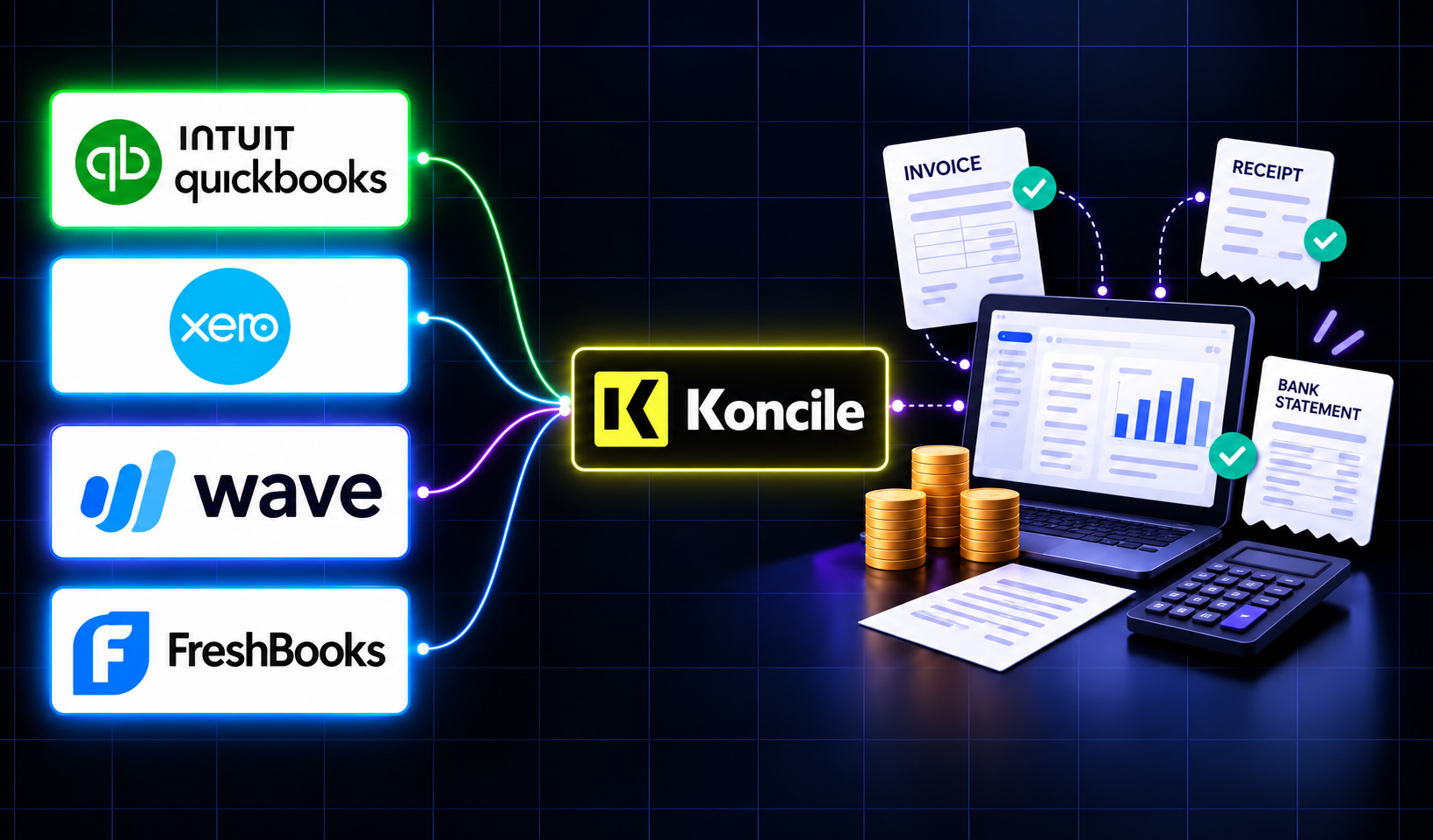
A freelancer sending a dozen invoices a month can blow through Xero's cheapest plan by week three, and a $19-a-month FreshBooks account caps out at five clients. The number on a pricing page is rarely the number you actually pay. Here is a real comparison of QuickBooks, Xero, Wave, and FreshBooks built for a business of one, not a growing team.