
OCR API that understands your documents
Extract, split, classify docs with high accuracy with LLM intelligence. Integrate our API in minutes, not weeks.

Trusted by product teams and regulated organizations






Document types
Fraud detection models, tailored to every document
Every document has its own fraud patterns. We build specialized models to detect them.


Source documents
JSON or CVS data
Document types
Fraud detection models, tailored to every document
Every document has its own fraud patterns. We build specialized models to detect them.
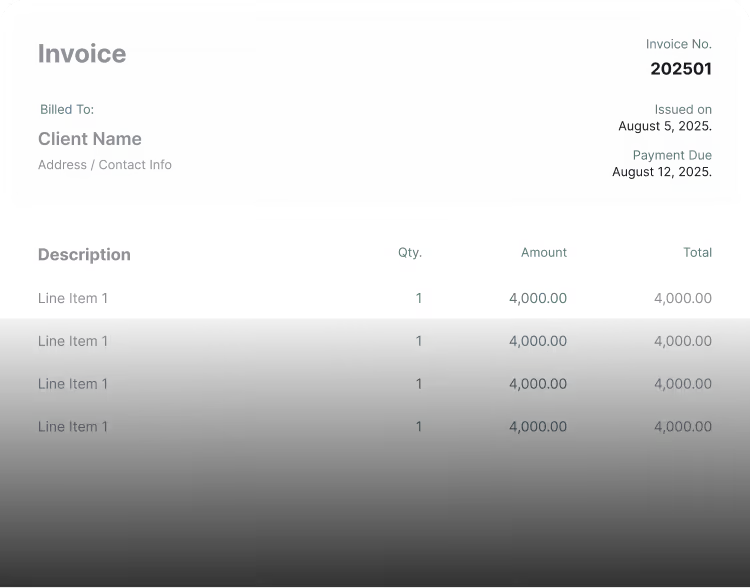
Invoice fraud
Inconsistencies, altered totals and post-issuance modifications.

Paystub
Verify gross-to-net consistency and detect altered income figures.

Bank statement forgery
Detect transaction gaps, balance inconsistencies and edited entries.
W-2 fraud
Extraction des données fiscales : revenus, retenues, identifiants

1099 fraud
Extraction des prescriptions, dosages, médicaments et posologie.

Utility bill fraud
Extraction des données de facture énergie : consommation et tarifs
50m
97%+
5
Koncile vS. Others
Enterprise-grade OCR API built for real workflows
Designed for SaaS platforms, ERP systems and document-heavy operations that require precision, scalability and control.

Security
Build for regulated environments
Founded by a former lawyer, Koncile was designed with compliance and data protection at its core. We are independently audited under SOC 2 and compliant with GDPR and HIPAA requirements.


Capabilities
A complete OCR and document processing API
Go beyond character recognition. Build automated document pipelines.
Data extraction
Structured data from unstructured documents. Every field, every time.
Document Classification
Stop sorting documents manually. Our API recognizes document types instantly.


Handwriting Recognition
Cursive, printed, mixed, our model deciphers every handwritten field with high accuracy.
Table Extraction
Complex tables, merged cells, multi-column layouts, extracted cleanly into structured JSON.
Smart Renaming
From scan_001.pdf to Payslip_Martin_Jan2026.pdf. Automatically.
Intelligent Page Splitting
One PDF, twelve documents? We separate them for you.
Metadata Analysis
See what's behind the document. Author, creation date, modification history.
Confidence Score
Every extracted field comes with a confidence score so you can trust or verify the result.
Détection Falsifications & Fraudes
Identifiez les documents falsifiés et les schémas suspects avant qu'ils ne causent des dommages.

INterface
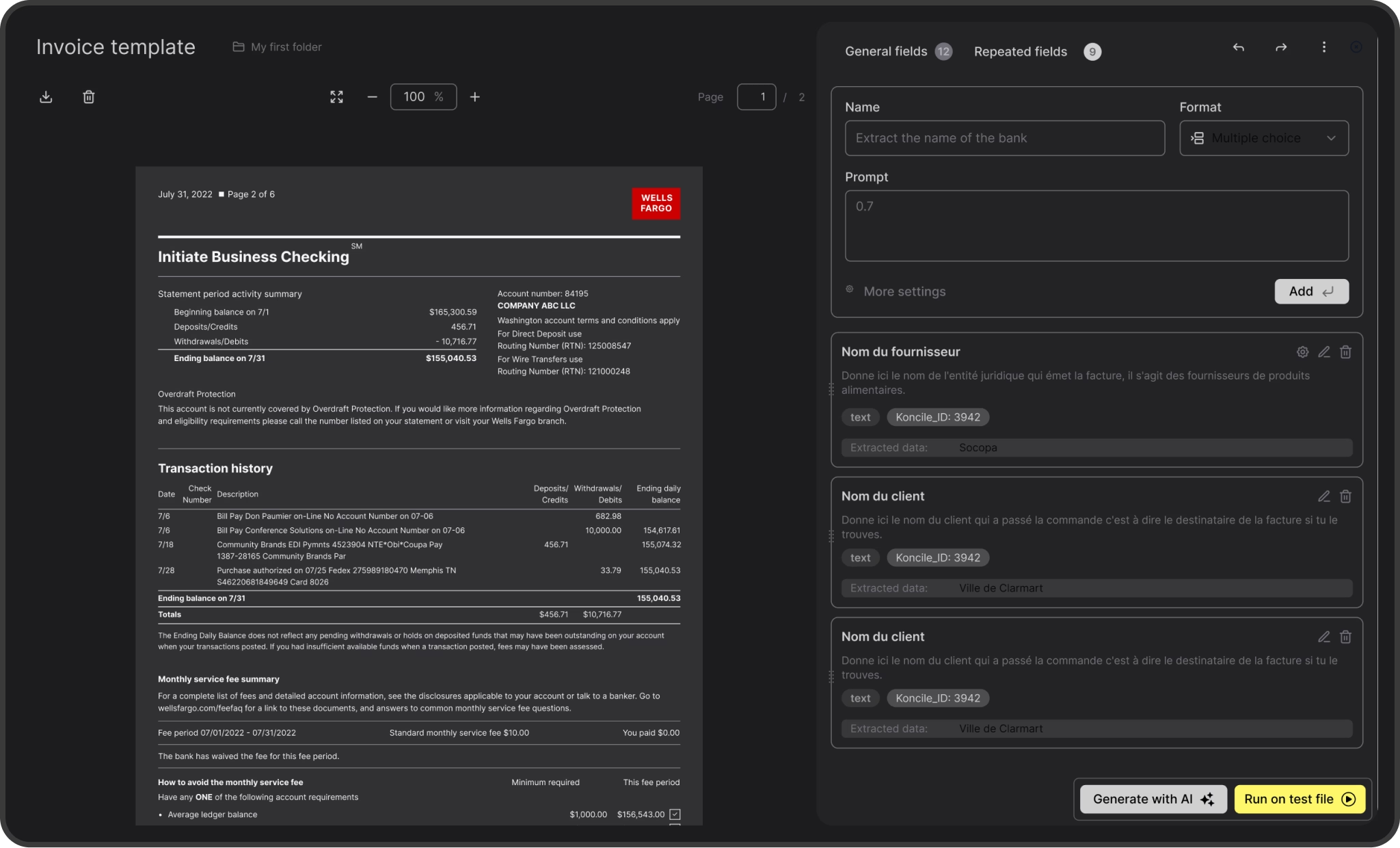
A simple and delightful OCR template editor
Ship enterprise-grade OCR in a day. Your domain experts can configure templates directly, not just your developers.
Our real life insights on OCR API
Fraud investigations, product releases, customer stories and perspectives on how AI is transforming document workflows.
The 10 Best AP Automation Software Platforms for 2026
From Tipalti to AppZen, the accounts payable automation market in 2026 has been reshaped by AI agents, autonomous invoice processing, and deepfake-resistant fraud detection. Here is our comparison of the 10 AP automation software platforms every finance team should know, and how to pick the right one.

5 Best French OCR Solutions to Extract Data from Your Documents
Five French OCR solutions now make it possible to automatically extract data from your invoices, contracts, and accounting documents using optical character recognition, with hosting based in France. Here's our overview.
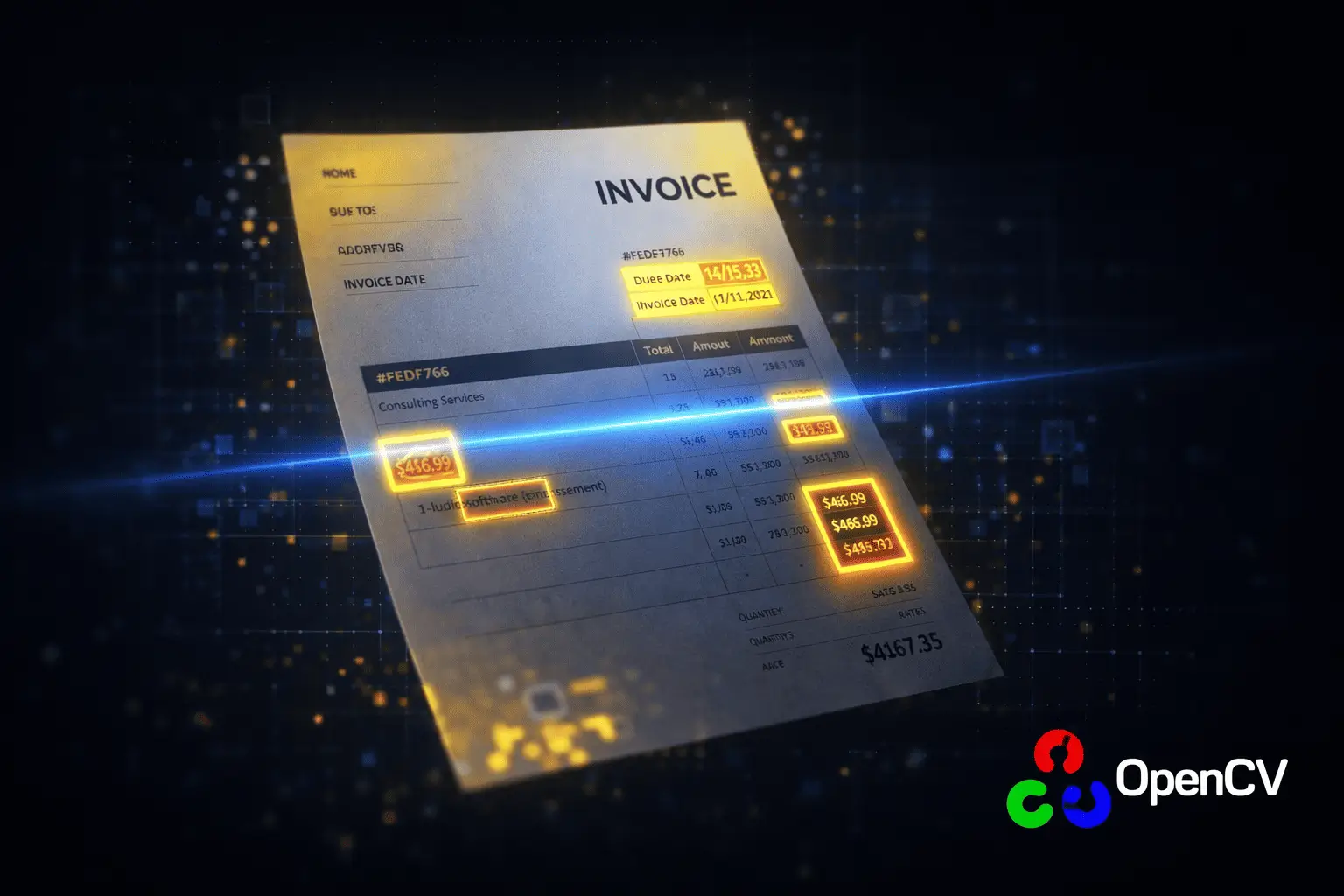
OpenCV in Python: Detecting Document Fraud Through Image Analysis
OpenCV is one of the most widely used computer vision libraries in Python. But can it really detect document fraud? In this article, we test OpenCV on several real-world falsification scenarios: amount modification, signature copy-paste, inpainting removal, and compression analysis (ELA). The objective is simple: understand what visual detection can actually identify and where its limits are.
Your questions about OCR API
Can’t find the answer? Contact us or book a demo to see how Koncile detects document fraud in your workflows.
What is an OCR API?
An OCR API (Optical Character Recognition) is a programmable service that automatically converts images, PDFs, and scanned documents into structured, machine-readable text data. Modern AI-powered OCR solutions go far beyond simple character recognition: they understand document structure, extract specific fields, identify tables, and validate data, all powered by deep learning models trained on millions of documents.
How does AI OCR work?
AI OCR operates in several stages: image preprocessing (orientation correction, resolution enhancement), text zone detection, character recognition via neural networks, structured data extraction, and post-processing with validation. Unlike rule-based traditional OCR, AI OCR relies on Transformer models and large language models (LLMs) to interpret document context, handle complex layouts, and continuously improve accuracy.
What is the difference between traditional OCR and AI OCR?
Traditional OCR simply recognizes characters in an image without understanding their meaning or context. It struggles with handwritten documents, complex layouts, or degraded files, with error rates that can exceed 15%. AI OCR, by contrast, understands the semantic structure of a document, extracts precise information (amounts, dates, names, reference numbers), handles multiple languages simultaneously, and achieves accuracy above 99% on standard documents. It can also detect inconsistencies and flag suspicious documents.
What level of accuracy can I expect from Koncile's AI OCR API?
With Koncile, accuracy rates on high-quality standard documents (invoices, purchase orders, payslips, statements) are consistently very high, thanks to an approach that combines OCR, intelligent data structuring, and configurable consistency checks.
Accuracy depends on several factors: source document quality and resolution, layout complexity, supplier format variability, and the presence of handwritten text.
Unlike traditional OCR tools limited to character recognition, Koncile applies field and table-oriented extraction logic with confidence scores and inconsistency alerts delivering a significantly higher reliability level in demanding operational environments.
Can Koncile's OCR API read handwritten documents?
Koncile can process documents containing handwritten text, but as with any AI-based OCR technology, accuracy is generally lower than on structured printed text.
Performance depends heavily on handwriting legibility, scan quality, and form standardization.
Koncile's approach is context- and field-oriented: when handwriting appears in a structured document (form fields, short annotations), results can be operationally viable, with associated confidence scores.
For critical use cases requiring maximum reliability, it is recommended to combine extraction with validation rules or human review on sensitive fields.
What types of documents can an OCR API process?
An AI OCR API can handle a very wide range of documents: supplier and customer invoices, payslips, bank statements, contracts and commercial agreements, ID cards and passports, tax assessments, administrative certificates, medical prescriptions, delivery notes, purchase orders, expense reports, and various forms.
The most advanced solutions handle scanned documents, native PDFs, and smartphone-captured photos alike.
In which industries is an OCR API used?
OCR APIs are used across many sectors: finance and banking (statement processing, KYC verification, accounts payable automation), human resources (payslip processing, onboarding document checks), legal (contract analysis, document archiving), healthcare (patient records, prescriptions), logistics (delivery notes, labels), insurance (claims management), and public administration (form and correspondence processing).
Wherever documents feed into a business process, AI OCR can automate their handling.
How do I integrate an OCR API into my information system?
Integrating an OCR API into your information system typically relies on REST HTTP calls: you send the document (PDF or image) to a secure endpoint, and the API returns a structured JSON containing the extracted data.
With Koncile, you can either make synchronous calls to retrieve results immediately, or configure webhooks to receive data automatically once processing is complete.
Beyond standard OCR, you define the fields to extract via configurable templates, and the API returns structured data, confidence scores, and consistency alerts.
Ready to be injected into your ERP or business tools. For technical details, see our API documentation.
How fast is an AI OCR API?
Processing speed depends on the architecture and the level of analysis applied to the document.
With Koncile, a single page is typically processed within a few seconds including not only field extraction but also table structuring, confidence score calculation, and configured consistency checks.
For high volumes, the API is designed for batch processing with automatic scaling. For workflows requiring seamless integration, Koncile offers both synchronous calls and an asynchronous mode with webhooks, enabling automatic downstream actions as soon as processing is complete, whether for online validation, an ERP workflow, or a document pipeline.
Is Koncile's AI OCR data extraction GDPR-compliant?
With Koncile, data is hosted on a secure infrastructure with encryption in transit and at rest, and a clear contractual framework through a Data Processing Agreement.
Processed documents are not used to train generic models, and retention policies can be adapted to client requirements.
For sensitive environments, Koncile follows a compliance approach aligned with recognized market standards, including security and audit requirements suited to regulated organizations.
It is essential to review the DPA and the safeguards in place to ensure that extracted personal data fully benefits from the protections required by the GDPR.
What is the pricing model for an OCR API?
Pricing models vary across providers: per-page billing, monthly subscription with an included page quota, or per-API-call pricing.
Some platforms offer free access with volume limits ideal for testing.
For high volumes, negotiated enterprise pricing typically offers the most competitive unit costs. It's also worth comparing total cost of ownership: a cheaper but less accurate solution may end up costing more in manual corrections.



.png)


