
Contents
- What counts as proof of income?
- Which proof of income do employees use?
- How do self-employed and gig workers prove income?
- What about retirement, benefits and other income?
- What is a proof of income letter?
- How do landlords and lenders verify proof of income?
- What are the red flags on a proof of income document?
- How much income do you need to show?
- How we put this guide together
- Frequently asked questions
Proof of income is any document from a third party that shows how much money you earn and how regularly: recent pay stubs, a W-2 or 1099, a tax return, bank statements, or an award letter for benefits or a pension. Landlords, lenders and benefit agencies ask for it to check that you can pay what you are committing to. The document alone is rarely the end of it, because more and more of them are checked at the source, and a careful reviewer also starts with pay stub verification before trusting the figures. This guide lists what counts for each situation, what each type of reviewer expects, and how they verify it.
What counts as proof of income?
The right document depends on how you are paid, not on who asks. The table below matches each situation with the documents most often accepted and with what a reviewer can confirm them against.
| Situation | Documents usually accepted | Checked against |
|---|---|---|
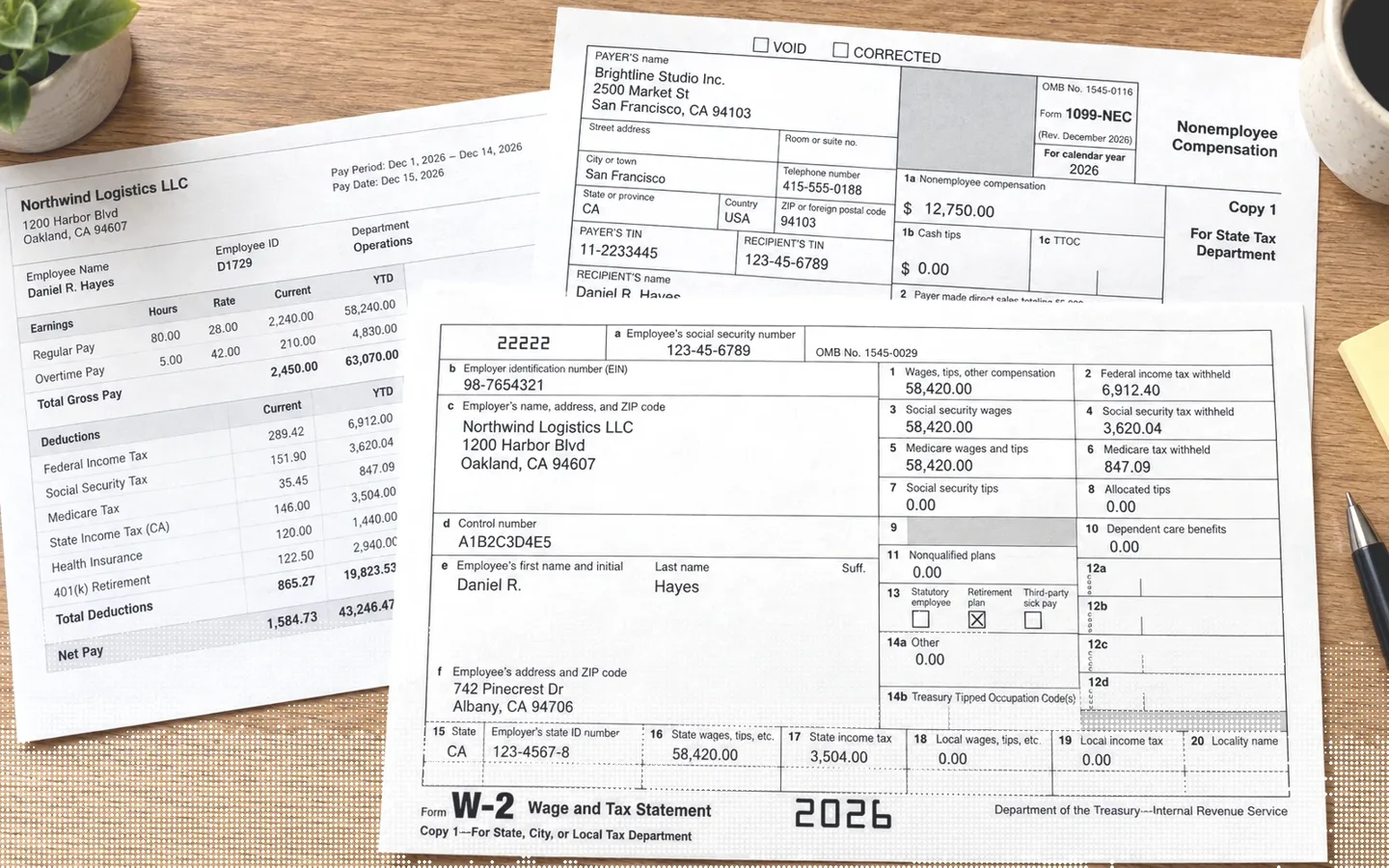
| Employee | Recent pay stubs, W-2, employer letter | Employer, payroll database |
| Self-employed | Tax returns with Schedule C, 1099s, profit and loss statement | IRS transcript, bank deposits |
| Gig or freelance | 1099-NEC or 1099-K, platform earnings reports | Bank deposits, IRS transcript |
| Retired | Social Security or pension award letter, account statements | Issuing agency or fund |
| Benefits or support | Award letter, unemployment statement, court order | Agency, court record |
| Paid in cash | Bank statements showing deposits, tax return, invoices | Deposits over several months |
Two rules hold in every case. The document must come from someone other than you: an employer, a payer, a bank or a government agency. And it must be recent: a pay stub from the last few weeks (Fannie Mae requires one dated within 30 days of a loan application), or the last one or two tax years for income that varies.
Which proof of income do employees use?
For salaried and hourly workers, the pay stub is the default. Lenders that sell loans to Fannie Mae follow a precise standard: the most recent pay stub must be dated no earlier than 30 days before the loan application and must show year-to-date earnings, alongside W-2 forms for the most recent one or two years. A year-end pay stub covering the full year can replace the W-2 (Fannie Mae Selling Guide, B3-3.1-02). Landlords are usually less formal and ask for two or three months of recent stubs.
The W-2 confirms the annual picture: same employer, same pay, taxes withheld. When you have just started a job and have no stub yet, an offer letter or an employment verification letter signed by the employer fills the gap. That letter should state your position, start date, pay rate and hours, on company letterhead, with a contact the reviewer can reach through the company's public switchboard.
How do self-employed and gig workers prove income?
Without an employer, the tax return becomes the central document. Expect to provide the last two years of federal returns with Schedule C (profit or loss from business), because self-employed income is judged on its trend, not on one good month. A year-to-date profit and loss statement covers the months since the last return, and business bank statements show that the money actually came in.
Freelancers and gig workers add the 1099 forms they receive from clients and platforms: 1099-NEC for contract work, 1099-K for payments through apps and marketplaces. Platform earnings reports help too, but a reviewer will weigh them against deposits, since a report shows what was billed, not what reached your account.
What about retirement, benefits and other income?
Regular income that does not come from work is proven by the letter of the body that pays it. That means a Social Security or pension award letter, an annual statement from a retirement account showing scheduled distributions, an unemployment benefit statement from the state agency, or a court order and payment history for alimony and child support. Rental income appears on Schedule E of the tax return; investment income on 1099-DIV and 1099-INT forms.
In housing, many states and cities ban discrimination based on the source of income, so a housing voucher or a benefit letter has to be treated like a salary when assessing whether an applicant can pay. The Rental Housing Association of Washington reminds its members that rejecting an applicant only because they receive public assistance such as a Section 8 voucher is illegal (article of February 10, 2026).
What is a proof of income letter?
A proof of income letter, or income verification letter, is a short statement from an employer, a client or an accountant that confirms what you earn. It is useful when you are paid in cash, have just started a job or work for a small business without a payroll system. On its own it carries little weight: it is easy to write and hard to check. Reviewers treat it as a pointer to someone they can contact, and they still expect deposits or a tax return that match the figure. A letter you write about yourself is a self-declaration, which agencies accept only as a last resort.
How do landlords and lenders verify proof of income?
The trend is to check income where it originates rather than trust a copy. The chain below shows the four steps most verification processes follow, from the file an applicant sends to the decision.
From an income document to a decision
- Step 1Collect the documents
- Pay stubs, W-2, statements
- Signed consent to verify
- Step 2Check the file itself
- Math, dates, layout
- Edits in the PDF
- Step 3Confirm at the source
- IRS transcript, employer
- Bank deposits
- AfterDecide on the file
- Income against the rent or loan
Mortgage lenders go furthest. With the applicant's written consent on Form 4506-C, they order tax transcripts directly from the IRS through its Income Verification Express Service, and the IRS only releases those records to a third party with the taxpayer's consent. They also confirm employment with the employer or through a payroll database, and compare deposits on bank statements with the pay stubs.
Public housing works with a formal order of preference. HUD's verification hierarchy places its own Enterprise Income Verification system and other upfront sources at the top, then written third-party verification, then oral confirmation, and the applicant's own declaration last, to be used only when nothing else can be obtained (Notice PIH 2018-18). Private landlords have no such rule, but the same logic applies: a figure confirmed by the payer beats a document handed over by the applicant.
For tax forms and statements the same goes: tax document verification means matching the W-2 or 1040 with an IRS transcript, and a bank statement checker looks at the file before the reviewer compares deposits with the stated pay.
What are the red flags on a proof of income document?
Most altered income documents give themselves away through inconsistency rather than through visible tampering. The signs below are the ones reviewers and property managers list most often, from the arithmetic on the page to the way the PDF itself was produced.
- Arithmetic that does not hold: gross pay minus deductions does not equal net pay, or year-to-date totals do not grow from one stub to the next.
- Numbers that are too regular: exactly the same amount every period, round figures, no overtime, no change in withholding.
- Missing deductions: no health insurance, retirement contribution or state tax where the employer and state would normally show them.
- Deposits that do not match: the bank statement shows different amounts or dates from the pay stubs, or a large deposit just before the application.
- Contact details that lead nowhere: an employer phone number that reaches a mobile phone, or a company that does not exist at the address shown.
- A file with a history: fonts that change within a line, text boxes laid over the original, or a PDF produced by an editing tool rather than by the payroll provider or the bank.
The last point matters more each year. Online pay stub generators produce documents that look like real payroll output, and generative AI can now rewrite the figures of an existing PDF in seconds. Neither is an employer-issued document. A stub that comes from such a tool, even with accurate figures, does not prove that an employer paid you, which is why reviewers move to source checks and to document verification that reads the file structure, not just the printed amounts.
Submitting a falsified income document is not a gray area. A false statement to obtain a loan from a federally insured lender can be punished by up to 30 years in prison and a $1,000,000 fine under 18 U.S.C. § 1014, and state laws on forgery and rental fraud apply to leases.
How much income do you need to show?
There is no single threshold, because each landlord, lender and program sets its own. In rentals, a common guideline is that rent should not exceed about 30% of the applicant's gross income, a ratio the Rental Housing Association of Washington describes as a general rule that varies with location and other debts. Put the other way round, 30% means a gross income of a little over three times the monthly rent. Mortgage lenders use a debt-to-income ratio that includes every monthly debt payment, and benefit programs compare household income with limits set against the federal poverty level. The proof is the same in each case; only the bar changes.
How we put this guide together
This guide was written on November 6, 2026. We read in full the pages that rank for "proof of income" in the United States, then checked each requirement against its primary source: Fannie Mae's Selling Guide for mortgage documentation, the IRS page on its Income Verification Express Service for transcripts, and HUD's verification hierarchy for public housing. Several pages that rank today belong to pay stub generator sites; we did not use them as sources for any requirement.
Frequently asked questions
Is a 1099 form proof of income?
Yes. A 1099-NEC, 1099-K or 1099-MISC shows what a client or platform paid you during the year and is the main income document for contractors. Most reviewers want it with your tax return, because the return shows what you kept after business expenses.
What is the difference between gross and net income?
Gross income is what you earn before taxes and deductions; net income is what reaches your account. Rental and loan thresholds are usually set on gross income, while a reviewer checks the net figure against the deposits on your bank statements.
How do you show proof of income if you are paid in cash?
Deposit the cash regularly and use bank statements covering several months, together with your tax return reporting that income. Invoices, receipts or a letter from the person who pays you support the file, but deposits and a filed return are what reviewers trust.
Can a bank statement be used as proof of income?
Often, yes, especially for self-employed and cash income, as long as the deposits are regular and match what you declare. Many landlords and lenders still ask for a pay stub or a tax return alongside it, since a statement shows deposits, not their source.
Can a landlord verify my pay stubs with my employer?
Yes, with your consent. Landlords commonly ask applicants to sign an authorization, then call the employer's human resources department on a number they look up themselves, or use a payroll verification service, to confirm your position and pay.