Contents
The best Pangram alternatives in 2026 are GPTZero for teachers, Originality.ai for publishers, Copyleaks for multilingual teams, Turnitin for universities that already license it, and Winston AI for the cheapest all in one plan with image detection. Pangram itself starts at $20 a month and now covers AI text, similarity checks, scanned files and, in research preview, AI images. Prices below were checked on the vendors' own pages on October 31, 2026. If what you need to check is a supporting document rather than a text, such as a bank statement or a pay stub, a fake document detector answers a different need, covered at the end of this guide.
Pangram alternatives at a glance
The table puts the five alternatives next to Pangram on what decides a purchase: the entry price, the discount for paying yearly, the volume you get each month, the free access you can use to test, and the integrations that save time.
| Tool | From | Monthly volume | Free access |
|---|---|---|---|
| Pangram | $20/mo | 300k words | 7 day trial |
| GPTZero | ~$10/mo | 150k words | 10k words a month |
| Originality.ai | $14.95/mo | 200k words | 10k words once |
| Copyleaks | $16.99/mo | Credits | A few scans |
| Turnitin | On quote | Per student | None |
| Winston AI | $18/mo | 100k credits | 14 day trial |
Paying yearly lowers the monthly price at most vendors, and the integrations decide how much time a tool saves in your workflow. The second table lists both for each tool, as published on October 31, 2026.
| Tool | Billed yearly | Integrations |
|---|---|---|
| Pangram | $60 saved a year | Google Docs, Gmail, API |
| GPTZero | Lower monthly price | Chrome, Google Docs, LMS |
| Originality.ai | $12.95/mo | Browser, API ($179 plan) |
| Copyleaks | $13.99/mo | LMS, API |
| Turnitin | Annual contract | Canvas, Moodle |
| Winston AI | $10/mo | Zapier, API |
How we compared these tools
We read each vendor's pricing and product pages on October 31, 2026, and kept only what a buyer can check: monthly price, yearly discount, included volume, free access and integrations. For accuracy we rely on independent work, not on vendor claims. The main reference is the study by Brian Jabarian and Alex Imas, Artificial Writing and Automated Detection (University of Chicago, Becker Friedman Institute, 2025, NBER working paper 34223). It tested Pangram, GPTZero, Originality.ai and an open source RoBERTa model on human and AI texts of several genres and lengths, written with recent models such as Claude Opus 4. All three commercial tools kept false positives under 1%, Pangram had the lowest, and it was the only one to keep high recall with false positives capped at 0.5%. That study predates Pangram 4 and did not test Copyleaks, Turnitin or Winston AI, so it ranks three tools on one corpus, not every tool for every use.
The 5 best alternatives to Pangram

1. GPTZero
For whom: teachers and schools. Why choose it over Pangram: it was built around the classroom, with a writing replay in Google Docs that shows how a text was typed, sentence highlighting, and integrations with learning platforms. Its free plan, around 10,000 words a month, is enough to try it on real assignments. Trade off: in the Chicago study it separated AI from human text less well than Pangram and missed about half of the texts passed through humanizer tools. Price and limits: paid plans from about $10 a month for 150,000 words, plagiarism checks from the next tier up.

2. Originality.ai
For whom: publishers, content agencies and SEO teams. Why choose it over Pangram: one scan returns AI detection, plagiarism, a fact check, readability and grammar, which suits an editorial workflow. Trade off: it is known to be strict; in the Chicago study it had more false positives than GPTZero and more false negatives than Pangram. Price and limits: $14.95 a month ($12.95 billed yearly) for 200,000 words, one credit per 100 words; the API is only on the Enterprise plan at $179 a month.
3. Copyleaks
For whom: teams that check text in many languages, or code. Why choose it over Pangram: wide language coverage, AI detection in source code, and plagiarism checks in the same product, with LMS and API integrations for institutions. Trade off: it was not part of the Chicago study, so we have no independent figure to compare its error rates with Pangram's. Price and limits: individual plans from $16.99 a month ($13.99 billed yearly) on a credit system; education and enterprise plans are on quote.

4. Turnitin
For whom: universities that already use Turnitin for plagiarism. Why choose it over Pangram: the AI writing indicator appears inside the submission flow teachers already use, with no extra tool to deploy. Trade off: it is sold to institutions only; an individual cannot buy AI detection, and iThenticate, Turnitin's individual offer, checks similarity but not AI writing. Price and limits: annual institution licence, priced per student on quote.

5. Winston AI
For whom: freelancers and small teams who want text and image checks at a low price. Why choose it over Pangram: every plan includes AI text detection, AI image and deepfake detection, plagiarism and OCR for photos and handwriting, from $10 a month billed yearly. Trade off: no independent study comparable to the Chicago one tested it, and its accuracy figures come from the vendor. Price and limits: $18 a month ($10 billed yearly) for 100,000 credits, up to $49 a month for 500,000; a 14 day free trial with 2,000 credits.
Which Pangram alternatives offer free access?
Only GPTZero offers a free quota that renews every month, around 10,000 words. Originality.ai gives 10,000 words once, Winston AI a 14 day trial with 2,000 credits, and Pangram a 7 day trial on its Individual plan. Copyleaks offers a few free scans to test the tool. Turnitin has no free access for individuals. A trial is enough to compare tools on your own texts, which is the only test that matters for your use.
Which alternative should you choose?
Start from the cost of a mistake. If wrongly flagging a human writer is the worst outcome, stay with Pangram or test it first, since it had the lowest false positive rate in the independent study. If you grade student work, GPTZero or the Turnitin licence your school already pays for. If you publish content, Originality.ai for its combined report. If you work in many languages, Copyleaks. If the budget is tight and you also need image checks, Winston AI. In every case, treat a score as a reason to look closer, never as proof on its own.
When you need document fraud detection instead
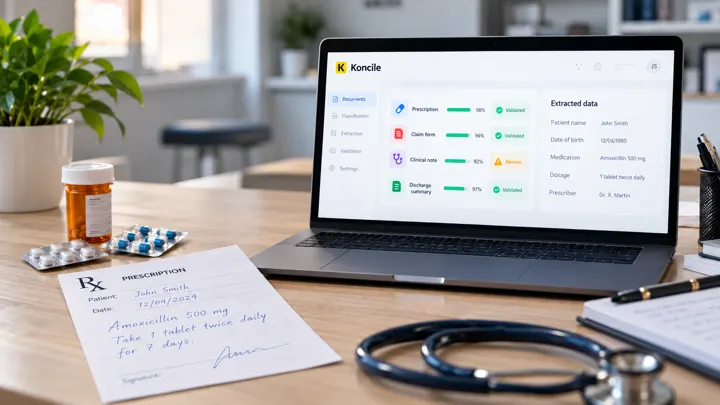
Detecting AI writing, detecting an AI image and checking that a supporting document is authentic are three different needs. The tools above answer the first two: they tell you whether words or a picture were generated. They do not tell you whether a genuine bank statement, pay stub or invoice was edited after it was issued. On 150,000 bank statements analysed by Koncile, 1.42% were falsified: some built from scratch in an office tool, others real statements edited after the fact, a balance changed in a PDF editor, a name replaced, a total retouched. The text still reads as human, and the page is not an AI image, so a content detector has nothing to flag.
AI makes this easier, not different. In an internal test in September 2026, two mainstream chat assistants edited the figures of a PDF in seconds, and the result looked clean on screen. One invoice we analysed displayed 50,900 while copying the amount returned 50,400: the visible layer had been changed, not the text underneath. That gap is invisible to the eye and to a text detector, but it is written in the file.
Koncile reads the file the way a forensic examiner would, in three layers. First the file itself: which software really wrote the bytes, whatever the metadata claims, revisions added after the document was issued, previous versions still hidden in the PDF, characters whose displayed value differs from the stored one. Then the image: retouched scans, an image editor's traces carried by the page, text laid over a scan, pages produced by a generator, and batches of IDs that come out of the same template. Last the business logic: totals, balances and dates recalculated, identifiers checked, the document compared with genuine documents from the same issuer. More than 150 checks add up to a fraud score from 0 to 100, with each clue shown, never a 100% verdict. The hardest case stays a fine edit made in a specialist tool and then flattened, which is why the score is a screening signal that tells your team where to look, not a judgment.
Two resources show this work in practice: what the metadata of a PDF reveals about the software that produced it, and how AI generated documents such as fake receipts and ID cards give themselves away.
Frequently asked questions
Is Pangram accurate?
In the University of Chicago study by Jabarian and Imas (2025), Pangram had the lowest false positive rate of the tools tested, close to zero on medium and long texts, and stayed accurate on texts passed through humanizers. Errors rose slightly on short texts. The study tested a version earlier than Pangram 4 and only three commercial tools.
Pangram vs GPTZero: which one should I use?
Pangram if a false accusation is the costly mistake, since it scored better on false positives and humanized texts in the Chicago study. GPTZero if you need classroom features such as writing replay and LMS integrations, or a free monthly quota.
Is there a free Pangram alternative?
GPTZero is the only one with a free quota that renews monthly, about 10,000 words. Originality.ai, Winston AI and Pangram offer one time credits or a short trial.
Does Pangram check for plagiarism?
Yes. Pangram's plans now include a similarity check on every scan, along with file upload and OCR for scanned documents.
Can Pangram detect a fake PDF or an AI generated image?
Partly. Pangram reads the text of uploaded and scanned files and checks whether it was written by AI, and its image detector, in research preview, flags generated images. It does not check whether a real document was edited after it was issued. For that, use a document fraud tool that inspects the file structure, the metadata and the consistency of the data.