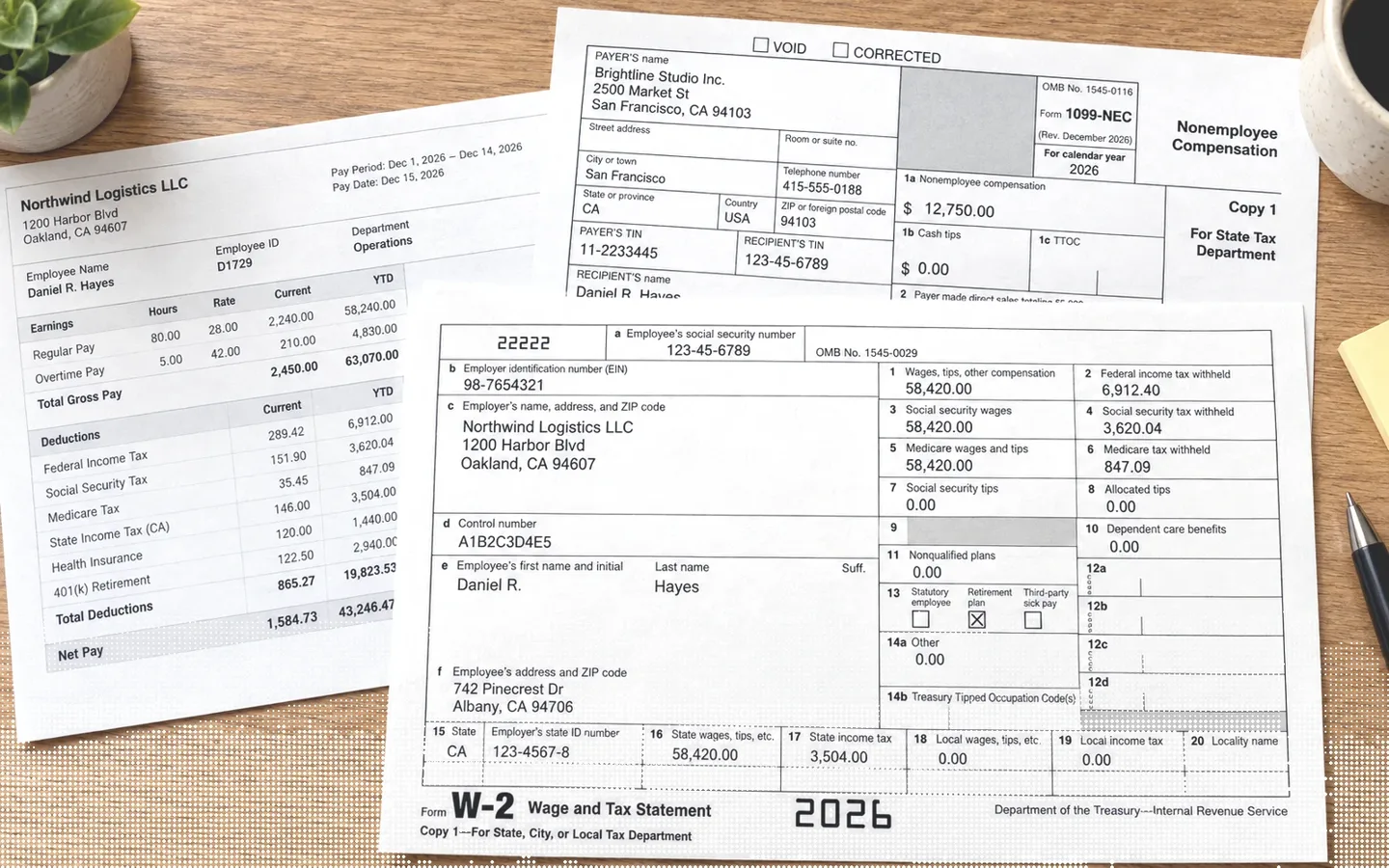
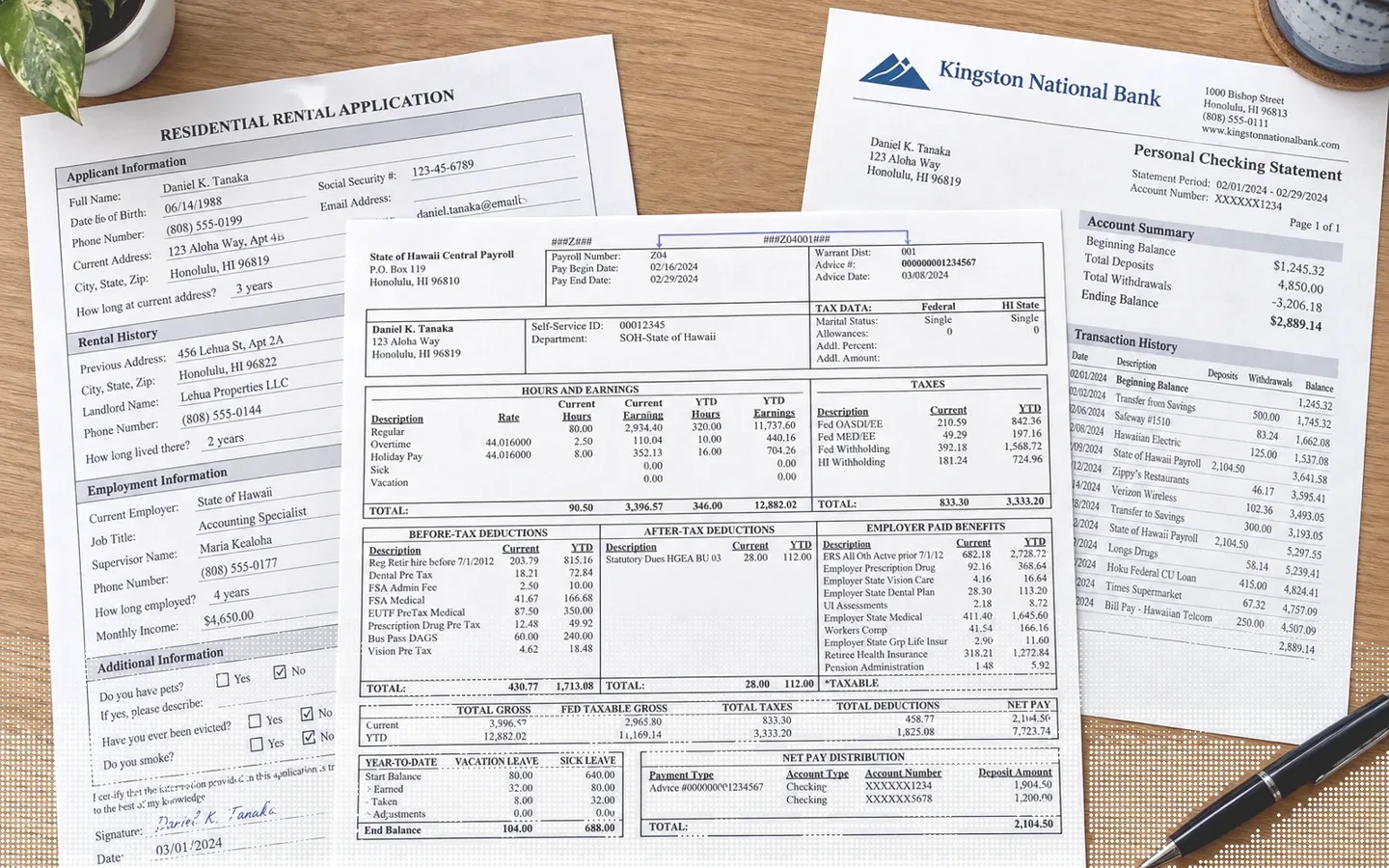
Contents
- How much income do landlords require for an apartment?
- What counts as proof of income for an apartment?
- How do landlords verify income?
- How to spot fake pay stubs and bank statements
- What can landlords legally ask, and what must they tell applicants?
- What if an applicant cannot meet the income requirement?
- Frequently asked questions
Most landlords and property managers ask for proof of income showing gross monthly earnings of about three times the rent, usually two or three recent pay stubs, an offer letter, tax returns or bank statements. What separates a careful landlord from an easy target is the second step: checking that those documents are real. In a National Multifamily Housing Council survey of 75 apartment firms, 84.3% of those hit by fraud had seen applicants falsify pay stubs, employment references or other income documents. This guide covers what to ask for, how to check it at the source, how to spot a fake pay stub, and the rules that limit how you decide.
How much income do landlords require for an apartment?
The most common benchmark is gross monthly income of at least three times the monthly rent. For a unit at $2,000 a month, that means $6,000 a month before taxes, or $72,000 a year. Some owners in expensive markets accept 2.5 times the rent; others ask for more from applicants with a thin credit file or a short job history.
The number matters less than how you apply it. Write the threshold into your screening criteria before you list the unit, apply it to every applicant in the same way, and say how you count income: gross or net, one earner or the whole household, and whether a guarantor's income can stand in. An inconsistent threshold is where fair housing complaints start.
What counts as proof of income for an apartment?
The right document depends on how the applicant is paid. Each one shows something different and can be checked against a different source, which is what makes it useful to a landlord. The table matches the usual applicant profiles with what to ask for and where to confirm it.
| Applicant | Ask for | Confirm with |
|---|---|---|
| Salaried or hourly | 2 to 3 recent pay stubs | Employer, payroll database |
| New hire | Signed offer letter | Employer HR line |
| Self-employed | 2 years of tax returns | IRS transcript, deposits |
| Gig worker | 1099 forms, app reports | Bank deposits |
| Retired | Benefit award letter | Agency letter, deposits |
| Voucher holder | Voucher, award letter | Housing authority |
Our guide to proof of income goes through each document in detail. On a rental application, the rule of thumb is simple: ask for the document that comes from someone other than the applicant, and keep a way to check it with that someone.
How do landlords verify income?
Reading a pay stub is not verifying it. A document only proves what its issuer would confirm, so each method below goes back to the issuer in a different way. Most professional managers combine at least two of them, and the schema shows the order in which they usually run.
Checking an applicant's income
- Step 1Set the threshold
- Usually 3 times the rent
- Written before listing
- Step 2Collect documents
- Pay stubs or tax returns
- Same list for everyone
- Step 3Check the file
- Math, dates, metadata
- Step 4Confirm at source
- Employer or bank data
- Number found yourself
Call the employer
The oldest method still works, with one condition: find the phone number yourself, on the company's website or a business directory, never from the application or the letter. A fake employer reference is usually a friend or a paid service answering the number printed on the document. Ask HR to confirm the job title, start date and pay; many employers will only confirm employment, which is still useful.
Use a payroll database
Large employers report payroll data to verification services such as The Work Number from Equifax, which landlords can query with the applicant's consent. The answer comes from the payroll system rather than from a document, so it cannot be edited. Coverage is the limit: small employers and most self-employed applicants are not in it.
Ask for bank-verified income
Open banking providers connect to the applicant's bank account, with their permission, and return deposit history for the last months. You see the actual paychecks arriving, their regularity and their source. It is the strongest check against a forged stub, because the money either reached the account or it did not. Several screening platforms sell it as an add-on paid by the applicant.
Check tax figures with an IRS transcript
For self-employed applicants, ask for an IRS tax return transcript next to the return itself. Applicants can download it from their IRS online account in minutes. The transcript comes from the IRS, so a return edited before printing will not match it.
How to spot fake pay stubs and bank statements
Pay stub generators and AI editing tools have made a convincing document cheap to produce. A forged file usually fails on details that the forger did not think to keep consistent. These checks take a few minutes per applicant, and the table lists what to look at first.
| Check | What a real stub shows |
|---|---|
| Net pay | Gross minus deductions, to the cent |
| Year to date | Grows by each period's gross |
| Social Security | 6.2% of taxable wages |
| Medicare | 1.45% of taxable wages |
| Pay dates | Fit the stated pay frequency |
| Employer | Real address, real EIN format |
Beyond the math, compare the documents with each other: the employer name, the address and the income on the stubs, the application and the bank statement should agree, and deposits on a fake bank statement rarely match the net pay of the stubs it is meant to support. Round figures everywhere, fonts that change from one line to the next and a letter O typed where a zero belongs are classic signs of editing.
Digital files also carry evidence of how they were made. A pay stub exported by a payroll provider has its own producer software and creation date; one edited afterwards often shows a different tool or a modification date after the pay date. A free PDF metadata viewer shows these fields without uploading the file. Automated document checks go further: they recompute the totals, recognize the payroll provider's layout and look for traces of editing in the file itself. They give a risk signal, not a verdict, and a flagged file still deserves a call to the employer before you decide.
What can landlords legally ask, and what must they tell applicants?
Federal fair housing law bars treating applicants differently because of race, color, religion, sex, national origin, familial status or disability, and an income rule applied unevenly can become evidence of that. Many states and cities go further and ban refusing an applicant because of a lawful source of income, such as a housing voucher, Social Security or child support; California and New York are among them. In those places, voucher payments count toward the income threshold.
If you use a tenant screening report, the Fair Credit Reporting Act adds a duty. According to the Federal Trade Commission, when you deny an application, ask for a larger deposit or require a co-signer based even partly on a consumer report, you must give the applicant an adverse action notice. It names the agency that supplied the report, states that the agency did not make the decision, and explains the right to a free copy of the report within 60 days and to dispute errors. The notice is required even if the report was not the main reason.
Keep a written record of what you asked for, what you checked and why you decided. It protects you if a decision is challenged, and it makes the next screening faster.
What if an applicant cannot meet the income requirement?
Students, recent graduates, retirees living on savings and people between jobs often fall short of three times the rent on paper. Common alternatives are a guarantor or co-signer who meets the requirement, proof of savings or investment income covering the lease, a strong rental payment history, or a larger security deposit where state law allows it. Whatever you accept, write it into your criteria and offer it to every applicant in the same situation.
Frequently asked questions
How many months of proof of income do landlords want?
Usually two to three months of recent pay stubs, or the last one or two years of tax returns for self-employed applicants. Bank statements for the same two or three months are often requested alongside them to show the pay actually arriving.
Can a landlord call my employer to verify income?
Yes, with your consent, which most rental applications include. Many employers will only confirm that you work there and since when; some will confirm salary. Payroll databases such as The Work Number give the same answer without a phone call.
How do you show proof of income without pay stubs?
An offer letter, tax returns with 1099 forms, bank statements showing regular deposits, a benefit award letter or a letter from your accountant can replace pay stubs. Bank-verified income, where you connect your account to a screening service, is accepted by more and more landlords.
Do landlords check if pay stubs are real?
Careful ones do, and fraud surveys explain why: in the NMHC survey, 84.3% of apartment firms hit by fraud had seen falsified income documents. Checks range from recomputing the stub and calling the employer to bank-verified income and automated document analysis.
Is the 3x rent rule a law?
No. It is a common screening standard, not a legal requirement, and some landlords use 2.5 times or another ratio. What the law requires is that the rule you choose is applied consistently and, in many places, that lawful sources of income such as vouchers are counted.