
Contents
Finovox is a Paris-based document fraud detection company that sells a four-module suite to banks, insurers and telecom operators in Europe. The best Finovox alternatives in 2026 are Resistant AI, Inscribe, Ocrolus and Doxis AI.dp (formerly Klippa). To catch a fake bank statement in a US loan file, the choice is less obvious than it looks. Every fact below comes from each vendor's own website, read on November 19, 2026.
A Finovox alternative to detect fakes?
A complete tool to detect tampered, forged and AI generated documents. Plugs into your tools by MCP and API.
Discover Koncile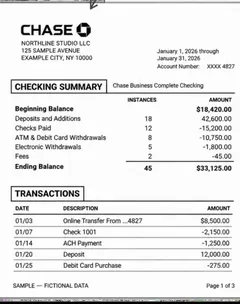



What is Finovox and how does it work?
Finovox is a French software company with offices at 96 rue de la Victoire in Paris and in Luxembourg. Its co-founder and CEO is Marc de Beaucorps. The company built its business in France, then opened in Luxembourg, Belgium and Spain, and announced its launch in the United Kingdom on May 5, 2026, according to Identity Week. It describes itself as a document verification platform that secures "the entire life cycle of documents", and its customer page lists Bouygues Telecom, PwC France, iCover, HP and MetLife among the organizations that use it.
The product works mainly through an API. Your systems send each document to Finovox as soon as it arrives, Finovox returns a risk level and alerts, and your analysts open the flagged files on the Finovox platform to investigate. The company insists that the decision stays with you: its own pages say an alert is a reason to look closer, not a finding of fraud. Here is the path a document follows when all four modules are switched on.
The Finovox document workflow
- Step 1Document Processing
- Splits bundled files
- Classifies and extracts data
- Step 2Document Validation
- Checks your business rules
- Returns true or false per check
- Step 3Fraud Analysis
- Risk level and alerts via API
- Step 4Case Investigation
- History, 3D view, PDF report
- Your team decides
What does Finovox offer?
Finovox sells four modules that can be bought separately, with one dependency: Document Validation needs the data prepared by Document Processing. The rules are defined with your teams during implementation and then configured by Finovox, so this is a project with onboarding rather than a self-serve tool. Each module below is described from its product page.
Document Processing
This API separates a file that contains several documents into individual PDFs, checks their quality, identifies their type and extracts the fields you need, such as amounts, dates, references or identity details. Finovox explains that it goes further than OCR, which only turns an image into text: Document Processing classifies each document and structures its data for your business tools.
Document Validation
Validation checks a document against your eligibility criteria, your reference data and your business rules. The API returns a true or false value for each check and an overall status in a field called global_document_validation, positive only if every check passed. Finovox is careful to separate this from fraud: a document can meet your rules and still be forged, or be genuine and ineligible.
Fraud Analysis
This is the core of the product. Fraud Analysis looks at the digital integrity and the consistency of each document and flags six families of signals: visual alterations, hidden or overlaid text, documents reconstructed from several sources, AI-generated content, reused documents and semantic inconsistencies such as a total that does not match its lines. The reuse check is distinctive: Finovox says it can alert you when a document already flagged as high risk is submitted again, including by another organization using Finovox, through a digital fingerprint and without storing the document.
Case Investigation
Flagged documents are examined on the Finovox platform, where analysts see the located anomaly, the explanation of each alert, the software used, the document's available history and a 3D view, then export a PDF report. The FAQ of the suite page sums up the philosophy in one line:
"An anomaly is a signal to investigate, not sufficient proof of fraud."
Finovox, The Finovox Suite page, read November 19, 2026
On security, Finovox announces ISO 27001 and ISO 27701 certifications issued by AFNOR. It works with partners: PwC Luxembourg combines its forensic team with the software, and the KYB platform Ondorse offers a Finovox integration.
How much does Finovox cost in 2026?
Finovox does not publish prices. We found no rate card on its English site on November 19, 2026, and every product page leads to a demo request. That is common for enterprise fraud tools, but it means you cannot estimate a cost per document before talking to sales, and the scope of your project (which modules, which rules, which document types) will drive the quote.
What you can measure is the value Finovox claims. Its customer page cites a processing time cut from 1 hour 30 minutes to 15 minutes at a financing company, and an audit in which PwC France reviewed 13,000 documents and found nearly 280 cases of tampering. These are vendor figures, useful to frame a pilot, not to predict your own results.
Finovox vs Koncile: which should you choose?
Koncile, which publishes this guide, also detects document fraud, so we compare the two openly on the points that usually decide a purchase. The table sticks to what each website states, as read on November 19, 2026.
| Criterion | Finovox | Koncile |
|---|---|---|
| Access | Demo, then project | Self-serve account |
| Main interface | API, investigation platform | App and API |
| Public prices | No | Yes, from $229 a month |
| Free start | Not stated | 20 credits |
| Markets named | France, Benelux, Spain, UK | United States and Europe |
Choose Finovox if you run a large European workflow, want a vendor to configure eligibility rules and investigation tools around your process, and value the shared alert on reused documents across its customers.
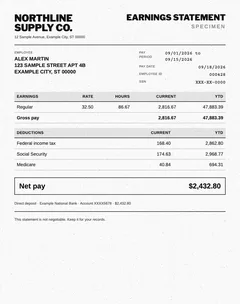
Choose Koncile if you want to test on your own files today and know the cost per page in advance. Koncile reads three layers of each document: the file (the software that produced it, revisions after issue, hidden versions, characters whose displayed value differs from the stored value), the image, and the business logic, such as net pay that does not follow from gross pay. More than 150 checks produce a score from 0 to 100 that never reaches 100%, a screening signal rather than a verdict, with US documents in scope, from a fake pay stub to a W-2. The Advanced plan costs $229 a month for 1,000 credits, and fraud detection uses 2 credits per page, about $0.44. Koncile is SOC 2 audited.
Koncile's limits, stated plainly: it does not detect AI-written text, it checks documents after they are received rather than replacing the app where a customer photographs an ID, and a subtle edit made with a specialist tool and then flattened into an image remains the hardest case. It has no shared fingerprint network across customers like the one Finovox describes.
The 4 best Finovox alternatives
Each tool below answers a specific reason to look past Finovox, especially for a team in the United States. The summary table gives the short version; the profiles that follow say who each tool fits, why you would pick it, the trade-off, the price and the limits, from its own website as read on November 19, 2026.
| Tool | Best for | Pricing | Trial |
|---|---|---|---|
| Resistant AI | Very large volumes | On request | Demo |
| Inscribe | US lending files | Base or Premium, quoted | Four-week pilot |
| Ocrolus | Lending data plus fraud | On request | Demo |
| Doxis AI.dp | Processing plus forensics | License or per document | Demo |
1. Resistant AI: the closest match, at very large scale
Who it is for: banks, lenders, payment companies and screening services that check documents from many countries. Why pick it over Finovox: Resistant AI's homepage promises to check "any document, from any country", with decisions in under 20 seconds, and says more than 8,000 fraud and compliance analysts use it. It also sells transaction monitoring models, so document fraud and financial crime signals can live with one vendor. Trade-off: no self-serve access; you book time with its experts and state your annual document volume. Price: not published. Limits: we found no description on its homepage of a business-rule engine like Finovox's Document Validation. Our page on Resistant AI alternatives covers it in depth.
2. Inscribe: built for US lenders
Who it is for: US banks, credit unions, lenders and fintechs that review bank statements, pay stubs, W-2s and tax transcripts. Why pick it over Finovox: Inscribe focuses on the financial documents behind US credit decisions and reasons across a whole application, connecting signals between documents. Its detection combines forensic, network, semantic and perceptual analysis, and it integrates with loan origination systems. Trade-off: it is not designed for claims invoices or telecom onboarding. Price: two plans, Base and Premium, both quoted on document volume. Limits: no public rate, but a complimentary four-week pilot on your own sample. See our guide to Inscribe alternatives.
3. Ocrolus: lending data and fraud flags together
Who it is for: US lenders that underwrite on cash flow and income and want the data extracted, not only checked. Why pick it over Finovox: Ocrolus turns bank statements, pay stubs and tax forms into credit analytics, delivered into loan origination systems, with human reviewers in clean-room facilities for edge cases. Its fraud detection analyzes documents down to the pixel and shows the evidence behind each flag. Trade-off: its document fraud detection is "powered by Resistant AI", as its platform page states, so you are buying a lending platform with a partner's engine. Price: not published. Limits: centered on US lending documents.
4. Doxis AI.dp (formerly Klippa): processing with forensic checks
Who it is for: operations teams that want extraction, classification and fraud screening in one tool, including for invoices, receipts and identity documents. Why pick it over Finovox: Doxis lists more than 100 document types out of the box, intake by email, mobile capture, API or SFTP, and forensic checks such as EXIF and metadata analysis, copy-move detection, pixel analysis and duplicate detection. Trade-off: fraud is one feature of a broad processing platform. Price: annual licenses or pay-per-document plans, quoted on volume. Limits: its FAQ says it supports Latin-based languages, others on request.
Finovox review: final verdict
Finovox is a serious, focused European vendor. It covers the whole path from intake to a documented decision, explains every alert, tells its customers plainly that an alert is not proof, and adds a reuse network that few competitors describe. Its limits are those of an enterprise project: no public price, rules configured by the vendor, and a footprint that, on its own pages, stops at France, the Benelux, Spain and the United Kingdom. A European insurer or bank that wants a configured workflow should put Finovox and Resistant AI through the same test set. A US lender should start with Inscribe or Ocrolus. A team that wants to measure fraud detection on its own files before any sales call can open a Koncile account. For a wider view, our ranking of document fraud detection software compares eleven platforms on the same grid. In every case, run the tools on documents you have already decided, not on a vendor's demo set.
Frequently asked questions
What is Finovox?
Finovox is a French document fraud detection company based in Paris and Luxembourg. It sells four modules, Document Processing, Document Validation, Fraud Analysis and Case Investigation, mostly through an API, to banks, insurers, lenders and telecom operators.
How much does Finovox cost?
Finovox does not publish prices. Its English site, read on November 19, 2026, sends every visitor to a demo request, and the quote depends on the modules, the business rules and the document volume of your project.
What is the best alternative to Finovox?
Resistant AI is the closest match for very large, multi-country volumes. Inscribe and Ocrolus fit US lenders, Doxis AI.dp suits teams that also need extraction, and Koncile suits teams that want public prices and a self-serve test.
Does Finovox detect AI-generated documents?
Yes. Finovox says Fraud Analysis looks for markers of documents or images generated or altered by AI, alongside visual edits, overlaid text, reconstructed documents, reused documents and semantic inconsistencies.
Is Finovox available in the United States?
Its pages name France, Luxembourg, Belgium, Spain and, since May 2026, the United Kingdom. We found no US office or US document list on its site on November 19, 2026, so ask its team directly about US coverage.