Contents
- AI fraud detection at a glance
- What is AI fraud detection?
- How does AI detect fraud?
- Where is AI fraud detection used?
- How has generative AI changed fraud?
- How to check if a document is AI generated or edited
- What are the limits of AI fraud detection?
- AI or rules: which does a fraud team need?
- How we put this guide together
- Frequently asked questions
AI fraud detection is the use of machine learning models to score transactions, accounts, identities and documents for signs of fraud, in real time and at a volume no team of analysts could review by hand. Instead of fixed rules such as "flag every transfer above $10,000", the model learns what normal activity looks like and flags what departs from it. Banks, insurers, lenders and marketplaces use it first on payments, but the same techniques now matter for document fraud detection, because generative AI has made forged pay stubs, bank statements and IDs cheap to produce. This guide explains how it works, where it is used, what generative AI changed and where its limits are.
AI fraud detection at a glance
Fraud reaches a business through four doors, and each one gives the model different data to read. The table shows, for each layer, what the AI actually looks at and the kind of fraud it is best placed to catch.
| Layer | What the AI reads | Fraud it catches |
|---|---|---|
| Transactions | Amount, timing, merchant, payee | Card fraud, mule payments |
| Accounts | Logins, devices, behavior | Account takeover |
| Identities | Selfie, ID photo, liveness | Synthetic IDs, deepfakes |
| Documents | File structure, pixels, figures | Edited or generated files |
What is AI fraud detection?
AI fraud detection replaces or complements hand-written rules with models trained on past data. A rule engine only catches what someone thought to write down; a model can weigh hundreds of signals at once and find combinations no analyst listed, such as a new device, an unusual hour and a payee created the same day.
The output is almost always a risk score, not a yes or no. The business decides what happens at each level of score: approve, ask for more proof, hold for review or block. That design matters, because it keeps a human in charge of the cases the model is unsure about.
The technique is not new in payments. What changed in the last few years is the reach: cheaper computing, better models for images and text, and, on the other side, fraudsters who use the same generative tools to produce convincing fakes.
How does AI detect fraud?
Every AI fraud system, whatever the vendor, follows the same chain: collect data, turn it into signals, score it, then learn from the outcome. The diagram below shows the four steps, and the methods that follow explain what happens inside the scoring step.
How an AI fraud system works
- Step 1Collect data
- Transactions and accounts
- Identities and documents
- Step 2Find signals
- New device, unusual hour
- Payee created the same day
- Step 3Score risk
- One score with its reasons
- Approve, hold or block
- AfterLearn
- Analyst decisions fed back
- Keeps up as fraud changes
Supervised learning on known fraud
The model is trained on past cases labeled "fraud" or "legitimate" and learns the patterns that separate them. It works well for schemes that repeat, such as stolen card testing or refund abuse, and it needs a steady supply of confirmed cases to stay accurate.
Anomaly detection for new schemes
Unsupervised models learn what normal looks like and flag what departs from it, without needing labeled fraud. They catch schemes nobody has seen yet, at the price of more false alarms, since unusual is not the same as fraudulent.
Behavioral and network analysis
Behavioral models compare a session with the user's own history: typing rhythm, device, location, time of day. Graph models link accounts, devices, addresses and bank details, which exposes rings of fake accounts that look clean one by one but share the same phone number or payout account.
Risk scoring and human review
The signals are combined into one score with the reasons behind it. High scores are blocked or sent to an analyst, and every analyst decision is fed back so the next version of the model learns from it. Without that feedback loop, accuracy decays as fraud patterns move.
Where is AI fraud detection used?
Financial services were first, but any business that pays out money or grants credit on the strength of data now uses some form of it.
- Banking and payments: transaction monitoring, check fraud and mule accounts. The US Treasury reported on October 17, 2024 that its fraud detection work, including machine learning to spot check fraud, helped prevent and recover over $4 billion in fiscal year 2024, of which $1 billion came from check fraud recovery.
- Lending and account opening: identity checks, income and address proofs, synthetic identities built from real and invented data.
- Insurance: claims with inflated invoices, recycled photos or repair estimates edited after the fact.
- E-commerce: payment fraud, fake accounts and refund abuse, scored at checkout.
- Accounts payable: vendor impersonation and changed bank details, the external schemes described in our guide to the types of fraud that hit businesses.
How has generative AI changed fraud?
Generative AI did not invent new frauds; it made old ones cheaper, faster and more convincing. A forged document that took an hour of skilled editing now takes a prompt. Three official or widely cited figures frame the shift.
- FinCEN, the US Treasury's financial crimes unit, published alert FIN-2024-Alert004 on November 13, 2024 after an increase in suspicious activity reports describing deepfake media. It notes that criminals have used generative AI to create falsified documents, photographs and videos to get past identity verification.
- The Deloitte Center for Financial Services estimated on May 29, 2024 that generative AI could enable fraud losses to reach $40 billion in the United States by 2027, from $12.3 billion in 2023, a compound annual growth rate of 32%.
- The FTC said on March 25, 2026 that consumers filed 3 million fraud reports in 2025 and reported $15.9 billion in losses, a figure the agency itself considers understated.
Practitioners saw it early. In February 2024, as a deepfake video call that cost a Hong Kong office about $25 million was making headlines (the victim, the engineering firm Arup, confirmed it in May), a crypto founder summed up what it meant for identity checks:
Today AI is able to fake an ID screenshot for KYC. Yesterday someone used a deepfake on a video call to defraud $25m from a CFO. The dark web is already littered with thousands of hacked KYC databases. Seems like only a matter of time before KYC is dead.
Michael Bentley (@euler_mab), February 5, 2024
The same tools work on financial paperwork. In an internal test in September 2026, two mainstream chat assistants edited the figures of a PDF in seconds, and the result looked clean on screen. That is why the document layer now needs the same automated scrutiny as the payment layer.
How to check if a document is AI generated or edited
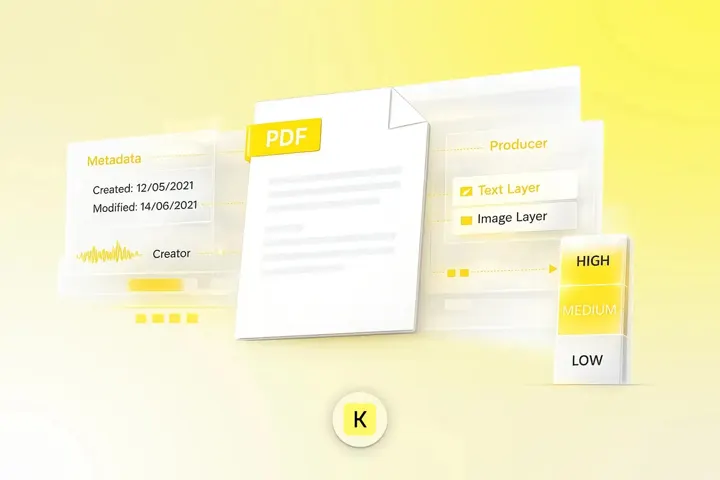
A document can be fully generated, or it can be a genuine file edited after it was issued; the second case is far more common. Looking at the page is not enough: the evidence sits in three layers, and an AI system checks all three on every file.
The file itself
A PDF records which software produced it, when it was modified and whether content was added in a later revision. A bank statement that should come straight from a bank's system but was last saved by an image editor, or that hides an earlier version under the visible one, is a strong signal. One invoice we analyzed displayed 50,900 while copying the amount returned 50,400: the visible layer had been changed, not the text underneath.
The image
Image models look for retouched areas, fonts that differ by a pixel, copied blocks and textures typical of generators. A dedicated AI generated image detector handles pictures and scans; on a native PDF, the file layer usually says more.
The business logic
Totals, running balances, dates and identifiers must add up and match what the issuer normally produces. A fake bank statement often fails here first: a balance that does not follow from the transactions, a weekend posting date, an account number with the wrong format.
For identity documents, FinCEN's red flags are a useful checklist: a photo with visual tells of editing, several IDs that are inconsistent with each other, a reverse-image search that finds the photo in a gallery of AI-generated faces, and a customer who uses a third-party webcam plugin or reports repeated "technical glitches" during a live check.
At Koncile, where we build document fraud detection, more than 150 checks across these three layers add up to a fraud score from 0 to 100, with each clue shown. On 150,000 bank statements we analyzed, 1.42% were falsified, most of them genuine statements edited after the fact rather than documents generated from scratch.
What are the limits of AI fraud detection?
AI fraud detection is a screening layer, not a judge. The teams that get the most from it plan for five known limits from the start, and they review them each quarter with real outcomes rather than with vendor benchmarks.
- False positives: a model tuned to miss nothing blocks good customers. The threshold is a business choice between losses and friction, and it should be reviewed with real outcomes.
- Explainability: a score without reasons cannot be defended to a customer, an auditor or a regulator. Each alert should come with the signals that triggered it.
- Drift: fraud patterns change, and a model trained on last year's data loses accuracy unless analysts' decisions are fed back.
- Bias and data quality: a model learns the gaps and biases of its training data, which is why monitoring outcomes by customer segment matters.
- The hardest forgeries: a fine edit made in a specialist tool and then flattened into a new image leaves few traces. No system catches everything, which is why a score is never a 100% verdict.
AI or rules: which does a fraud team need?
Both. Rules remain the right tool for what is certain and must be explained simply: a sanctions list, a hard limit, a mandatory callback when bank details change. Models add what rules cannot do: weigh many weak signals together and adapt as fraud moves. In practice, rules handle policy, models handle detection, and analysts handle the gray zone, including CEO fraud attempts that rely on urgency and a convincing voice rather than on data a model can see.
How we put this guide together
This guide draws on FinCEN alert FIN-2024-Alert004 of November 13, 2024, the Deloitte Center for Financial Services analysis of May 29, 2024, the FTC statement of March 25, 2026 on 2025 fraud reports, and the US Treasury release of October 17, 2024. Sources were checked on November 5, 2026. The pages ranking for "AI fraud detection" in the United States were read in full; they cover payments well and documents hardly at all, which is the gap this guide fills with figures from Koncile's own document analyses.
Frequently asked questions
What is AI fraud detection?
It is the use of machine learning to score transactions, accounts, identities or documents for fraud risk. The model learns normal patterns from data and flags departures from them, then a business rule or an analyst decides what to do with each score.
How does AI detect fraud?
By combining several methods: supervised models trained on confirmed fraud cases, anomaly detection for new schemes, behavioral and network analysis, and a risk score with its reasons. Analyst decisions are fed back so the model keeps up as fraud changes.
Can AI detect AI-generated documents?
Yes, when it checks more than the image. Generated or edited documents leave traces in the file structure, in the pixels and in the figures themselves. Checking all three layers catches far more than a visual review, though a fine edit flattened into a new image can still slip through.
Can AI detect fraud in real time?
Yes. Payment and login models typically score each event in milliseconds, before the transaction completes. Document checks take a few seconds per file, fast enough to run at account opening or before a payment is released.
Will AI replace fraud analysts?
No. It removes the routine reviews and points analysts to the cases worth their time. Decisions on borderline cases, investigations and customer contact stay human, and analysts' outcomes are what keep the models accurate.